
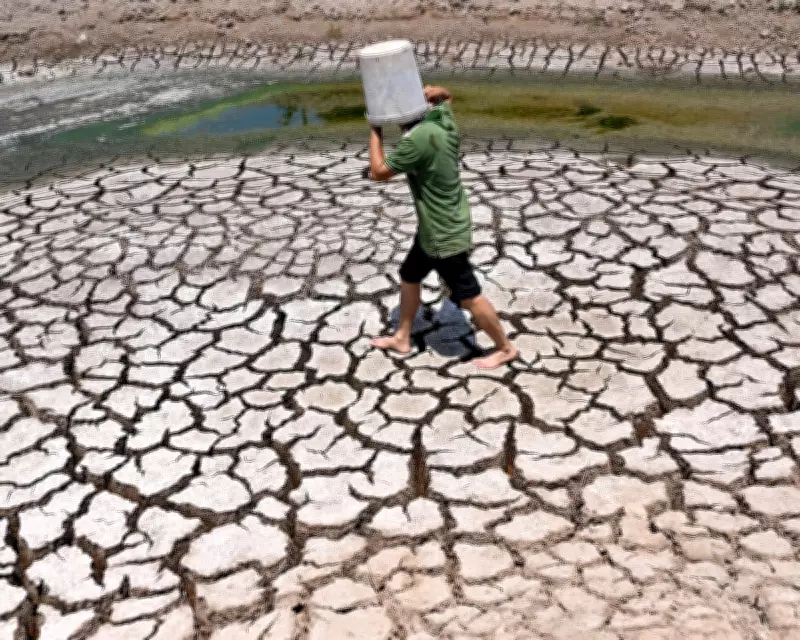
The United Nations' World Meteorological Organization (WMO) has issued a stark warning: a record-breaking hot year is almost certain by 2030 as the climate crisis continues to escalate. With an El Niño event expected later this year, the global temperature record could fall as soon as 2027.
Rising Emissions and Extreme Weather
Carbon dioxide emissions from fossil fuels are still rising, trapping more heat and driving extreme weather events, including the unprecedented heatwave currently affecting the UK and Europe. Global heating is already estimated to claim one life every minute, a toll that is likely to increase unless emissions are reduced rapidly.
WMO Report Predictions
The report, produced for the WMO by the UK Met Office, forecasts an 86% probability that at least one year between 2026 and 2030 will surpass 2024 as the hottest ever recorded. There is a 75% chance that the average temperature for the five-year period from 2026 to 2030 will exceed 1.5°C above pre-industrial levels.
Simon Stiell, the UN climate chief, commented: "The latest heatwave in Europe is a brutal reminder of the spiralling impacts of the climate crisis, both human and economic. Many other parts of the world are also being hit hard, such as India and other parts of Asia." He emphasized that protecting lives, businesses, and economies from extreme heat and the soaring costs of climate change is essential for every nation, starting with accelerating the transition away from fossil fuels.
Paris Agreement Goals at Risk
Scientists have repeatedly warned that warming beyond 1.5°C increases the risk of severe heatwaves, droughts, storms, and floods, making adaptation more difficult. However, every fraction of a degree of warming avoided reduces damage. The Paris Agreement's goal of limiting global temperature rise to 1.5°C above pre-industrial levels, assessed over a 20-year period, is now unlikely to be met. The weaker 2°C target remains achievable if urgent action is taken. The WMO report finds less than a 1% chance that any single year from 2026 to 2030 will exceed 2°C above pre-industrial averages.
El Niño's Role
Global temperatures are expected to be boosted by El Niño, a natural cyclical weather pattern expected by the end of the year. The US National Oceanic and Atmospheric Administration forecasts a 96% probability of an El Niño in December 2026 to February 2027, with a 35% chance of a super El Niño. El Niño events occur due to changes in Pacific Ocean winds, releasing heat stored in the ocean into the atmosphere. Dr. Leon Hermanson, lead author of the WMO report, stated: "There is an El Niño predicted for the end of 2026, which increases the chances of the following year, 2027, being the next record-breaking year."
Arctic and Rainfall Predictions
The Met Office, as the WMO's lead centre for annual to decadal climate prediction, synthesizes forecasts from 13 institutes worldwide. The new report predicts that the next five winters in the Arctic will be 2.8°C above recent averages, indicating the region is warming more than three times faster than the global average. The report also forecasts rainfall patterns: northern Europe, the Sahel, Alaska, and Siberia are likely to be wetter than usual from May to September over the next five years, while the Amazon is expected to be drier.



