
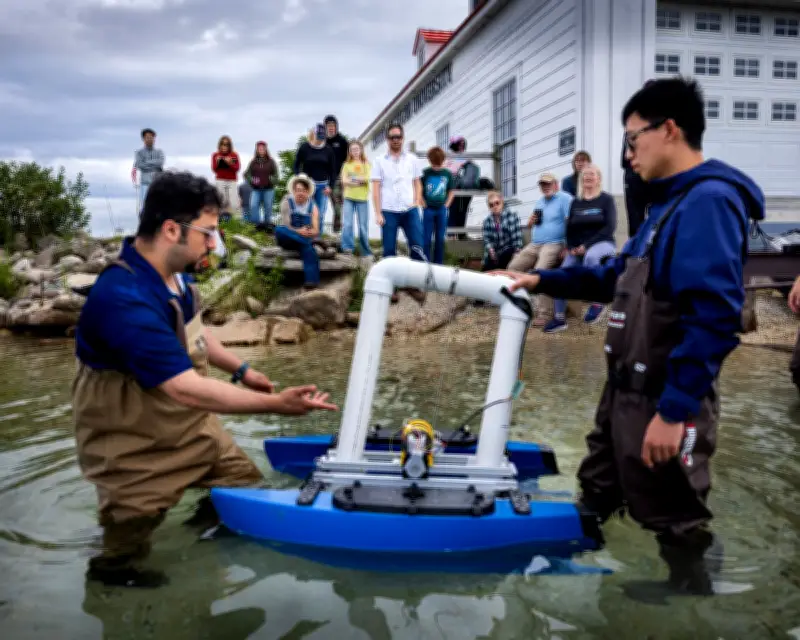
Researchers on Beaver Island, in Lake Michigan, are testing wave energy converters to provide a more reliable power source for the remote community. The island, about 70 miles from the Canadian border, experiences frequent outages due to its vulnerable underwater cables from the mainland. A devastating ice storm last year left residents without power for weeks.
Prototype devices power lightbulb and phone
In June, University of Michigan engineers deployed two prototype wave energy converters on the shoreline. The devices, resembling small boats with PVC frames, convert wave kinetic energy into electricity. They successfully powered a lightbulb and charged a mobile phone, demonstrating their potential.
Lead researcher Lei Zuo emphasized community collaboration: "We need to work with the community together to identify the need and design together with them." Residents prioritized dependable power for the airport.
Remote communities seek energy independence
Beaver Island joins other remote areas like Galena, Alaska, and Adjuntas, Puerto Rico, in pursuing local renewable energy. Seamus Norgaard, a summer resident, said: "It's a combination of looking at cost savings and also wanting to be independent and not dependent on the mainland for everything."
The island already uses solar and geothermal energy, and has received federal funds for renewables. However, funding uncertainty under the Trump administration threatens future projects.
Wave power challenges and potential
Dan Hellin, director of PacWave in Oregon, noted wave power is not yet widely used due to cost and deployment difficulties. Most US wave energy projects rely on federal funding. The Michigan project is supported by National Science Foundation grants awarded two years ago.
Marine energy has escaped some of the administration's hostility toward renewables, Hellin said. Trump included hydropower in his priority list for regulatory fast-tracking, and the Department of Energy allocated $220 million for such research.
Great Lakes as an ideal testing ground
Saeid Bayat of the University of Michigan explained that the Great Lakes offer real-world wave conditions that are safer and less expensive than ocean sites. "The Great Lakes provide real-world wave conditions while being much easier, safer and less expensive to access than most ocean sites," Bayat said.
The team plans to install a final version in the coming years. Norgaard expressed excitement: "There is that excitement about these new futures and cleaner sources, and more locally produced, dependable sources of energy."



