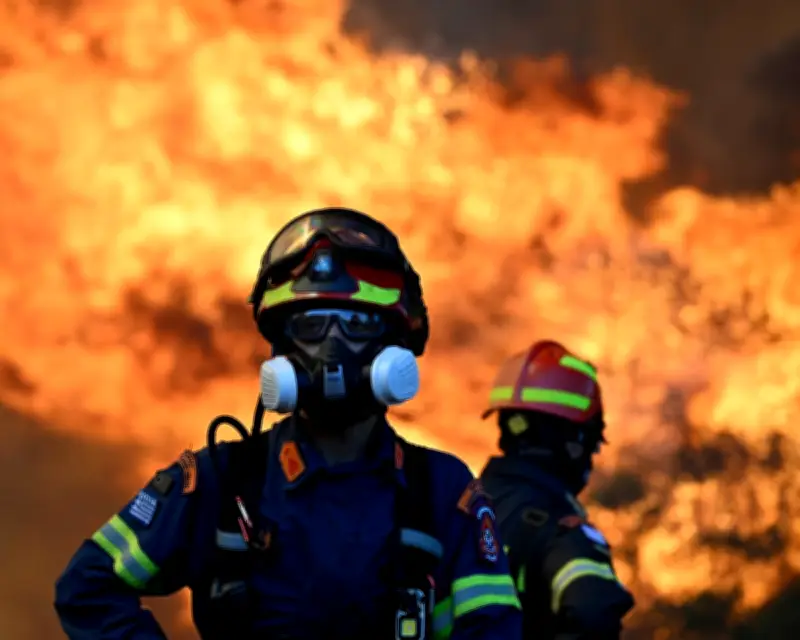
Two firefighting helicopters collided west of Athens on Sunday, killing the two-person crew of one aircraft, as Greece intensified efforts to control a massive wildfire barreling toward the outskirts of the capital. The incident occurred amid gale-force winds that have been fanning flames toward settlements on Athens' western fringes, with video capturing one helicopter going down.
“The pilots ... were taken unconscious to hospital, where their death was confirmed,” said Vassilis Vathrakogiannis, the fire department’s director of communications. Greek Prime Minister Kyriakos Mitsotakis identified the deceased as a Dane and a Greek, while the two crew members of the second helicopter were rescued.
Wildfires rage across Greece
As Europe’s wildfire crisis intensified, blazes ripped through Greece’s tinder-dry landscape, climbing mountain slopes and descending to the sea before encroaching on the capital. Warning of “extremely difficult” days ahead, Mitsotakis highlighted the threat from gusts that have exceeded 78mph (125km/h) recently. “When the winds blow with such force, even the dozens of aircraft we have at our disposal cannot operate safely,” he wrote on social media.
More than 100 homes were destroyed overnight in fires around the coastal village of Porto Germeno, about 45 miles (70km) north-west of Athens. By Sunday, over 500 firefighters and forest commandos had been dispatched to contain the flames. The eastern Mediterranean, accustomed to wildfires, had experienced a relatively calm summer, leaving Greeks shocked as blazes hit farther west.
Mass evacuations and devastation
While wildfires in Spain were finally curbed and French officials announced that a mega-fire – four times the size of Paris – had begun to be contained, the Greek blazes prompted mass evacuations and devastated vast areas from Crete to the southern Peloponnese, the Ionian isle of Cephalonia, and islands across the Aegean. Last week, three Greek firefighters died from injuries sustained while fighting blazes.
Extreme winds have been a double-edged sword: they brought down summer temperatures but also hindered firefighting efforts with gale-force strength. Greece’s civil protection minister, Evangelos Tournas, a retired air force general, said the fire department had been “pushed to its limits.” High winds created “extremely difficult conditions resulting in many cases where aircraft either cannot draw water or cannot carry out drops due to extreme turbulence,” he added.
France battles massive fires
France’s largest wildfire remained contained after 224,000 people were forced to flee in what may have been the largest peacetime evacuation in French history. Active pockets still burned across 160 sq miles (420 sq km) of devastated forest. Thousands remained unable to return home, and nearly 3,000 firefighters were deployed against the Gironde mega-fire and a second blaze in Provence that had stopped advancing but remained uncontained.
“The fire is now fixed, which does not mean that the fire is extinguished,” the Gironde prefecture said on Sunday, using the French firefighting term for a blaze whose advance has been stopped and whose perimeter has been contained. The region remained under France’s highest red forest fire alert, with dry conditions, soaring temperatures around Bordeaux, and afternoon winds creating a continued risk of renewed flames. Additional firefighters from Ukraine, Lithuania, and French Polynesia were expected to reinforce the operation.
Other fires in France and Spain
Nearly 1,500 firefighters were battling a separate fire in the south-eastern Var department that tore through roughly 7 sq miles in little more than a day. Authorities said the fire in the Gros Bessillon hills was stabilised on Sunday morning, meaning its perimeter had not expanded overnight, but it had not yet been declared contained. Firefighting aircraft supported crews working to keep flames away from villages among vineyards, olive groves, and wooded hills in the region known as Green Provence. About 2,500 people were evacuated as the fire threatened communities.
The blaze was the fourth major fire to strike the central Var since 19 July. A separate, smaller fire near Brignoles earlier in the week forced Hollywood actor George Clooney and his family, along with about 700 other residents, to evacuate before it was brought under control. Prime Minister Sébastien Lecornu said France’s wildfires were generally under control but cautioned that conditions remained highly changeable. He announced a national coordinator attached to the prime minister’s office would oversee reconstruction in fire-ravaged areas. More than 450 sq miles have burned across France since the beginning of the year.
Climate crisis fuels fires
Fires in France and Spain alone have driven roughly a third of a million people from homes and holiday sites, emptied communities at the height of summer, and stretched firefighters, aircraft, and emergency services across simultaneous disasters. The crisis is unfolding on the world’s fastest-warming continent. Europe has heated at more than twice the global average since the 1980s, according to the EU’s Copernicus Climate Change Service.
Higher temperatures and prolonged drought leave forests and scrubland drier and more combustible, allowing fires to spread faster and burn more intensely. Human-caused climate breakdown doubled the likelihood of the extreme fire conditions that fuelled the French blazes, scientists at World Weather Attribution calculated in a rapid analysis on Thursday while the fires were still burning. The Associated Press contributed to this report.