
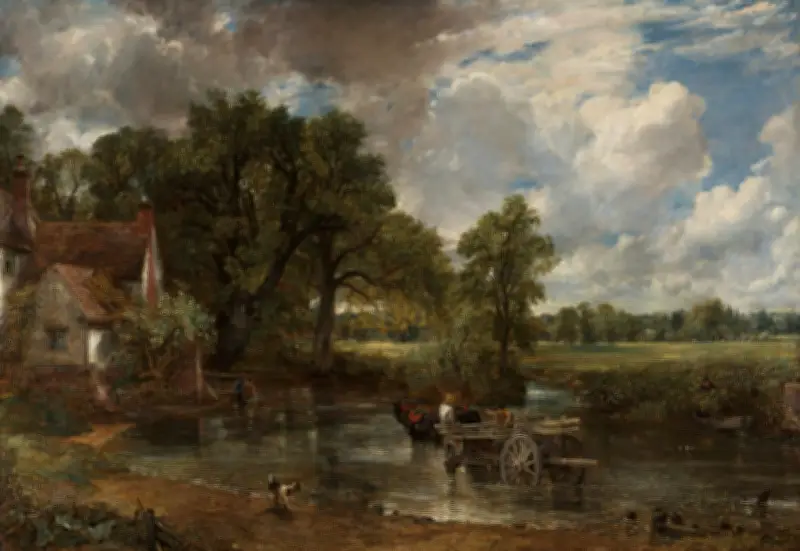
A new exhibition at Christchurch Mansion in Ipswich, titled The Hay Wain: Walking Constable's Landscape, reinterprets John Constable's 1821 masterpiece as a conservationist work that speaks directly to the climate crisis. The show, running from 11 July to 4 October, brings the iconic painting from the National Gallery to the Tudor house, allowing visitors to see it anew amid a heatwave that has turned the surrounding Suffolk countryside brown and parched.
A Masterpiece for the Climate Crisis Age
Jonathan Jones, writing for the Guardian, notes that the exhibition opened at the start of a heatwave, making a scorching ironic comment on Constable's temperate scene. Inside the museum, grey, blue and brown masses of rain-promising cloud hung above the painted fields, but outside the grass was straw yellow and the landscape around Dedham Vale and the River Stour appeared blowtorched into oblivion. This contrast underscores the relevance of Constable's work to today's environmental challenges.
Constable as Conservationist
The exhibition challenges the stereotype of Constable as a conservative painter, instead presenting him as a conservationist. His lifetime encompassed the Industrial Revolution, and he was aware of the blast furnaces of Coalbrookdale and the factories of the Midlands. Yet he chose to paint a rural world where people lived in nature rather than conquering it with machines. The show includes works such as Golding Constable's Kitchen Garden (1815), depicting his parents growing foodstuffs for subsistence, and Avenue of Trees (c. 1820), which emphasizes the lush greenery that enfolds old villages.
The Hay Wain: Space and Time
The Hay Wain itself is described as Constable's most elegiac work, about space and time. The painting's foreground shows Willy Lott's house by the Flatford mill pond, while fields stretch for miles in a flat dappled vista. The hay wain seems stuck in the water, a boy fishes, and a dog pauses to watch. The scene is a working landscape filled with rural toil, from a woman doing laundry to a row of reapers and a distant hay wain being loaded. According to Jones, Constable is going out of his way to suggest this painting holds a whole world.
Movement and Scale
Constable, along with Gainsborough, brought a sense of movement to landscape painting. The light in The Hay Wain seems to change as one contemplates it. The dog stands on a beach curved like a vast bay in a Claude canvas, a witty play on scale that summons classical splendour only to remind us that we are looking at a small corner of Suffolk. Constable painted large-scale works to gain attention at exhibitions, but in The Hay Wain he exposes the absurdity of that: an epic where nothing happens, reapers reap, the cart is stalled, and the wet cool sky refreshes.
Exhibition Details
The exhibition is subtitled Walking Constable's Landscape and focuses on Constable's own walks and reveries, recorded in drawings, watercolours and oil sketches that hang around the six-foot-wide main attraction. The earliest item is a piece of graffiti carved by the 16-year-old Constable on a beam from his father's windmill at East Bergholt. The show is at Christchurch Mansion, Ipswich, which also holds a fine collection of Constables and works by Gainsborough.



