
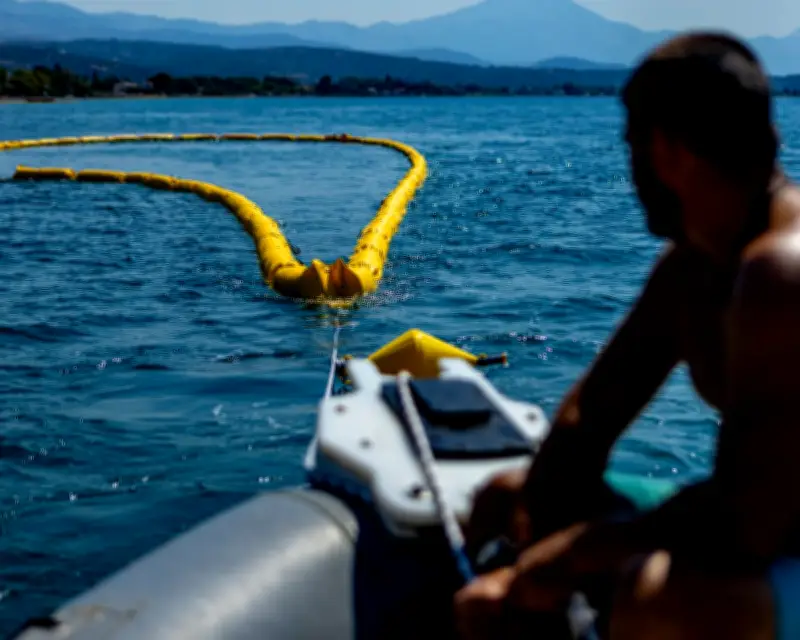
Greece has installed its first floating sea barrier in the Gulf of Euboea to protect swimmers from toxic pufferfish, which have migrated into the Mediterranean due to rising sea temperatures linked to the climate crisis. The barrier, placed across a bay on the island of Evia, aims to prevent encounters with the long-toothed Lagocephalus sceleratus, a species capable of inflicting severe bites and containing a lethal neurotoxin.
Barrier installation and community response
The barrier was installed last month under the supervision of Antonis Spanos, vice-mayor of Chalkida, the island's capital. Spanning 2.5 kilometres, the net is designed to block both jellyfish and pufferfish. 'Our duty and primary concern has to be the safety of our citizens,' Spanos said. 'It's better to be safe than sorry.'
Local residents, like retired truck driver Pavlos Beleyiannis, expressed relief. 'Thank god it's there to protect them,' he said, watching his grandchildren play beyond the barrier. 'There weren't such dangers in these seas when I was a child.'
Pufferfish threat and health warnings
In June, the Greek Red Cross issued a public health warning after pufferfish were spotted near beaches. The fish's beak-like jaws can cause severe wounds and heavy bleeding. The species contains tetrodotoxin, a neurotoxin with no known antidote, making it dangerous if consumed. 'I don't think anything will be able to get through that net, not even the fangs of a pufferfish,' said Nikos Choulieris, a diving instructor who helped anchor the barriers.
Government eradication programme
In response to the proliferation, Athens announced a catch programme offering €5.33 per kilogram of pufferfish surrendered. The EU-funded initiative will also provide fuel subsidies to fishers, initially in Crete and the southern Aegean. Collected fish will be frozen and incinerated. 'All this is too late,' said amateur fisher Nikos Ayiaskoufitis, 54. 'No measure is going to be effective because what we're seeing is part of the law of nature.'
Scientific and public debate
Some experts downplay the threat. Marine scientist Ioannis Batjakas from the University of the Aegean said, 'Yes, they have long teeth and look scary, but like most wild animals they don't attack humans.' However, officials remain cautious. An estimated 7 kilometres of barrier will be delivered to the region. 'If you ask me, these barriers should be installed across Greece,' Beleyiannis said.



