
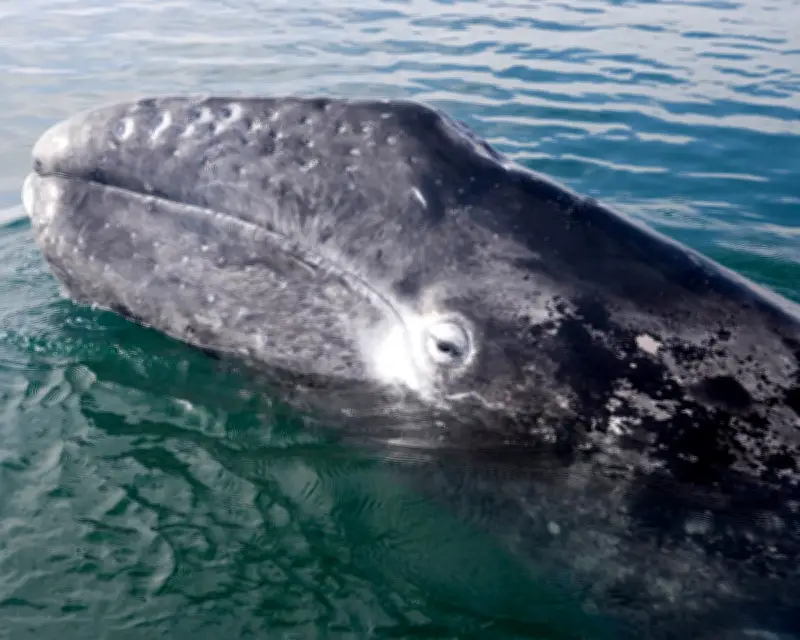
Climate change is driving a gray whale “catastrophic mortality event” in the Pacific Ocean as melting sea ice depletes food sources and the animals starve, environmental groups warn. The population has nearly halved, dropping from 20,000 in 2019 to fewer than 13,000 this year, with deaths appearing to accelerate.
Multiple threats compound the crisis
A range of other issues, including ship strikes, oil spills, microplastic pollution, algal blooms, and Russian harvesting, are also likely contributing to the die-off. Environmental groups have petitioned the National Oceanic and Atmospheric Administration (NOAA) to relist the gray whale under the Endangered Species Act (ESA). However, approval is unlikely as the Trump administration moves to weaken wildlife protections.
Rick Steiner, an Alaska marine ecologist and chair of Public Employees for Environmental Responsibility’s (PEER) board, described the whales as being in “very, very serious trouble.” He noted that stranding numbers in the past year and this year are enormous compared to the annual average.
Historical context and current estimates
Gray whales, which migrate annually from Baja California to Alaska to feed, nearly went extinct in the 1970s but rebounded due to robust conservation. They were delisted from the ESA in 1994, which Steiner called a “colossal mistake.” The situation is most dire for 2026, with an estimated 2,500 to 8,000 whales dying so far this year, meeting the criteria for a catastrophic mortality event.
Determining exact numbers is difficult because marine biologists can only count stranded whales. The average annual number of gray whale strandings from 2006 to 2023 was 43, but rose to 179 in 2025. In the first half of this year, 146 whale carcasses have been directly counted. Scientific literature estimates the ratio of unobserved (sunk) mortalities offshore to observed mortalities onshore for gray whales is between 7-to-1 and 25-to-1.
Starvation linked to sea ice loss
The whales that wash up are emaciated, according to Steiner, and the scientific consensus is that they are starving due to reduced access to food sources caused by the dramatic reduction in sea ice around Alaska from climate change. David Weller, a NOAA marine biologist, said in an agency release that while the whales have been resilient in the past, the environment may now be changing at a pace that tests their ability to rebound.
Some stranded whales show signs of ship strikes, and Indigenous populations in Russia hunt the whales, killing up to 40 annually. Steiner claims the hunt is for subsistence but that the meat is fed to cattle. Additionally, the Trump administration is increasing oil drilling in the region, creating more pollution and threats.
Legal and policy responses
Steiner stated that state and federal governments can act. NOAA’s response to the petition to relist gray whales under the ESA is due in about a month. If the Trump administration ignores or rejects the request, PEER will sue. The second Trump administration has so far not listed any animal as endangered or threatened and has taken unprecedented steps to dismantle the ESA.
Steiner remains hopeful, noting the science is clear and gray whales are immensely popular in the US West. “The gray whales are in dire straits, so hopefully they see that and this can be the first one they list,” he said.
Regional measures and challenges
California has implemented voluntary ship speed reduction zones in areas with high gray whale concentrations, and some ships use spotters to look for whales. These measures have reduced ship strike deaths by about 50%. However, Oregon, Washington, and Alaska have not implemented similar programs due to shipping industry opposition, though advocates are pushing for action.
“If you lose thousands of whales in two years – that should concern everyone,” Steiner said.



