
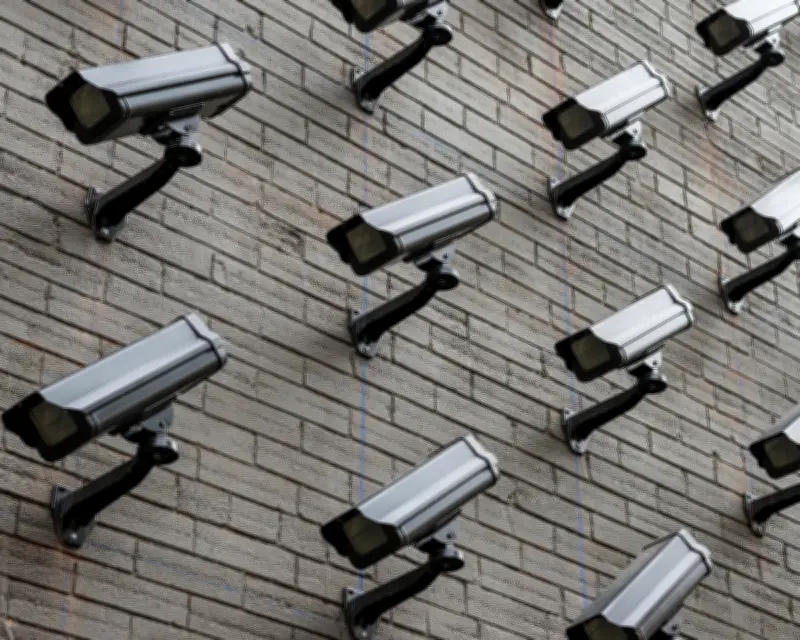
In the near future, AI-powered surveillance systems will be able to track everything we do in public, and much of what we do in private. According to security technologist Bruce Schneier and law professor Jon Penney, these systems will notice and retain any infraction—shoplifting, littering, jaywalking—tie it to official government records, communicate the violation in real time, and alert authorities or even the public.
Automated Enforcement on Steroids
Think of these systems as automated speed cameras, but on steroids. They will enforce not just speed limits but any rule imaginable, issuing fines immediately rather than weeks later by mail. Combining powerful AI, real-time facial recognition, digital tracking, mass databases, and personalized enforcement, they will have profound chilling effects on personal freedoms, democracy, and social progress.
China already has over 600 million surveillance cameras, increasingly powered by AI and facial recognition. In one case, a Chinese citizen named Lao Duan was blacklisted after losing his job and defaulting on loans. When he visited Beijing, the AI system identified him at an intersection and displayed his face, name, and citizen ID on a large electronic billboard with the message that he was an untrustworthy person. Similar systems are now being deployed across China and integrated with its online monitoring, censorship, and social credit systems.
Global Expansion of AI Surveillance
AI surveillance is now being experimented with in North America, South America, Europe, Asia, and Africa. According to a new report, the US Department of Homeland Security is rapidly increasing its use of AI-based surveillance, including facial recognition and social media monitoring, to track immigrants, dissidents, journalists, legal observers, and protesters. While ostensibly for security and public safety, the real aim is often social control. Larry Ellison, CEO of Oracle, has said: “Citizens will be on their best behavior because we’re constantly recording and reporting.” The chilling effects are the point.
AI surveillance raises public policy challenges: technical biases, unauditable systems, and inflexible automated enforcement that can promote discrimination and undermine transparency, accountability, and the rule of law. But the most urgent and long-term impact will be its broader chilling effects.
Mechanisms of Chilling Effects
In their new book, Chilling Effects: Repression, Conformity, and Power in the Digital Age, Penney explains how surveillance, technology, and power can be weaponized to influence behavior at scale. Surveillance, personalization, uncertainty, and authority are key mechanisms that increase the scale and impact of chilling effects. They cause people to self-censor, become more conformist and compliant, and thus easier to manage and control. The effects are additive: the more mechanisms employed, the greater the chill.
Computerization has long allowed data collectors to track locations, communications, and spending habits. What’s new is an unprecedented fusion of these mechanisms, persistent and unrelenting. AI brings analytical ability to spy on communications and answer sophisticated questions about whereabouts and activities—actions that previously required human analysts are now automated. “The result will be a kind of supercharged societal level of chilling effects where fear, self-censorship, and groupthink reign, and dissent, creativity, and innovation become increasingly rare,” write Schneier and Penney.
Impact on Social Progress
In this atmosphere of fear and conformity, risky ideas, social activism, and self-reinvention—especially by disfavored groups—are also chilled. This will have long-term effects on social progress. Consider the societal normalization of same-sex relationships and recreational marijuana use. Over decades, those ideas progressed from immoral and illegal to moral and legal. But for that to happen, a counterculture had to experiment and demonstrate that morality could change. To the extent that AI surveillance chills such experimentation, social progress becomes impossible.
There are no real historical precursors to these technologies. Even the FBI’s wiretapping and informant network during the 1950s and 1960s, or East Germany’s human-centric surveillance, appear archaic compared to modern AI-enhanced surveillance. Only science fiction, from George Orwell or Aldous Huxley, comes close—but even Big Brother’s “telescreen” feels mid-20th-century by comparison.
Policy Choices to Reject AI Surveillance
But we need not sit idly. Now that we recognize the danger, we can make policy choices not to implement it. Bans on facial recognition and other identification tech can slow development; robust privacy and data protections can restrict tracking and retention; AI regulations can curtail invasive uses; and structural reforms can scrutinize and break up powerful state/tech cartels that pave the way for technological excesses like AI surveillance. “The chill of AI-powered mass surveillance will suffocate the very foundations of healthy democratic societies. But we can still choose a different path,” conclude Schneier and Penney.



