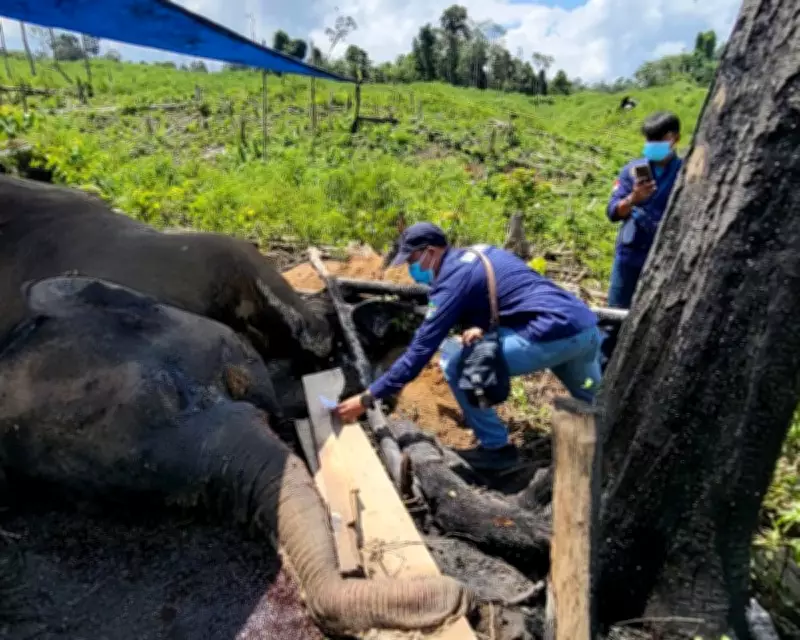
The recent deaths of a mother elephant and her calf in Indonesia's Bengkulu province remain under investigation, but conservationists point to the animal's rapidly shrinking habitat as a primary cause. The two elephants were discovered dead in a production forest area in southern Sumatra, lying side by side with their tusks intact, ruling out poaching. A tiger was also found dead nearby at the end of April. This incident is not isolated; at least seven wild elephants have died in Bengkulu since 2018.
Population Plummet
The Sumatran elephant (Elephas Maximus Sumatranus) once thrived around the Seblat district of Bengkulu. However, poaching and deforestation driven by farming and palm oil plantations pushed the species onto the IUCN's critically endangered list in 2011. According to Ali Akbar, director of Kanopi Hijau Indonesia, the population in Seblat Landscape has dropped from an average of 100-150 individuals in 2010 to no more than 50 today, making the situation critical.
Human-Elephant Conflict
As elephants are increasingly pushed out of their habitat, conflicts with humans are rising. Animals encroach on farmland and wander into settlements. Prof. Burhanuddin Masyud of Bandung Technology Institute estimates that at least 1,585 hectares of elephant habitat were lost between January 2024 and October 2025. He describes the situation as a direct attack on the ecology, reproduction, and balance of interaction between elephants and the environment, with multilayered and long-term impacts.

Investigation and Monitoring
Since the discovery of the carcasses, the Bengkulu Natural Resources Conservation Agency (BKSDA) has deployed thermal-imaging drones to monitor the Seblat area. The head of BKSDA, Agung Nugroho, says the goal is to assess the elephant population and habitat, and to determine protective measures. These include short-term habitat protection through encroachment control and long-term improved governance. The drones identified a group of 17 elephants, including four calves, before dawn when cooler temperatures made detection easier.
Wahdi Azmi of the Indonesia Elephant Conservation Forum and the Asian Elephant Specialist Group-IUCN notes that thermal drones help understand elephant distribution, movement patterns, and potential conflicts. However, he emphasizes that monitoring alone is insufficient if the root problem—habitat loss—is not addressed.
Call for Action
Egi Ade Saputra, director of Genesis Bengkulu, urges that monitoring be followed by landscape restoration, including revoking logging and palm oil licenses and establishing the Seblat landscape as a wildlife sanctuary. This month, Forestry Minister Raja Juli Antoni pledged to strengthen conservation efforts, including implementing an early warning system for communities near elephant habitats and mapping corridors to connect areas. A sanctuary is among the schemes being considered.
Community Engagement
Harry Siswoyo of Lingkar Inisiatif Indonesia stresses the importance of involving local communities, many of whom view elephants as pests. He calls for campaigns to change perspectives about the elephant's role in the ecosystem. Elephants are ecosystem engineers; their movements shape forest structure, open pathways, create space for vegetation, and aid seed dispersal. Wahdi Azmi adds that elephant conservation is about maintaining ecological systems that support humanity's future. Conservationists must shift from conflict resolution to building landscapes that allow humans and elephants to coexist safely and sustainably, combining science, policy, landscape management, technology, cross-sector collaboration, and long-term community engagement.