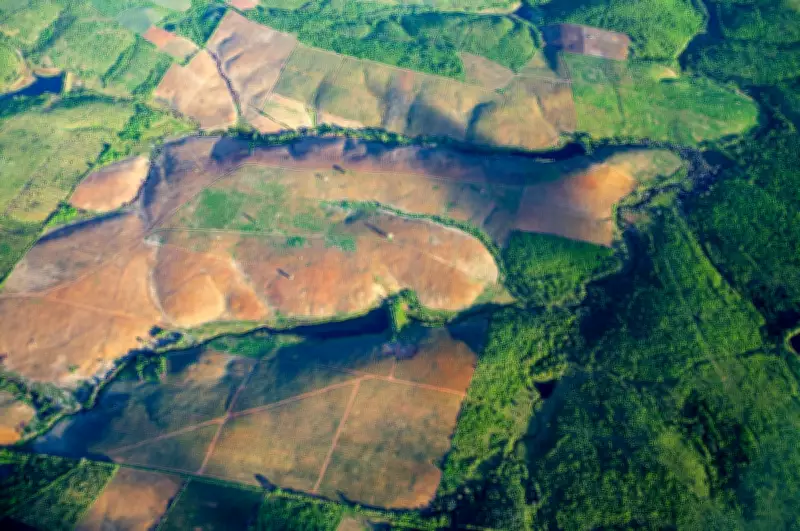
Brazil's Atlantic forest, the country's most threatened biome, recorded its lowest level of deforestation since monitoring began 40 years ago, according to a new report released on Thursday. In 2025, the forest saw 8,658 hectares of deforestation, marking the first time it has fallen below 10,000 hectares since 1985.
Significant Decline in Deforestation
The Atlantic forest is Brazil's most populous biome, home to 80% of the population and major cities such as Rio de Janeiro and São Paulo. Environmentalists have welcomed the results, which they say could even lead to "zero deforestation" in the Atlantic forest within just a few years. However, they warned of potential risks that could reverse the downward trend of recent years.
Two new sets of data were released, both based on monitoring carried out in partnership between the NGO SOS Mata Atlântica and other organisations. One dataset, conducted over four decades, showed a 40% drop in deforestation from 2024 to 2025, falling from 14,366 to 8,658 hectares. The other dataset showed a 28% decline, from 53,303 to 38,385 hectares, and has been conducted only since 2022. The difference between the two monitoring systems stems from the satellites they use, with the newer system being more precise and the older one providing a longer historical record.

Threats to Progress
Despite the decline, "deforestation is still high" in the biome, said Luís Fernando Guedes Pinto, executive director of SOS Mata Atlântica. He added that "in the Atlantic forest, every fragment lost makes a huge difference." The biome is the country's third largest, behind the Amazon and the Cerrado savanna, but is by far the most urbanised and degraded. The Atlantic forest now has only 24% of its original forest cover, while the Amazon retains about 80% and the Cerrado around 50%.
Environmentalists point to two major threats that could reverse the progress. One is the recent approval of the so-called "devastation bill" in Brazil's congress, which drastically weakens environmental law. The other is the prospect of a far-right government, opposed to environmental protection policies, returning to power in the October presidential election. Flávio Bolsonaro, the senator and son of former president Jair Bolsonaro, is tied in the polls with current president Luiz Inácio Lula da Silva, who will seek re-election.
"It's a very worrying scenario," said Pinto, who added that with a victory for Bolsonaro, "Brazil could lose the opportunity to be a global environmental leader." During the elder Bolsonaro's 2019–23 administration, his policies led to a historic surge in deforestation and a gold rush into Indigenous lands. Many scientists, environmentalists and activists fear such rampant destruction could return if his son, who has vowed to follow his father's playbook, comes to power.
Legal and Political Challenges
Standing in the way of further progress is the new law, considered the greatest setback to Brazil's environmental legislation since licensing first became a legal requirement in the 1980s. President Lula vetoed parts of it, but his vetoes were overturned by the largely conservative congress at the end of 2025. The new law removes the requirement for prior approval from the federal environmental agency for states to authorise deforestation, leaving the decision entirely to local authorities. Its constitutionality is being challenged in the supreme court.
Malu Ribeiro, director of public policy at SOS Mata Atlântica, said the law is a "distortion" that puts Brazil at odds with the Paris agreement and could exacerbate climate disasters. "Weakening protection instruments now risks everything we have spent years building," she added.
If the downward trend of recent years continues, which the NGO attributes to a combination of public pressure, civil society mobilisation, environmental policies and enforcement actions, Pinto believes the biome could reach "zero deforestation" within the next three years. However, the new law and the political landscape pose significant obstacles to achieving this goal.