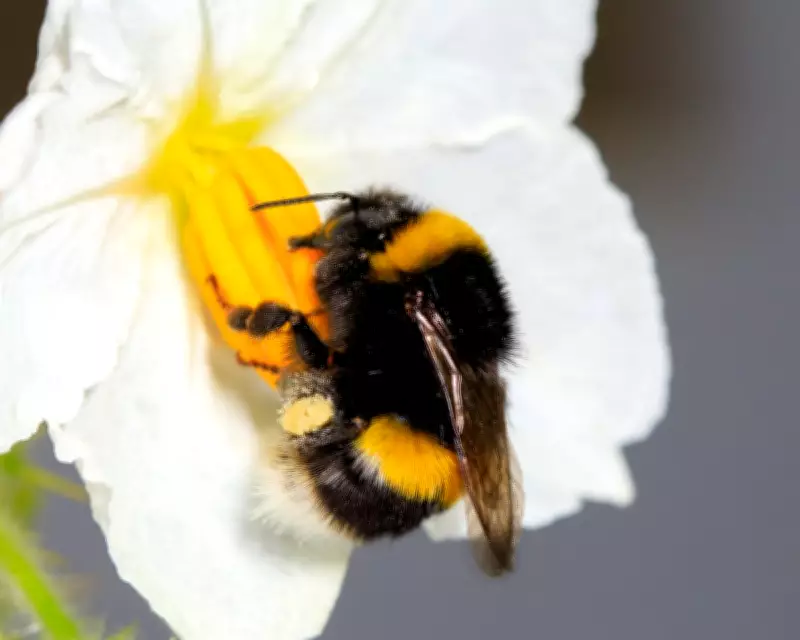
Collecting pollen can be as exhausting for bees as flight take-off, according to a new study from the University of Sussex. The research reveals that 'floral buzzing'—the vibrations bees use to shake pollen loose from flowers—requires far more energy than scientists previously realized.
Energy Demands of Floral Buzzing
Scientists have found that the vibrations bumblebees produce to extract pollen are among the most energy-intensive behaviors they perform. This forces bees to 'carefully choose' which flowers are worth visiting to conserve energy. The study, published by the Royal Society, is the first to directly measure the energy cost of floral sonication, also known as buzz pollination.
Natacha Rossi, a University of Sussex research fellow who led the study, stated: 'As nectar availability shifts due to climate change or habitat loss, the energetic demands of pollination could influence bee behaviour and, ultimately, where bees forage and which plants they pollinate. These results help us to better understand plant-pollinator relationships and just how hard at work a buzzing bee really is.'

Declining Bee Populations
In 2024, the number of bumblebees in the UK declined by almost a quarter compared to the 2010–2023 average, according to the Bumblebee Conservation Trust. Researchers attribute this drop to the cold and wet conditions during that spring. Although numbers rebounded in 2025, many species still remain below average.
Using lasers and respirometry equipment to monitor three colonies of buff-tailed bumblebees, the researchers discovered that a single buzzing event requires about the same amount of energy as a flight take-off. Because buzzing can last longer, the total energy drain can be even greater.
Implications for Bee Behavior
Dr. Beth Nicholls, principal research fellow at the University of Sussex, commented: 'The findings suggest that floral buzzing could represent a major part of a bee’s daily energy budget, something that has previously been overlooked. These bees must carefully choose which flowers they visit to ensure they have enough energy to pollinate.'
The research challenges the common assumption that flight dominates bee energy budgets. The metabolic rate of a floral buzzing bee is more than 30 times higher than its resting metabolism, making the process among its most energetically demanding behaviors.
Environmental Pressures
The researchers warned that declining nectar supplies caused by the climate crisis and habitat destruction could intensify the strain on pollinators. Prof. Mario Vallejo-Marin, at Uppsala University, said: 'We long suspected that buzz pollination was an energetically expensive affair. We can now put a number to it and begin making quantitative predictions of how it could affect the ecology and evolution of bees and buzz-pollinated flowers.'
The study also notes that the energetic drain on the bee does not stop when pollination ends. After vibrating the pollen loose, the bee must engage in a 'grooming and pollen-packing phase,' which requires even more energy. The bee then must force a high-power take-off to carry its heavier load away, making the entire process a demanding two-phase sequence.