
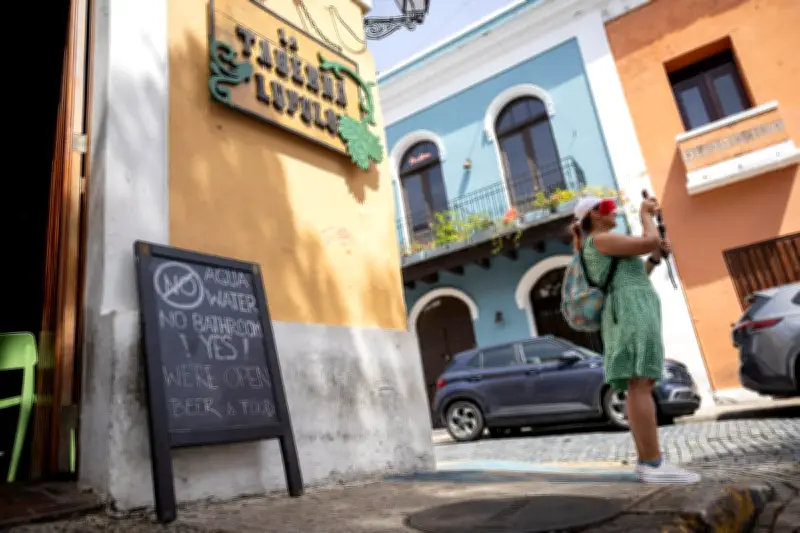
Water shortages triggered by a pipeline rupture have driven up costs and deepened frustrations across Puerto Rico, with residents and businesses spending hundreds of dollars daily to secure water for basic needs. The crisis has prompted the governor to activate the national guard to distribute drinking water across the US territory.
Restaurants struggle to stay open
Jonathan Collazo, owner of Lela's Eatery and Fefis in San Juan, relies on two cisterns, including a 1,000-gallon tank that he needs to refill every two days at a cost of about $300 per fill. On Thursday alone, he spent $600 just to keep running water available for his customers in both restaurants. At times, when logistics become too complicated, he has had to close some of the restaurant's bathrooms.
“We were without water for more than 50 days here on Calle Loíza,” he said, referring to a popular street known for its restaurants and bars. The water problems began in May and have continued, with only brief periods of reliable service. “Customers are confused. It's not just me, it's all the businesses next door. If it were one week or two weeks, fine. But this is as if a hurricane had passed.”
Widespread impact beyond San Juan
The shortages extend beyond San Juan, with sectors in municipalities including Loíza, Guaynabo, Bayamón and others experiencing interrupted service. Water distribution stations have been set up in some of the archipelago's most densely populated areas, but after weeks of scrambling to secure water for bathing, flushing toilets and drinking, many Puerto Ricans say they have reached breaking point.
Kali Solack, co-owner of Café Regina and Hilda Deli, said she's “battling two businesses with no water.” One nearby coffee shop kept a running tally on its front window, marking the days customers had gone without reliable water service. “We're treating it kind of right now as a norm, unfortunately,” Solack said, estimating the businesses are spending about $300 per day on water, in addition to increased costs for disposable items. “I feel like there really hasn't been much communication about why our area has been without water for so long.”
Pipeline rupture worsens chronic issues
Although residents have experienced bouts of intermittent service due to ageing infrastructure and years of inadequate maintenance, matters got worse when a massive disruption erupted in June, triggered by a rupture in the 72in Superaqueduct pipeline in Bayamón. Since then, disruptions at water treatment plants and reservoirs have compounded the problem, and the government has not publicly pointed to the cause of the outage's severity.
Puerto Rico's water utility extracts water from rivers, reservoirs and underground aquifers that have provided sufficient supply in the past. Residents are also paying a premium for water, buying bottled gallons or rearranging their entire day around collecting it from distribution stations. Those unable to travel can request deliveries through their municipal office of emergency management. The burden is especially heavy for households without cisterns, a costly investment that is out of reach for many on the island of 3.2 million people, where more than 40% of residents live below the poverty line.
Residents compare crisis to Hurricane Maria
Marta Acevedo, 75, is grateful that her apartment complex in San Juan has two cisterns that are consistently refilled. But she still has to schedule her day around the limited windows when the building turns on the water. Acevedo, who has lived in the same building for 44 years, said this has been the “longest amount of time” she has gone without reliable running water, even surpassing the disruption caused by Hurricane María, which devastated the island in 2017 and killed an estimated 4,645 people.
San Juan mayor Miguel Romero sued Puerto Rico's Water and Sewer Authority in late May over the outages. The Guardian contacted the offices of Governor Jenniffer González-Colón and Romero, as well as the Puerto Rico Aqueducts and Sewer Authority (Prasa). The water shortages are unfolding as parts of the archipelago face drought conditions linked to prolonged rainfall deficits, adding another layer of strain as Puerto Rico enters hurricane season, which runs from June to November.



