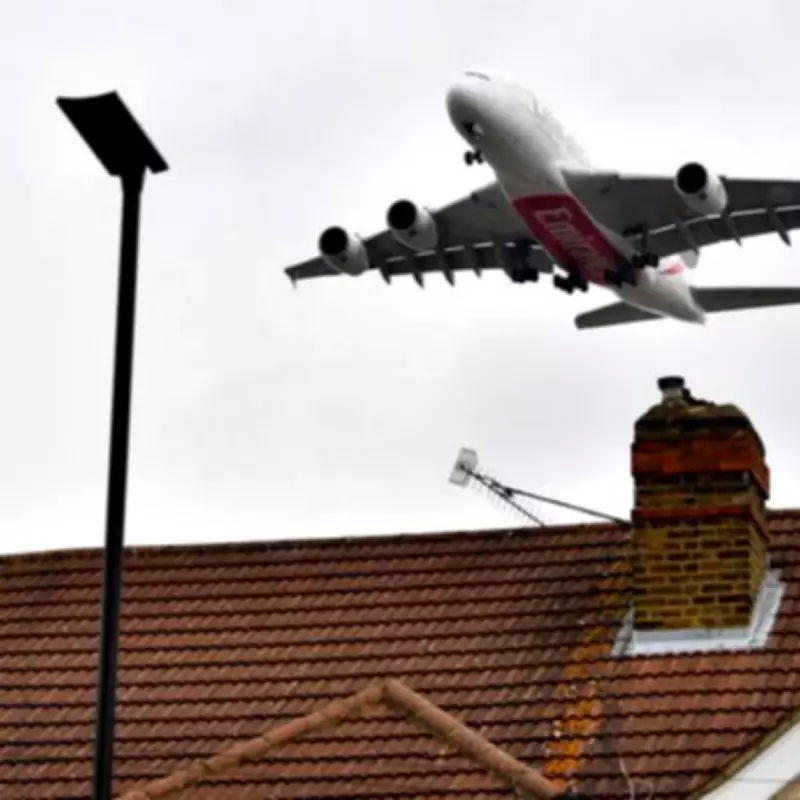
London's New Towns Set for 'Virtually Guaranteed' Sleep Disruption from Airport Noise
Exclusive analysis has uncovered that residents planning to move into London's proposed New Towns will likely endure significant aircraft noise, with sleep disruption described as "virtually guaranteed." Both Thamesmead and Crews Hill in Enfield, two major developments shortlisted by the government's New Towns Taskforce, are situated directly beneath flight paths from the capital's major airports.
Thamesmead Faces Noise Levels Equivalent to Diesel Lorry
According to My Flight Path, an aviation impact analysis service, future residents of Thamesmead could experience noise levels reaching up to 82 decibels (dBA) between 3am and 10pm, comparable to a diesel lorry. The report, obtained by the Local Democracy Reporting Service, highlights that Thamesmead sits beneath converging flight paths from both London City Airport and Heathrow approach routes.
With London City Airport planning to extend its operating hours and Heathrow's third runway approved at a cost of £49 billion, aircraft movements over Greenwich are projected to increase substantially. This escalation in air traffic raises serious concerns about the quality of life for thousands of new homeowners.

Crews Hill Residents Not Much Better Off
The same analysis indicates that Crews Hill residents will fare only slightly better, facing noise levels of up to 77 dBA, equivalent to a washing machine. This planned New Town is located below flight paths for Stansted and Luton airports, both of which are set to expand further, sending more planes over north London between 5am and 1am.
Jono Oates, Co-Founder of My Flight Path, told the Local Democracy Reporting Service: "Crews Hill's location makes it among the worst of all New Towns sites. At 77 dBA, outdoor conversation becomes difficult, children's learning is impaired, and sleep disruption is virtually guaranteed during flight operations."
Health Risks and Property Value Impacts
The World Health Organisation states that aircraft noise above 45 dBA at night causes sleep disturbance and increases risks of cardiovascular disease. Research shows that property values decrease by 0.5-0.6 per cent for every decibel of aircraft noise above this threshold.
Based on this data, a typical £420,000 home in Thamesmead could lose up to £84,000 in value, while a similar property in Crews Hill could depreciate by up to £73,500. For Enfield alone, the financial impact could reach a staggering £1.85 billion in lost property value.
Planning Oversights and Political Concerns
Oates emphasized that while planners focus on transport links, schools, and ground infrastructure, aircraft noise exposure has received minimal attention in public consultations or environmental assessments. "This isn't about stopping development – it's about being honest with Enfield residents about what they'll face," he stated.
Andrew Boff, a Conservative Assembly Member on the cross-party Planning and Regeneration Committee, expressed concern: "That the New Town at Thamesmead will suffer from high volumes and loss of property value is something which needs to be taken into account before any new homeowners are missold properties and end up trapped in a town they can't escape."
Broader Implications for London Development
The analysis from My Flight Path found that 11 of the 12 locations recommended by the Government's New Towns Taskforce – which together could yield 250,000 new homes – will be significantly affected by aircraft noise. Only the planned 10,000-home regeneration in Plymouth will be unaffected.
Last week, a member of the New Towns Taskforce told the London Assembly that Crews Hill and Thamesmead, if successful, could "show the way" for other sites in London to be developed. The London Assembly Planning and Regeneration Committee is currently investigating how these two New Towns will best fit into London and what their impact will be on the capital.
This revelation comes at a critical time when London faces a severe housing crisis, yet raises fundamental questions about sustainable urban planning and resident wellbeing in an increasingly noisy urban environment.