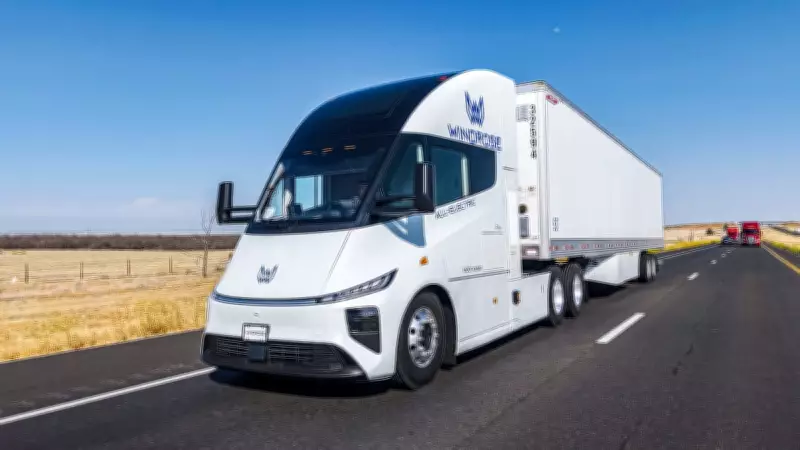
Chinese electric truck company Windrose has demonstrated that its all-electric prime mover can outperform diesel counterparts in extreme conditions. During a trial on Mount Ousley escarpment in Australia, the Windrose truck pulled 68 tonnes of steel from Port Kembla to Sydney, overtaking most diesel trucks on the steep incline.
Electric Trucks: A Viable Alternative?
Bo Christensen, a fleet electrification specialist who followed the Windrose truck during the trial, noted, "It's a very tough run, but we were overtaking pretty much all the trucks going up the hill. We did it pretty comfortably." This comes as Australia faces soaring diesel prices due to geopolitical tensions, prompting calls for energy security.
The Australian government recently announced a $10 billion fuel security package, including $3.2 billion to store a billion more litres of diesel and jet fuel. However, critics argue that electrifying freight transport could reduce reliance on imported fuels.

Market Growth and Adoption
Windrose founder Wen Han expects to sell hundreds of trucks in Australia this year, with a target of 20,000 by 2030. The company has already sold 10 units at $450,000 each. Other manufacturers like Volvo, Sany, Daimler, Foton, and Deepway are also entering the Australian market.
Last year, 332 electric trucks and vans were sold in Australia, including 79 heavy-duty models—triple the previous year. Companies such as Ikea, Woolworths, Australia Post, Coles, Coca-Cola, and Temple & Webster have introduced electric trucks.
Challenges and Opportunities
Despite progress, electric trucks represent only 0.7% of new truck sales in Australia, compared to 20% in China. Bruce Hardy of the Energy Futures Foundation warns that Australia has "radically fallen behind." He notes that 80% of the diesel truck fleet could be electrified with current models.
High costs and charging infrastructure remain barriers. Todd Hacking of Heavy Vehicle Industry Australia says, "Battery electric trucks are more expensive and change operations, but without government assistance, it is a hard sell." He adds that 80% of road freight emissions come from long-haul trucks, which are harder to electrify.
Charging infrastructure is critical. Daniel Bleakley of New Energy Transport urges a "war footing" for charger rollout. Companies like NewVolt are building open-access charging hubs, supported by grants from the Australian Renewable Energy Agency.
Christensen, now at NewVolt, emphasizes that while electric truck technology is new to Australia, Chinese companies have been developing it for over a decade. "It's new to us. But it's not new," he says.