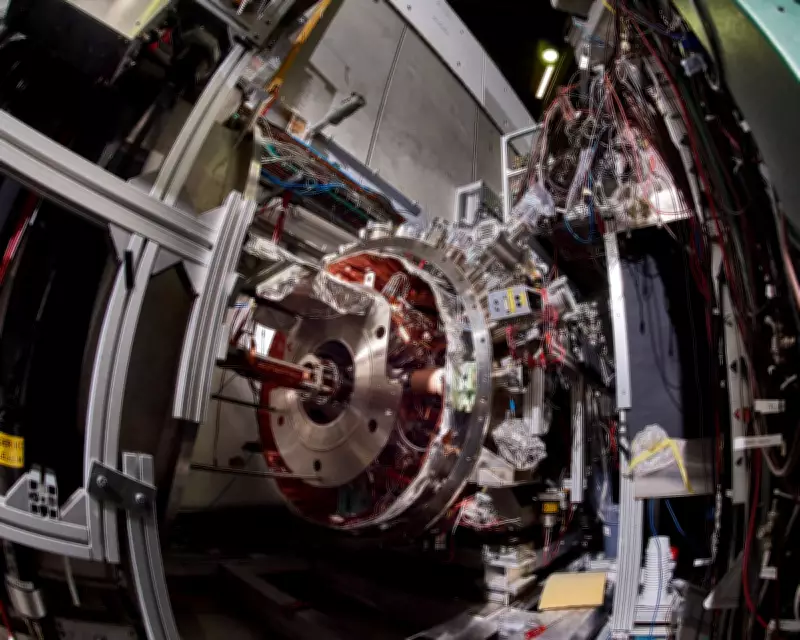
In a groundbreaking scientific endeavor, researchers at CERN, the European particle physics laboratory near Geneva, are set to conduct the world's first attempt to transport antimatter. This volatile substance, which annihilates into pure energy upon contact with normal matter, will be moved in a one-tonne device during a 20-minute test run around the campus later this month. If successful, this milestone could pave the way for transporting antimatter to other laboratories for precision measurements, aiming to unravel the cosmic mystery of why our universe is dominated by matter rather than its bizarre mirror particles.
The Quest to Understand Matter and Antimatter
Dr. Christian Smorra, a physicist on the Baryon Antibaryon Symmetry Experiment (BASE) at CERN, emphasizes the core questions driving this research. "A fundamental question we want to understand is where did matter come from. And then, if you know about antimatter, it's natural to ask, why is that not here? The process is not understood, and we are hunting for clues as to why it happened," he explains. According to modern cosmological models, the Big Bang produced equal amounts of matter and antimatter, but their mutual annihilation should have left the cosmos as a vast expanse of energy. Instead, matter prevails, creating a profound scientific puzzle.
Engineering a Trap for Exotic Particles
The antimatter trap is a marvel of engineering, designed to hold antiprotons without any contact with normal matter. It operates under an ultra-high vacuum, comparable to interstellar space, and is cooled to -269°C to freeze stray gases on the chamber walls. Strong magnetic and electric fields confine the antiprotons at the center, ensuring stability even if the transport truck encounters bumps or sudden braking. For the initial test, batteries will power the trap for up to four hours, with longer trips requiring an onboard generator to prevent power failure, a critical risk during traffic delays.

Antimatter, first predicted by physicist Paul Dirac in 1928 and later detected by Carl Anderson in 1932, consists of antiparticles like positrons and antiprotons. While science fiction often dramatizes antimatter as a powerful energy source, reality is more subdued. For instance, bananas emit antiparticles through potassium decay, but these are insignificant for research. The CERN trap will carry about 1,000 antimatter particles, weighing a minuscule fraction of a gram, with any containment failure producing only a feeble energy pulse, not warranting a radioactive label.
Future Implications and Precision Experiments
Currently, CERN's Antimatter Factory produces antiprotons by smashing high-energy protons into a dense metal target, but the facility's decelerator fields interfere with sensitive measurements. Transporting antimatter to laboratories like Heinrich Heine University in Düsseldorf could enable experiments with 100 times greater precision. Dr. Jack Devlin, a Royal Society research fellow at Imperial College London, notes, "If we were all made of antimatter and lived in a universe made entirely of antimatter, we wouldn't notice any difference. What's strange is that somehow the laws of physics allow the existence of this stuff that seems to behave in the same way as normal matter."
This transport test represents a crucial step toward advancing our understanding of fundamental physics. By comparing the properties of matter and antimatter with extreme accuracy, scientists hope to uncover subtle differences that explain matter's dominance in the universe. As Dr. Smorra states, "If we ever want to do experiments with antiprotons somewhere else, we need to get this on the road, and that's what we're trying to do. First of all, we have to show we can move the antimatter, and this is the big milestone for us." The success of this endeavor could open new frontiers in particle physics, shedding light on the origins and composition of our cosmos.