Massive Teacher Strike Brings Victoria's Education System to a Standstill
In an unprecedented display of industrial action, tens of thousands of public school teachers, principals, and education support staff across Victoria have brought the state's education system to a grinding halt. Approximately 500 public schools were forced to cancel classes as an estimated 35,000 educators participated in a 24-hour strike, marking the first such action in 13 years.
Historic Rally Transforms Melbourne's CBD
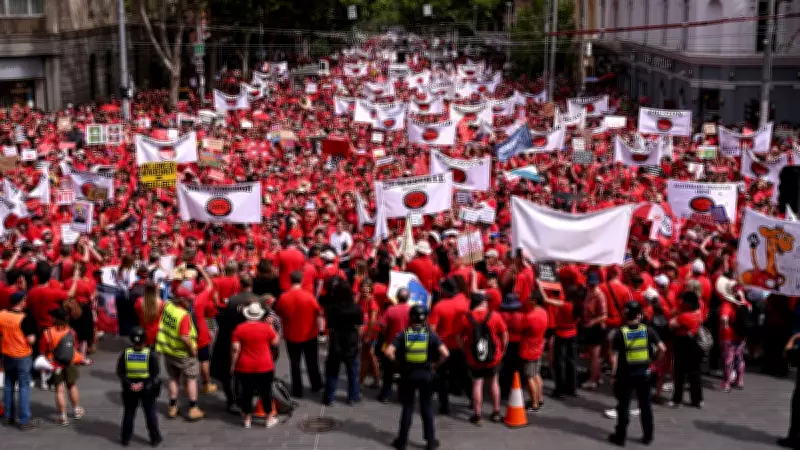
The strike culminated in what union leaders described as the largest teacher rally in Victorian history. A sea of red-clad protesters, wearing Australian Education Union (AEU) T-shirts, marched from Trades Hall to the steps of Parliament House in Melbourne's central business district. The massive crowd chanted "What do we want? A fair deal! When do we want it? Now!" while carrying creative signs that read "Allan government, see me after class" and "My preps can count, why can't the government?"
Major CBD roads were closed to traffic, and bus and tram services experienced significant disruptions before resuming around 1:30 PM. Victoria Police reported generally positive behavior among the thousands of protesters who attended the historic demonstration.

Union Leaders Warn of Escalating Action
AEU Victorian President Justin Mullaly delivered a stern warning to the government, stating the union would "escalate our action if that's what we need to do," with "rolling regional stoppages" potentially following the massive Melbourne rally. Mullaly highlighted a "chronic shortage" of public school teachers, noting that educators are leaving the workforce at "double the rate" compared to pre-pandemic levels.
"The government has relied on your passion and your commitment to cover the funding gap, to cover the staff shortages and they've been doing it for way too long," Mullaly told the gathered crowd of educators.
Key Demands and Government Response
The AEU entered Enterprise Bargaining Agreement negotiations approximately eight months ago with three primary demands:
- A 35% pay increase over four years
- Smaller class sizes
- Improved mental health and classroom support
In response to the strike action, the government offered an 18.5% pay package that included:
- An 8% pay rise for teachers and 4% for education staff effective April
- A 3% increase for each of the following three years
- A 1.5% overtime allowance
Education support worker Joyce Buckley criticized the offer as an attempt to "divide education staff and teachers," while technology teacher James Woodward revealed he relies on donated materials to resource his classes, questioning how this could be acceptable in Victoria's self-proclaimed "education state."
School Closures and Parental Support
AEU Victorian Vice-President Briley Stokes reported that more than 32,000 union members participated in the stop-work action, with entire teaching cohorts striking at some schools, effectively forcing closures. Affected institutions included Balwyn High School, Braybrook College, Vermont Secondary College, Montmorency Secondary College, and primary schools in Footscray West, Fairhills, Newmerella, and MacArthur.
Parent Helen Bell, a teacher in the Catholic system (which was not part of the strike action), brought her children to the rally to support their teachers from Brunswick East Primary School, which was forced to close. Bell and her children held signs reading "we love our teachers" and "pay our teachers more," with Bell stating, "We are here in our droves ... all the parents I know are in full support of the strike."
Government Attempts to Minimize Disruption
Education Minister Ben Carroll expressed disappointment about the strike, stating the government did "everything" to avoid the industrial action. "I've always said to the union, please prioritize making sure that kids go to school, let's not disrupt them," Carroll told reporters. Despite government claims that all schools remained open, the education department conceded that some schools wouldn't be able to support all children, with few students turning up on Tuesday morning.

The strike represents a significant challenge to Victoria's reputation as Australia's "education state," with union leaders warning that unless substantial improvements are made to pay, conditions, and resources, further industrial action is inevitable. The massive turnout and widespread school closures demonstrate the depth of frustration among Victoria's education professionals as they fight for what they describe as a "fair deal" for themselves and their students.