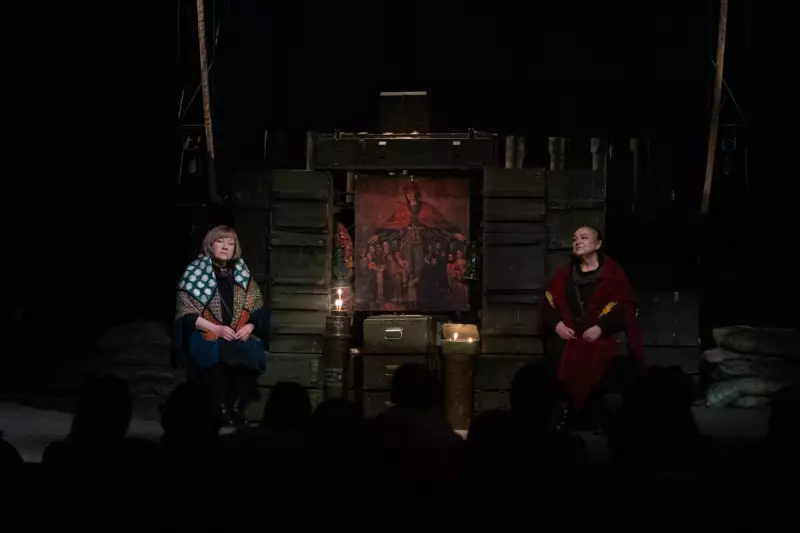
On a recent evening in Kharkiv, the stage of the city's puppet theatre presented a haunting scene. Ammunition boxes opened to reveal figurines of angels and the infant Jesus. Six actors sang mournful carols, their voices intertwining with the brooding poetry of Kharkiv's celebrated writer, Serhiy Zhadan. The audience sat in a transfixed silence, confronted by the raw intensity of a performance titled Nativity Scene. War. Poems.
A Stage That Mirrors a Nation's Anguish
This production is a stark symbol of how nearly four years of full-scale conflict have seeped into every facet of Ukrainian life. Oksana Dmitrieva, the 48-year-old director, rejects the idea of offering mere escapism. "We can't just put on comedies and escape from reality," she stated. For her, the stage is a crucial mirror. "We have to live through our emotions again, but this time from outside ourselves, together with others."
Yet, Dmitrieva admits that channelling such darkness does not guarantee personal peace. The process of creation is fraught with the same questions plaguing the nation: "What comes next? What should we talk about? What buttons should we press? I guess that's what every Ukrainian is living through now."
The Bleakest Winter Yet on the Frontline and at Home
This winter, the fourth since Russia's invasion, threatens to be Ukraine's most challenging. The geopolitical landscape has shifted, with Donald Trump's administration proving more receptive to Moscow than Kyiv. On the ground, Russian forces continue a grinding advance in the Donbas, while relentless missile attacks cripple energy infrastructure, plunging cities into prolonged blackouts.
The nation faces a severe budget shortfall, a crisis in military conscription, and a devastating absence of a clear, positive outcome on the horizon. Amid this, a fragile metropolitan life persists in cities like Kyiv and Kharkiv, powered by growling generators that keep businesses running, a testament to stubborn resilience.
However, as peace negotiations loom under uncertain terms, exhaustion is pervasive. Sevgil Musaieva, editor-in-chief of Ukrainska Pravda, captured the national mood at a recent awards ceremony: "This is one of the most difficult moments in our modern history, when every one of us is living on the edge between exhaustion and strength, between compromise and our principles."
Groundhog Day on the Frontline: Evacuations and Ruin
The human cost of the war's stalemate is most visceral near the frontline. Oleksiy Kharkivskyi, the police chief of the now-abandoned town of Vovchansk, north-east of Kharkiv, lives this reality daily. After raising the Ukrainian flag in Vovchansk following its liberation in September 2022, he watched as a Russian offensive last summer reduced it to ruins.
He now describes his hometown as worse than the ghost town of Pripyat near Chernobyl, littered with corpses, unexploded ordnance, and "half the Mendeleev table lying around on the ground." His current mission, a grim repetition, involves evacuating civilians from villages south of Vovchansk under intense drone attack, a task that already cost the life of a colleague.
"I think everyone would be ready to stop the war on the current contact line," Kharkivskyi said, his voice etched with fatigue. "But to just give away territory, how can we do that? What have we been fighting for for four years, then?"
In Staryi Saltiv, south of Vovchansk, the cycle of destruction and stubborn rebuilding continues. A school, painstakingly reconstructed after its 2022 destruction, was levelled again by a missile last spring just before completion. Now, an underground school is being built beside its ruins. Local official Konstiantyn Gordienko argues such efforts are essential, even this close to the border: "Without a school, people who work and pay taxes won't come back."
For elderly residents like Mykola and Halyna Spivak, both 87, who now live in a container on the site of their shelled home, the war is a wearying echo of past traumas. Deported by the Nazis as an infant, Halyna has again been displaced. They listen to the radio each day, not for geopolitics, but for one simple hope. "Peace, peace, peace, we are just waiting for peace," said Spivak. "Maybe they'll all sit at the table, have a shot of vodka and finally hammer it all out."
Back in Kharkiv's puppet theatre, the nativity play reaches its conclusion. The performance offers no easy answers, just as the war outside offers no quick resolution. It stands instead as a powerful, painful testament to a nation enduring, its art refusing to look away from the reality it must survive.