Tim Crouch's Experimental Tempest Challenges Theatre Conventions in London
Shakespeare's The Tempest appears ideally suited for experimental treatment, with its central themes of artifice and illusion through Prospero's rough magic. At the Sam Wanamaker Playhouse in London, writer-actor-director Tim Crouch has created a production that deliberately and comprehensively underlines its own theatrical artifice, resulting in a high-concept interpretation that both fascinates and frustrates.
Breaking the Fourth Wall with Exhausting Repetition
This production emphatically punctures the fourth wall throughout, making the drama feel leaden with meta-theatrical messages about the nature of theatre itself. The constant breaking of convention becomes draining for audiences, as actors frequently sit in static circles reminiscent of rehearsal rooms, occasionally stumbling over lines or speaking in unison. The performance intentionally blurs boundaries between rehearsal and finished production, creating an atmosphere of deliberate incompleteness.
Post-Colonial Reinterpretations and Character Transformations
Crouch's Prospero emerges as a curious hybrid - part curmudgeonly farmer, part festivalgoer, with distinct Worzel Gummidge undertones. The production significantly reduces Prospero's traditional lines, redistributing them among other characters in what appears to be a post-colonial decentring of the character's authority. Miranda, portrayed by Sophie Steer, shifts between playful and stroppy moods, while Caliban (Faizal Abdullah) appears in contemporary Gascoigne football attire rather than monstrous guise.
Most strikingly, Ariel (Naomi Wirthner) presents as decidedly unspritely, adopting a sombre, watchful presence in embroidered dress that suggests indigenous island culture. Both Caliban and Ariel visibly reject Prospero's definitions, with Caliban occasionally speaking Singaporean Malay - perhaps as resistance to colonial dominion. These character transformations raise compelling questions about identity and power dynamics within the play's colonial framework.
Audience Integration and Theatrical Tricks
The production frequently integrates audience members into the performance, with actors emerging from among spectators, standing from their seats, pushing toward the stage, then returning to watch as observers. Initially, this creates invigorating moments of transgression and originality, particularly when singers appear unexpectedly in gangways and balconies. However, the repeated use of this device eventually feels educational rather than magical, as if theatrical conventions are being systematically deconstructed for instructional purposes.
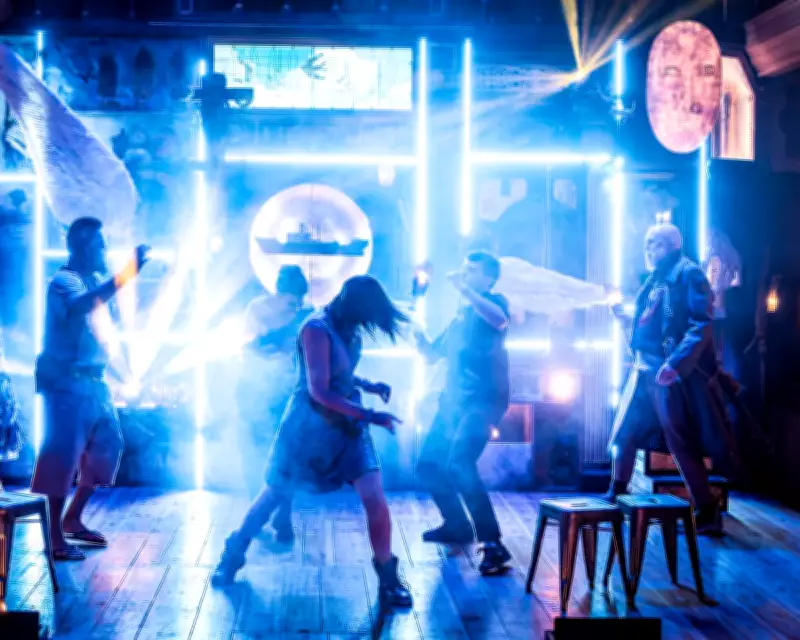
Rachana Jadhav's set design provides visual beauty with museum-like displays of contested exotic artefacts, while a model boat spins during Prospero's conjured storm. The production gains momentum in its second half, with set and lighting creating genuine magic even as the play attempts to reject Prospero's (and Shakespeare's) traditional alchemy.
Concept Versus Drama in Experimental Shakespeare
For all its interesting ideas - from audience engagement to post-colonial reinterpretation - the production occasionally feels medicinal, as if the experience is meant to be educational rather than purely dramatic. The high-concept approach sometimes sacrifices satisfying drama, potentially bewildering first-time viewers of the play. One particularly effective moment occurs when Prospero stops mid-sentence to admonish an audience member about their phone, blurring reality and performance boundaries.
Amanda Hadingue's Antonia provides comic relief as Prospero's usurping sister, declaring "I know this story and I don't recognise it at all... I shall be writing to the Telegraph" before storming out mid-scene. This moment cleverly anticipates critical responses while acknowledging the production's radical departure from traditional interpretations.
Ultimately, Crouch's The Tempest at the Sam Wanamaker Playhouse presents a fascinating but uneven experiment in theatrical deconstruction. While it sparks with dangerous energy at moments, the relentless emphasis on artifice and meta-theatrical commentary sometimes overwhelms the play's inherent magic, creating an experience that feels intellectually stimulating but emotionally distant.