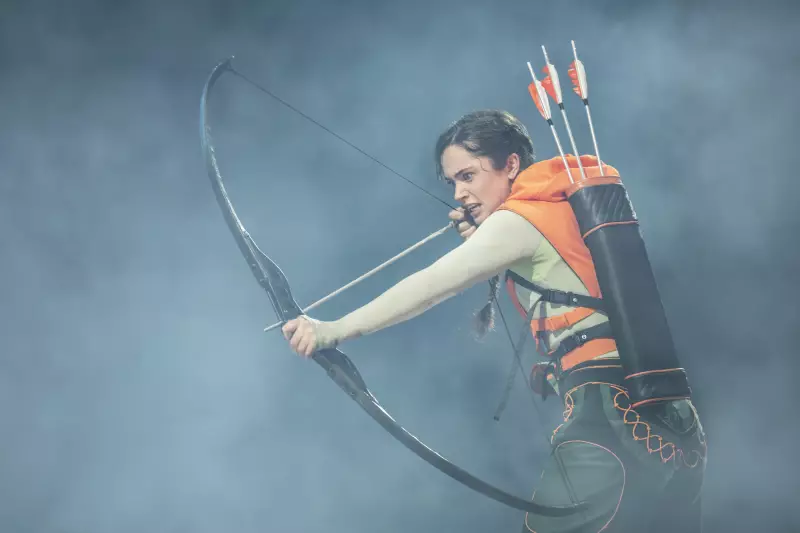
The ambitious stage production of The Hunger Games has arrived in London, presenting a lavish adaptation of Suzanne Collins's smash 2008 YA novel. Staged in the purpose-built Troubadour Canary Wharf Theatre, this show faces the monumental challenge of bringing the story's brutal, action-packed premise to the live stage.
Staging The Unstaged: The Games Come To Life
The central question surrounding this adaptation is whether it's sensible to translate The Hunger Games for theatre. A significant portion of the story unfolds during the titular Games, a gladiatorial reality TV contest where armed teenagers fight to the death. Director Matthew Dunster and his creative team tackle this head-on with an impressive array of theatrical tools.
For the extended combat sequence that dominates the second half, the production deploys aerial work, pyro, video screens, and tightly drilled choreography. Miriam Buether's highly mobile set transforms rapidly, helping to create a coherent and gripping representation of the various sub-locations. While it's hard to claim it surpasses the clarity of the Jennifer Lawrence film—especially without close-ups to identify minor characters—it's a solid, admirably quixotic effort.
A World of Contrast and Spectacle
Dunster's directorial style, which is not subtle, proves well-suited to Collins's novel. The themes of class oppression between the decadent Capitol and the impoverished District 12 are rendered with day-glo aplomb. The production is staged in-the-round within the steeply raked Troubadour theatre, cleverly resembling a sports stadium or TV studio audience seating, implicitly casting the audience as spectators to the Games.
The slickly amoral host, Caesar Flickerman, played by Stavros Demetraki, lifts and clarifies the action. The show is as effective in exploring Katniss's bemused dabbling with celebrity as it is with the fight sequences. Nathan Ives-Moiba delivers a fine performance as Cinna, Katniss's flamboyant yet nurturing stylist. At its best, the production finds its groove as a hybrid of The Running Man and The Devil Wears Prada.
Where The Production Stumbles
However, the adaptation is not without its problems. Mia Carragher meets the considerable physical demands of playing Katniss Everdeen, but is somewhat light on charisma. Her breathy, Marilyn Monroe-style accent is odd and at times distracting. The issue is compounded by Conor McPherson's adaptation, which casts her as both protagonist and narrator. This constant exposition undermines the sense of her living in a dangerous moment.
Another misstep is the use of a pre-recorded John Malkovich as President Snow. Having the famous American actor appear at massive scale on video screens is disorienting. The scenes where he 'interacts' with live performers feel like an odd spectacle that the production, already rich with its own effects, didn't need.
Theatrical Triumphs and Missed Opportunities
Ultimately, The Hunger Games: On Stage is at its strongest in its most theatrical moments. The introduction, where the inhabitants of District 12 rise from the floor to the thunderous sounds of Fuck Buttons' 'Sweet Love for Planet Earth', is in some ways more thrilling than the fighting. Weird, alluring bits of singing and dancing hint at the potential for a musical adaptation. The show is superb at evoking the decadent Capitol, with a parade of grotesque fops flooding the room to instantly communicate everything about the place.
The play's success will likely hinge on audience reception to the long action sequence in the second half. While it doesn't single-handedly vindicate the entire production, Dunster and his team have done a credible job that shouldn't alienate fans of the book or film. One is left to wonder if a new story set in the Hunger Games universe might have offered a stronger unique selling point and been less dependent on the success of one specific sequence.
Despite its flaws, this is hardly hack work. A tremendous amount of creative talent has been poured into this big-budget adaptation of popular IP. It is very nearly great—arguably just a stronger lead performance away from a total triumph.