Radical Road: Photographic Journey with Pip Simmons' Experimental Theatre Troupe
The maverick theatre-maker Pip Simmons, who passed away two years ago at the age of 80, is vividly brought back to life through a remarkable new photographic collection. Photographer Sheila Burnett, who also acted with the company, has compiled an intimate visual record in her book Offstage: The Pip Simmons Theatre Group, 1974-86, published by Tricorn Books. This unique archive documents the radical troupe's years of boundary-pushing European touring, capturing both on-stage performances and behind-the-scenes moments that defined their experimental approach.
European Touring Adventures
The photographs reveal the company's extensive travels across Europe during the 1970s and early 1980s. One striking image shows Rod Beddall cycling through Rotterdam in 1974 with Sheila Burnett perched on his shoulders and Rowan Wylie alongside them. Another captures the group at the bar of Chapter arts centre in Cardiff in 1977, where Burnett observed that "bar takings treble" whenever the Pip Simmons theatre group visited. The touring life extended to France, where in Douai, John Altman was photographed with his guitar at a loading bay, embodying the nomadic spirit of the company.
Avant-Garde Productions and Unconventional Casting
The company was renowned for its bold, avant-garde adaptations of classic works. In 1977, Simmons adapted and directed Edgar Allan Poe's The Masque of the Red Death, wielding an axe in one memorable photograph. The production unfolded around Amsterdam's Mickery theatre, where Roderic Leigh, playing Edgar Allan Poe, was captured digging a grave in the backyard as colleagues looked on. The troupe also staged innovative versions of works by Fyodor Dostoevsky and Yevgeny Zamyatin, pushing theatrical boundaries.
Their 1974 production of Dracula featured unconventional casting choices. Rod Beddall, described as "6ft 2in with a shaved head" who could "sing, play guitar, piano, tin whistle and the fool", embraced the role fully, wearing fishnet stockings and a leather jock strap bought from a sex shop. Sheila Burnett, who acted in the production alongside Chris Jordan as the Voice of God, photographed the company in France in 1977, with Jordan being a founder member of the group since 1973.
Memorable Performances and Creative Collaborations
The photographs capture numerous iconic moments from the company's history. For their 10th anniversary project in 1978, they staged a rock version of Shakespeare's The Tempest at Riverside Studios in London, with sand being unloaded for the production. The cast and crew gathered for this ambitious adaptation, with Simmons directing and Burnett playing Ariel. Another image shows Jessie Gordon rehearsing with her flute at the Mickery theatre in Amsterdam in 1977, where she remembered "the learning curve was intense, the creativity exciting" about her time with the troupe.
The company's version of Georg Büchner's Woyzeck in 1977 featured Gordon preparing to play Maria at Chapter arts centre, while Burnett herself played The Idiot. Later productions included Rien Ne Va Plus in 1980-81, set in a casino and inspired by a real story, written and directed by Simmons and starring Helena Fransson. The team was photographed raising a toast to this production, celebrating their collaborative spirit.
Off-Stage Moments and Personal Reflections
Beyond the stage, the photographs reveal the personal dynamics and adventurous spirit of the company. Emil Wolk was captured doing a handstand on the roof of Milan Cathedral, later reflecting that the experience involved "collaboration, youth, guts and stupidity: and I loved it all." Another intimate moment shows Rod Beddall with a dove from Dracula in a hotel room while on tour, highlighting the blurred lines between performance and reality.
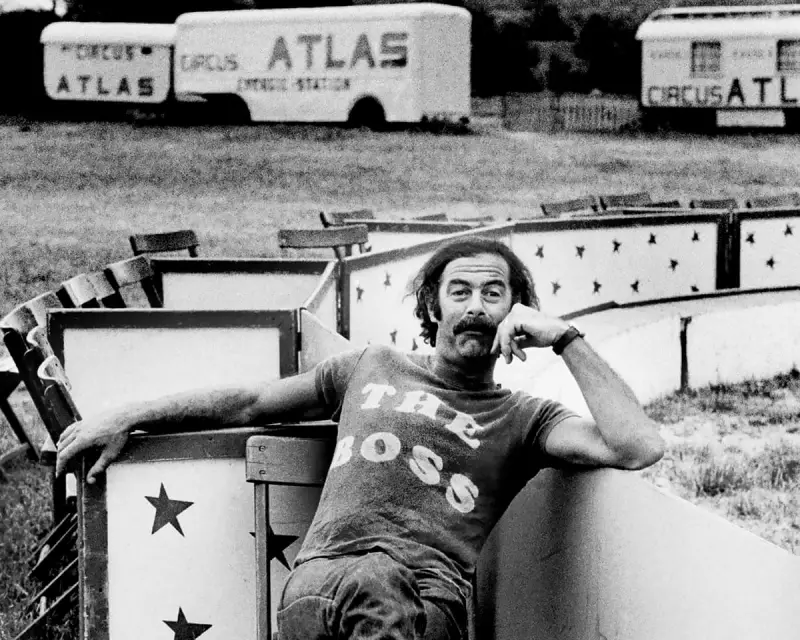
The collection culminates with a powerful image of Simmons himself in 1979, described as the "ringmaster of an endlessly inventive troupe," embodying the creative force behind this radical theatrical experiment. Through Burnett's lens, we see not just a theatre group, but a community of artists pushing against conventional boundaries during a transformative period in European performance art.