Maggots Review: A Haunting Exploration of Lonely Death and Community Failure
Farah Najib's compelling new drama, Maggots, currently running at the Bush theatre in London, confronts audiences with a profoundly unsettling question. What happens when a woman lies dead in her home for over a year without anyone noticing? The play opens with a telling quote that sets its thematic foundation: "living well and dying well is a community affair." This production meticulously examines the devastating implications when that community fails.
Inspired by Real Tragedies
While the central character Shirley is fictional, Najib's work draws direct inspiration from documented cases of lonely deaths. The script acknowledges real women, including Sheila Seleoane, who remained undiscovered for more than two years. This connection to reality lends the narrative a chilling authenticity, making the scenario far less far-fetched than it might initially appear.
The play raises urgent questions about both individual and systemic responsibility. Through the decaying evidence—from the permeating stench in hallways to the appearance of maggots in neighbouring flats—Najib probes where culpability truly lies in such tragic circumstances.
Intimate Storytelling Through Multiple Perspectives
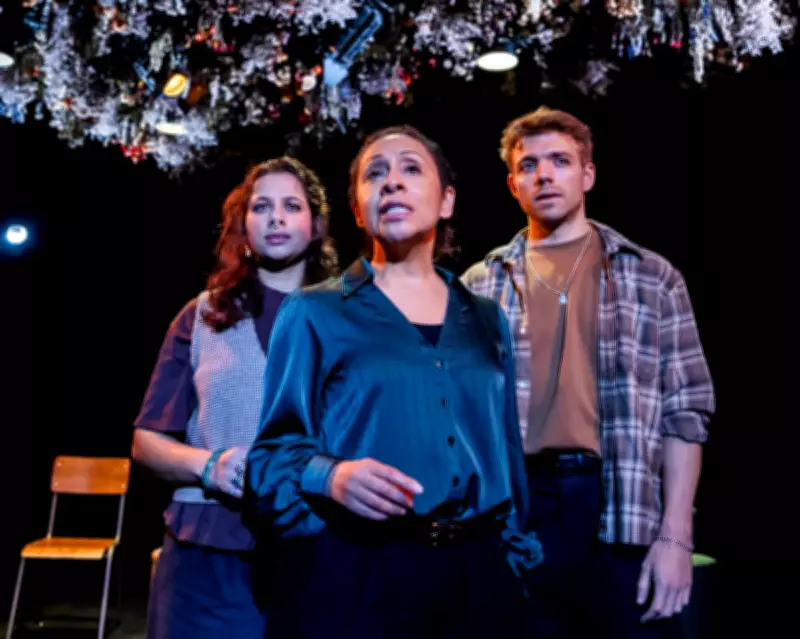
Three skilled performers—Marcia Lecky, Sam Baker Jones, and Safiyya Ingar—serve as storytellers, recounting events leading to Shirley's discovery from various neighbours' viewpoints. These characters include a struggling single mother, a diligent cleaner, a middle-aged widower, and his grieving daughter. Although the production occasionally emphasises its theatrical artifice somewhat redundantly, the intimacy and richness of the narratives shine through.
Director Jess Barton's staging, with Peter Small's focused lighting design, creates moments of striking stillness. Caitlin Mawhinney's set design cleverly employs irony, featuring beautiful dried flowers overhead while stories of maggots and skeletal remains unfold below. Humour is deftly woven into the bleak narrative, providing necessary levity amidst the desolation.
Strengths and Shortcomings in Execution
Najib demonstrates a remarkable ability to draw audiences into her carefully constructed world. The character backstories are seamlessly integrated into the present action, and the third-person narration manages to create surprising interior depth despite its technical distance. However, the play occasionally falters in its examination of broader systemic failures.
While thematically reminiscent of works like Alexander Zeldin's Beyond Caring and Kae Tempest's Let Them Eat Chaos in exploring urban isolation versus human connection, Maggots doesn't quite achieve the same rigorous fusion of personal and political elements. The central motif of maggots, which seems poised to evolve into surreal horror, ultimately serves more as atmospheric backdrop than transformative metaphor.
Similarly, the play's tendency to leaven darkness with warmth and goodness sometimes creates an anticlimactic effect. Najib clearly possesses significant dramatic talent, but some critics might argue she pulls her punches when deeper devastation is required.
A Timely Production with Lasting Resonance
Despite these limitations, Maggots remains a timely and thought-provoking addition to London's theatre scene. Its exploration of how communities function—or fail—in increasingly atomised urban environments resonates deeply in contemporary society. The production continues at the Bush theatre until 28 February, offering audiences a challenging, intimate theatrical experience that lingers long after the curtain falls.