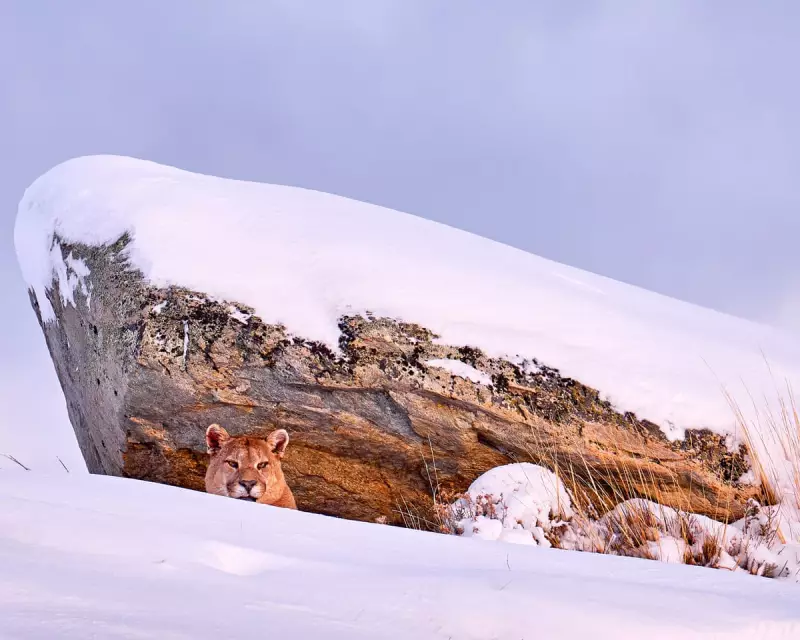
The eponymous puma remains an elusive presence throughout Daniel Wiles's compelling second novel, serving as both literal quarry and powerful metaphor in this serious historical work. Following his acclaimed debut Mercia's Take, which won the 2023 Betty Trask prize, Wiles continues his exploration of marginalised histories with this visceral tale of cyclical violence and human obsession.
A Father's Quest in Patagonian Wilderness
Set in the early 1950s, The Puma follows Bernardo, a morally ambiguous figure who has brought his young son James from England to the Patagonian woods where he himself grew up. Unlike the sympathetic miner Michael from Wiles's previous novel, Bernardo represents a more complex protagonist whose past trauma drives the narrative forward. James's innocent chatter about becoming a footballer contrasts sharply with his father's distracted state, haunted by shadows of family memories and childhood pain.
Navigating Past and Present Violence
The novel presents a sophisticated challenge through its subtle movement between timelines and locations. Wiles masterfully weaves together Bernardo's present in Patagonia with flashbacks to Liverpool and France, gradually revealing the violence he both fled and encountered. As a civilian during the Blitz and later as a British army medic in Normandy, Bernardo's experiences of violence become central to understanding his character's motivations and psychological state.

A sudden tragedy midway through the book fundamentally shifts the narrative direction, transforming Bernardo's search for home into an obsessive quest for revenge. This structural division creates two distinct sections that explore different aspects of the protagonist's journey and psychological transformation.
From Domestic Tension to Wilderness Obsession
The first part of the novel establishes a compelling father-son dynamic filled with tension and anticipation. Wiles captures the makeshift domesticity of their Patagonian existence with psychological precision, creating an atmosphere that keeps readers engaged and uneasy about what might unfold.
The second section, however, takes a different narrative approach as Bernardo becomes consumed by hunting the elusive puma. This portion of the book features extensive descriptive passages of the Patagonian landscape - brush and bramble, rocks and mountain ridges, smells and natural textures. Bernardo's existence becomes measured in dwindling bullets, and his obsession with the puma transforms into his sole purpose in life, sustaining him both physically and mentally.
Themes of Masculinity and Environmental Critique
Wiles uses the nonhuman world as both setting and symbolic element, presenting the landscape as a victim of Bernardo's inability to process difficult human emotions. This displacement of hurt onto the environment serves as a powerful critique of twentieth-century masculinity, particularly through striking imagistic parallels between human and animal suffering.
The novel briefly introduces a Mapuche character who accompanies Bernardo, establishing a contrast between capitalist destruction and more sustainable indigenous livelihoods. This thematic thread becomes explicit when Bernardo encounters other hunters whose purely commercial approach to hunting outrages him, highlighting the novel's environmental concerns and critique of exploitation.
Stylistic Considerations and Literary Voice
The Puma demonstrates a different narrative approach compared to Wiles's debut. While Mercia's Take featured compelling Black Country dialect, The Puma employs a more uneven and free-floating narrative voice. The prose often becomes stylishly elliptical, blending scientific precision with elegant simile in what reads as the dialect of literary fiction rather than specific character voice.
Some sections risk veering into escapist fantasy territory, particularly when describing Bernardo's transformation in the wilderness. At moments, the hormonal imagery approaches the realm of men's fragrance advertising, creating occasional discomfort in an otherwise serious literary work.

Literary Achievement and Historical Exploration
Despite these occasional uneven moments, The Puma represents a significant extension of Wiles's literary ambitions. The novel maintains his sincere commitment to exploring marginalised histories through viscerally affecting storytelling. While perhaps less distinctive than his debut in terms of voice and characterisation, it demonstrates the author's growing range and willingness to tackle complex themes of violence, masculinity, and environmental responsibility.
The novel ultimately succeeds in creating a powerful meditation on how personal trauma can become externalised and projected onto both landscape and innocent creatures. Through Bernardo's obsessive quest, Wiles examines the cyclical nature of violence and the human tendency to repeat patterns of destruction, even while seeking redemption or escape.