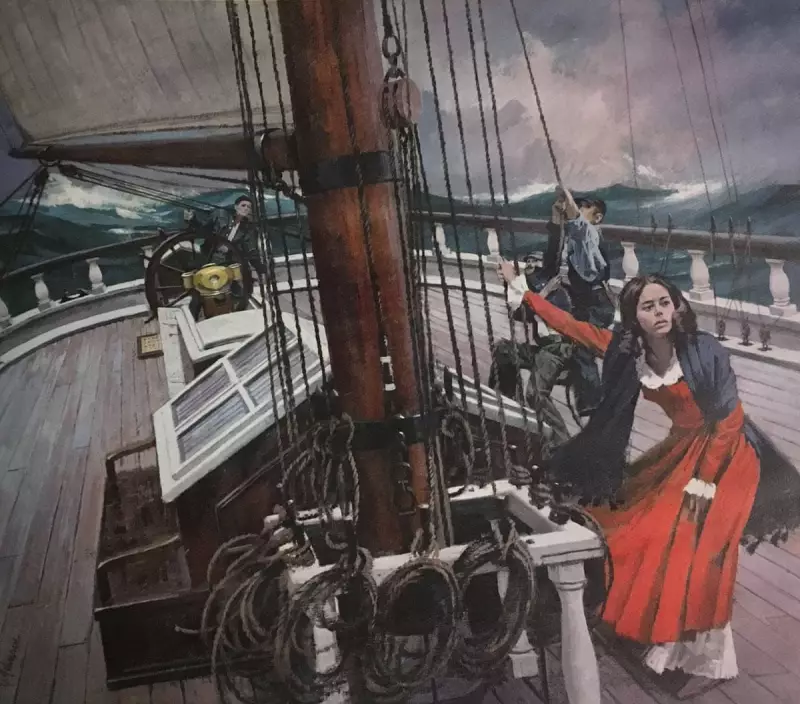
The extraordinary maritime achievement of Mary Ann Patten, a nineteen-year-old pregnant woman who took command of the fast clipper ship Neptune's Car during a treacherous 1856 voyage, represents one of seafaring history's most compelling yet overlooked narratives. Facing a mutinous crew, ferocious storms, and the perilous waters around Cape Horn, Patten's self-taught navigation skills and unwavering determination secured the safety of her vessel, cargo, and all onboard.
A Perilous Voyage Begins
In June 1856, Mary Ann Patten embarked from New York aboard Neptune's Car alongside her husband, Captain Joshua Patten. The 65-metre clipper ship, laden with mining equipment and groceries valued at approximately twelve million dollars in today's currency, was participating in a competitive five-way race to San Francisco. The couple aimed to break speed records and secure substantial financial rewards from this high-stakes maritime endeavour.
Unforeseen Challenges Emerge
Tragedy struck before departure when the original first mate suffered a broken leg on deck. His replacement, William Keeler, proved disastrously unsuitable for the role. Historian Tilar J Mazzeo, author of the new book "To the Edge of the World: A Perilous Storm, A Mutinous Crew and the Woman Who Defied Them All," suggests Keeler may have been incompetent, lazy, malevolent, or possibly even paid by competitors to sabotage the voyage.
Keeler's repeated negligence included sleeping while on duty, leading Captain Joshua Patten to demote him. The disgruntled first mate responded with violent threats, resulting in his confinement in leg irons within the ship's brig. Compounding these difficulties, the second mate was illiterate and therefore unable to perform essential navigational calculations using almanac tables.
Captain's Collapse and a Fateful Decision
Unbeknownst to the crew, Captain Joshua Patten had contracted tuberculosis before the voyage commenced. His deteriorating health forced him to maintain almost continuous watch on deck to ensure proper navigation. By early September, as Neptune's Car entered the treacherous Le Maire strait near Cape Horn—described by Mazzeo as "a graveyard of shipwrecks"—Joshua collapsed completely.
Faced with this crisis, the three-months-pregnant Mary Ann Patten confronted a critical choice: relinquish command or assume responsibility for the ship herself. Benefiting from education at one of America's first schools to admit working-class children and having learned celestial navigation from her husband, Patten chose to take command with support from the second mate.
Confronting Mutiny and Nature's Fury
As Neptune's Car rounded the strait into the Drake Passage, the vessel encountered what Mazzeo describes as "a terrible gale" that trapped them for days off one of the world's most dangerous coastlines. With progress impossible, the crew's confidence in their young commander began to waver, creating conditions ripe for mutiny.
Seizing this opportunity, the shackled Keeler sent a letter asserting his right to assume command. In response, Patten delivered what eyewitnesses later described as an extraordinary speech to the assembled crew. Though her exact words remain unrecorded, contemporary accounts report that older sailors had tears in their eyes witnessing the teenager's courage, and the entire crew ultimately applauded her leadership.
Navigating Impossible Conditions
Following her successful defiance of the mutiny attempt, Patten confronted days of relentless storms. Observing another vessel attempting the desperate "ahull" tactic—furling sails and drifting at the storm's mercy—Patten recognised that Neptune's Car would likely be crushed by the enormous waves if she adopted similar measures.
Instead, she implemented what Mazzeo identifies as "the most extreme measure a sea captain can take in bad weather": sailing to the outer edge of the cyclone to allow the storm to essentially expel the vessel. This daring manoeuvre succeeded but left Neptune's Car surrounded by icebergs and ice fields off the Antarctic coast, where stopping risked becoming permanently frozen in place.
The Crucial Role of Celestial Navigation
Patten's survival depended entirely on her mastery of celestial navigation—the ability to determine position using only an almanac, watch, and sextant. This sophisticated skill, which Mazzeo herself learned while researching the book, enabled Patten to navigate through the ice fields when conventional landmarks proved useless.
Remarkably, Patten managed to turn the vessel around and resume course toward San Francisco, arriving in the bay ten weeks after assuming command with both crew and cargo intact. Her achievement marked the first time a woman had commanded a merchant clipper ship, yet her story gradually faded from historical memory.
Rediscovering a Maritime Pioneer
Author Tilar J Mazzeo discovered Patten's story while sailing near her Vancouver Island home, finding a reference in books left aboard a recently purchased vessel. Intrigued by what she describes as Patten's "quietly heroic" accomplishment, Mazzeo embarked on extensive research that included retracing the clipper's route around Cape Horn and undertaking a 500-mile voyage from Chile to the South Shetland Islands.
Mazzeo was particularly struck by the "electric blue" icebergs and the alien landscape Patten would have encountered near Antarctica. "Before Mary Ann," Mazzeo notes, "no other woman is known to have captained a ship in those waters."
The historian emphasises that Patten's achievement represents more than mere survival: "There were very few sea captains in the 1850s and 1860s who could have achieved what she achieved, as a maritime feat. It's amazing she and her crew survived."
Mazzeo's book, published on 29 January, seeks to restore Patten to her rightful place in maritime history. As the author reflects: "The story is really about what a woman in the 1850s—given an education and an opportunity—was capable of doing, and how we remember that." Mary Ann Patten's extraordinary voyage stands as testament to human resilience, navigational expertise, and the transformative power of education, even under the most daunting circumstances imaginable.