In a bold al fresco production at Braboeuf Manor, Guildford, director Tom Littler presents a double bill of Shakespeare's comedies, Love's Labour's Lost and Much Ado About Nothing, elegantly stitched into a single continuing story. The production, a co-venture between the Guildford Shakespeare Company and the Orange Tree Theatre in Richmond, explores the scholarly hypothesis that the two plays may be parts 1 and 2, a theory advanced by editor H.R. Woudhuysen.
Double-billing deepens both plays
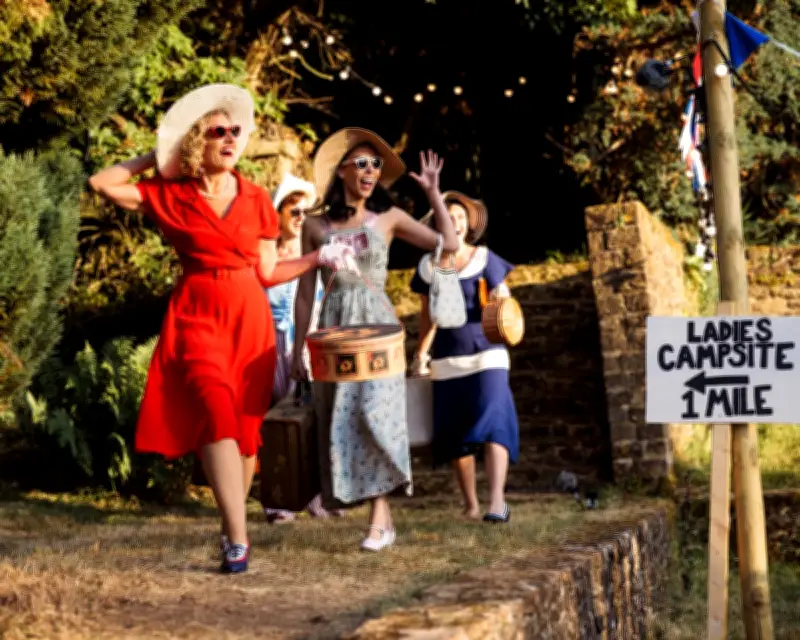
Littler's merging of casts and timelines sees 10 actors take on 17 roles, with characters who loved and lost on the eve of war in 1939 reuniting after the brutal conflict in 1945. This framing adds a poignant layer to the already complex relationships, deepening the psychological stakes. The setting, a harbour designed by Neil Irish, features a boat and bar that serve as key locations for concealment scenes in both dramas.
While purists may object to the textual cuts and redistributions, Littler's script retains most lines, with only a few additions to smooth continuity. The result is a production that feels both fresh and faithful, mining every possible tragicomic note from the source material.
Character conflations and performances
Berowne and Dumain from Love's Labour's Lost borrow the forenames Benedick and Claudio from Much Ado, while Rosaline and Katherine are retro-fitted as Beatrice and Hero. The curate Nathaniel and pedant Holofernes continue into the second play, subsuming roles of neighbourhood watchmen. A single constable, Dogberry, nicknamed “Dull”, polices the five hours of stage time.
James Sheldon delivers a standout performance as the combined commitment-phobe, tinglingly delivering Berowne's big speech (“And I forsooth in love!”) and Benedick's (“The world must be peopled”), making them part of the thought process of a man whose pomposity conceals confused longings. Phoebe Pryce’s Beatrice-Rosaline finds a poignant through line from confident to bruised sarcasm. Chirag Benedict Lobo’s Claudio Dumain makes the jilting of Hero shiveringly shocking. As Dogberry, Matt Pinches relishes the promotion of the village plod to a wartime captain, giving him a self-deluded swagger recalling Captain Mainwaring in Dad's Army.
Wartime context adds tragedy
The wartime setting adds tragedy to the expanded characters and extended timeline. The creakier scenes in Love's Labour's Lost are scaffolded by becoming a preview of Shakespeare's famous on-off lovers, with the mystery of Beatrice’s and Benedick’s hostility now plausibly filled. The suggestion is that, after the couples in the first finale promise to marry in a year, he has ended the pledge by letter or absence during the six years of conflict. The sometimes queasy psychology of Much Ado, especially the casual ruining of Hero, now occurs in the context of the trauma of war.
Littler also mines every possible comic note with slapstick involving a swing, fishing rods, a dinner gong, ice bucket, and beer pump. The production runs at Braboeuf Manor, Guildford, until 25 July, and at Orange Tree Theatre, Richmond, from 31 July to 22 August.