Theatre's Epic New Frontier: Five Hours of D&D Magic
In an era of shortening attention spans, a remarkable new theatrical production is boldly going against the grain. Initiative, an off-Broadway coming-of-age epic running at the Public Theater in New York until 7 December, embraces an ambitious runtime of approximately five hours, including several intermissions. Yet audiences and critics alike report that the experience flies by, creating what playwright Else Went describes as "a new type of commitment" between viewers and performance.
Beyond Nostalgia: D&D as Community Nucleus
Rather than following the standard narrative of tight-knit gaming groups pulled apart by life, Initiative introduces its seven teenage characters as individuals first. No one plays Dungeons & Dragons until late in the first of three 90-minute acts, when Riley (Greg Cuellar) becomes Dungeon Master for friends Em (Christopher Dylan White), Tony (Jamie Sanders), and Kendall (Andrea Lopez Alvarez). They're later joined by Riley's best friend Clara (Olivia Rose Barresi), who finds the game provides unexpected escape from academic pressures, romantic traumas, and post-9/11 anxieties.
Playwright Else Went, who uses they/she pronouns, explained the deliberate pacing: "It was very much part of the intent. When you sit in the theatre for long enough – without feeling like the thing that you're watching is failing you – there's a certain point that you cross as an audience member, where you enter a new type of commitment. And it is in that state that new things can happen, dramatically."
The production arrives during a resurgence of interest in Dungeons & Dragons, partly fueled by Netflix's Stranger Things. However, Initiative distinguishes itself through its early 2000s setting between 2000 and 2004 and its nuanced approach to character development. All characters are convincingly portrayed by adult actors, achieving remarkable depth in their fantasy lives precisely because their real-world personas feel thoroughly established.
Millennial Memories and Digital Isolation
Initiative stands out for its vivid grounding in millennial formative years, beautifully capturing early internet culture through what director Emma Rosa Went calls "chat ballets" – scenes depicting teenagers balancing multiple instant messaging conversations simultaneously. These sequences will likely activate powerful memories for anyone born between 1980 and 1990.
"I wanted to look at the early part of the internet and its effects on how we exist socially and interpersonally with each other, right before social media," explained Else Went. Emma added crucial insight about their directorial approach: "What we needed to do was not play the internet, but actually play teenagers in isolated spaces. You can't embody digital noise. But what you can embody is isolation."
The production carefully avoids what Else describes as tired theatrical shorthand: "I'm really tired of plays that use that shorthand, that do not invest in the humanity of their characters and rather use them as signifiers for some philosophical or sociopolitical argument." Though the play includes gay, bisexual, and potentially trans characters, it prioritises authentic human experience over clean lessons.
The Magic of Collective Imagination
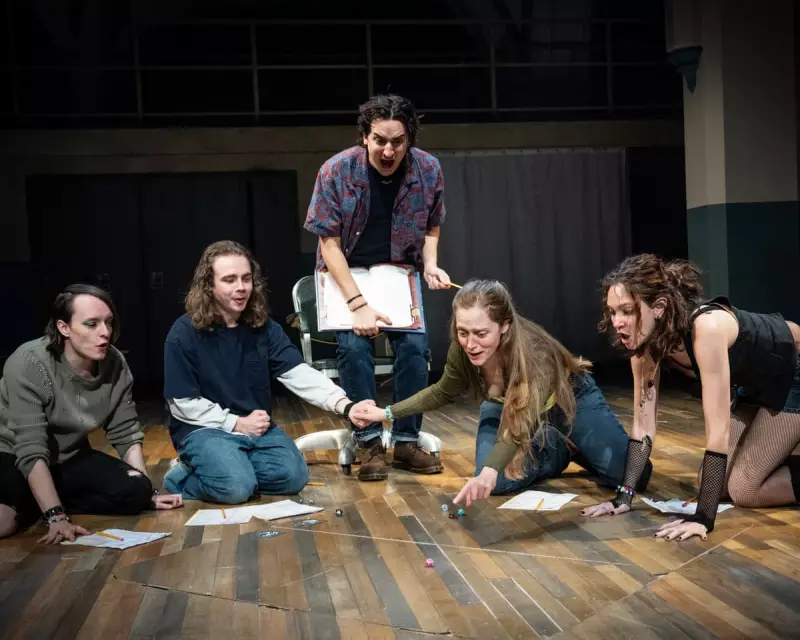
One of Initiative's most striking achievements occurs in its final act. After audiences have experienced traditional fantasy sequences complete with props, costumes, and special lighting effects depicting the characters' D&D adventures, the production dramatically shifts perspective. For the first time in hours, viewers see the players simply sitting on the floor, rolling dice and scribbling calculations on character sheets – no theatrical embellishments.
Remarkably, this stripped-back scene proves just as compelling as the elaborate fantasy sequences. Else Went summarised this narrative magic: "By the time we arrive at that last game, we're capable of doing that imagining with them."
Emma Rosa Went, who is married to the playwright and describes herself as not an experienced D&D player, found a powerful analogue for the game's community-building function: "For me, a lot of what the game is doing [in the play] is functioning as a stand-in for what it feels like to make theatre with your community."
This production redefines nostalgia not as comfortable reminiscence but as what Else describes using the term's original meaning: "The original concept of nostalgia is one of pain – not one of comfort, necessarily. It's a painful desire for home or for past, or some sense of being able to be in a situation in which one cannot again be." Initiative achieves precisely this complex emotional landscape, creating a theatrical experience that transcends its Dungeons & Dragons framework to explore universal themes of youth, community, and the stories we tell to find ourselves.