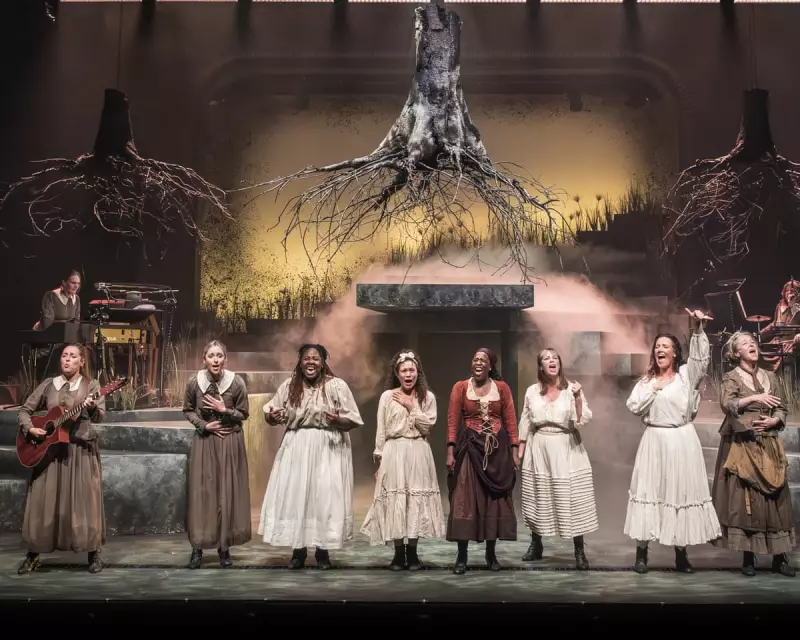
A new musical attempting to give voice to the victims of the Pendle witch trials has opened in London, but despite its powerful subject matter and strong vocal performances, the production struggles to find its footing.
Historical Inspiration Meets Modern Interpretation
Coven, created by Rebecca Brewer and Daisy Chute, takes inspiration from the real-life Pendle witch trials of 17th century Lancashire. The musical aims to transform the accused women from historical footnotes into fully-realised characters, highlighting the injustice they suffered.
The story unfolds in a prison where a group of Lancashire women await their fate. Among them are Frances, portrayed by Shiloh Coke, a church-going woman accused by her own husband who has experienced child loss; the heavily pregnant Rose played by Lauryn Redding; Maggie, interpreted by Jacinta Whyte, who creates medicines from herbs; and Nell, performed by Allyson Ava-Brown, who serves as either a midwife or maid to Frances.
The narrative tension ignites with the arrival of a new prisoner, Jenet, brought to life by Gabrielle Brooks. Her character carries the burden of having testified against her own family for witchcraft as a child, only to find herself facing the same accusations years later.
Promising Elements Undermined by Execution
The production at Kiln theatre, directed by Miranda Cromwell, contains numerous potentially powerful storylines. These range from the coercion of children to the targeting of society's most vulnerable and disempowered women.
Despite these compelling themes, the musical fails to fully evoke the horror of its subject matter. Critics have noted that the inclusion of too many elements creates a cluttered narrative, while the comic tone and cartoonish characterisations lend the production a Blackadder-ish glibness that undermines its serious intentions.
The talented cast delivers strong vocal performances supported by a robust onstage band, yet the overall production feels relentlessly off-key. The actors themselves are not at fault - the issues lie primarily with the sprawling plot and simplistic messaging in the book and lyrics.
Structural Challenges and Narrative Shifts
Initially presenting as an ensemble piece exploring each woman's story, the musical eventually focuses on Jenet's psychodrama. In an eccentric creative choice, her childhood self is represented by a puppet during journeys into her mind.
Once this storyline concludes, the production swings in multiple directions. Scenes include Maggie giving birth accompanied by songs about mother earth, broadly comic enactments of historical misogynistic men, and even an appearance by King James I in a ruff collar giving his approval to witch-hunts.
As the show progresses, the drama becomes increasingly static, charging relentlessly from one ballad to another. The abundance of ideas sloshes around haphazardly, transforming what might have been inspired gig-theatre into what one critic described as a strange soup.
Coven continues its run at Kiln theatre in London until 17 January, offering theatregoers a chance to experience this ambitious but flawed interpretation of one of England's most famous witch trials.