Arcadia Review: Love, Gardening and Euclidean Geometry Collide in Tom Stoppard's Cosmic Masterpiece
When Tom Stoppard was once asked to summarise his celebrated play Arcadia, he described it as a drama of romance, mathematics, landscape gardening and Byron. This concise description barely scratches the surface of what many consider to be the playwright's finest work. Now returning to London's Old Vic in an exuberant new production directed by Carrie Cracknell, this cosmic masterpiece continues to dazzle audiences with its intellectual depth and emotional resonance.
A Drama Across Time and Space
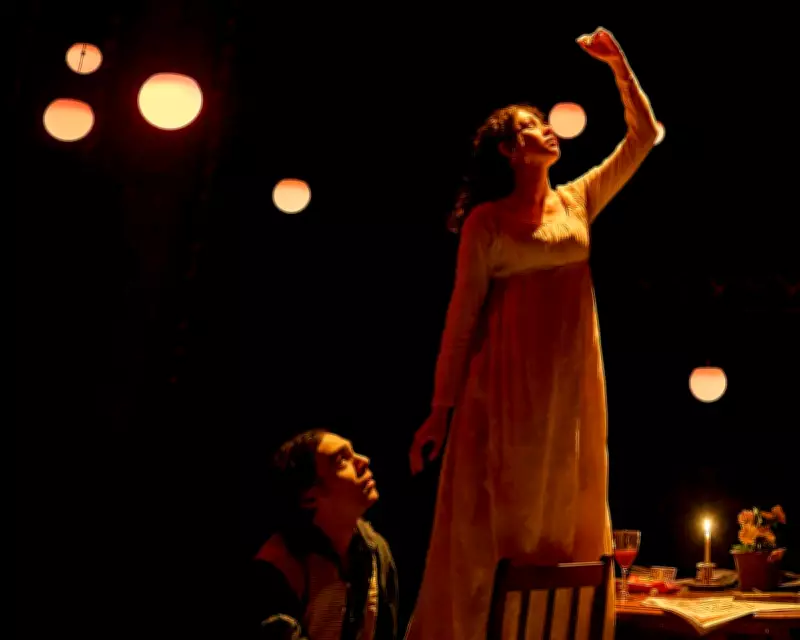
Stoppard's ingenious narrative unfolds within a single room across two distinct time periods, alternating between the early 19th century and the 1980s. Director Carrie Cracknell masterfully suggests these parallel worlds exist merely a hair's breadth apart, with characters from different eras virtually brushing past one another as they navigate their respective timelines. This clever staging creates a palpable sense of connection across centuries, emphasising the play's exploration of timeless human concerns.
The production opens with teenage prodigy Thomasina Coverly, portrayed with winning precociousness by Isis Hainsworth, engaging in amicable conversation with her tutor Septimus Hodge, played by Seamus Dillane. Their dialogue crackles with intellectual energy while simultaneously revealing a growing emotional connection. As Thomasina seeks to unravel the mysteries of the universe through algebraic equations, a slow-burning flirtation develops between student and teacher, resulting in a romance that proves both tender and moving.
Intellectual Pursuits and Emotional Depths
Alongside these historical scenes, the play presents contemporary academics hunting for Thomasina's lost story while investigating the mysterious presence of the roguish Romantic poet Lord Byron at the estate. Stoppard himself described Arcadia as containing elements of a detective story, and Cracknell's production captures this searching quality beautifully, transforming what might have been a conventional country-house drama into a cerebral exploration of ideas and emotions.
The elegant set design by Alex Eales transforms the single room into a veritable galaxy, featuring overhanging planetary ellipses and oversized atoms that create a cosmic atmosphere. Staged with a barely perceptible revolve, the production's movement subtly mimics the turning of the Earth in miniature, reinforcing the play's grand thematic concerns.
Complex Ideas Brought to Life
Throughout the production, characters engage with weighty concepts including thermodynamics, Euclidean geometry, the tension between poetry and science, and even the algebraic properties of leaves. These complex ideas shimmer like conceptual holograms throughout the performance, wavering before the audience just out of reach yet compelling in their intellectual beauty.
The actors demonstrate remarkable skill in bringing even the most arcane lines to life, infusing their performances with a spirit of playful romance that makes the intellectual content accessible and engaging. This is fundamentally a drama about knowledge and interpretation, where some scientific concepts may remain just beyond complete understanding. Rather than causing frustration, these unknown languages of Newtonian physics and mathematics gleam with the excitement of a playwright tossing about complex ideas with such dexterity and depth that comprehension becomes secondary to appreciation.
Contrasting Time Periods
While the historical scenes sparkle with intellectual and romantic chemistry, the present-day scenario proves somewhat weaker in dramatic impact. The modern academic jousting and flirtation lacks the tender chemistry of the historical romance, despite (or perhaps because of) the crass advances made by bombastic scholar Bernard Nightingale, played by Prasanna Puwanarajah, toward star academic Hannah Jarvis, portrayed by Leila Farzad. These scenes occasionally stall the play's momentum as characters debate scholarly ideas without the same emotional underpinning.
Nevertheless, the production maintains an inbuilt exuberance that proves thoroughly invigorating throughout. Like a complicated piece of algebra, the play remains exquisite in its difficulties, ultimately unsolvable yet endlessly fascinating. The sheer cleverness of Stoppard's writing gleams brightly in this production, which runs at The Old Vic until 21st March, offering London theatregoers a rare opportunity to experience one of the great dramatic works of our time in a fresh and vibrant interpretation.