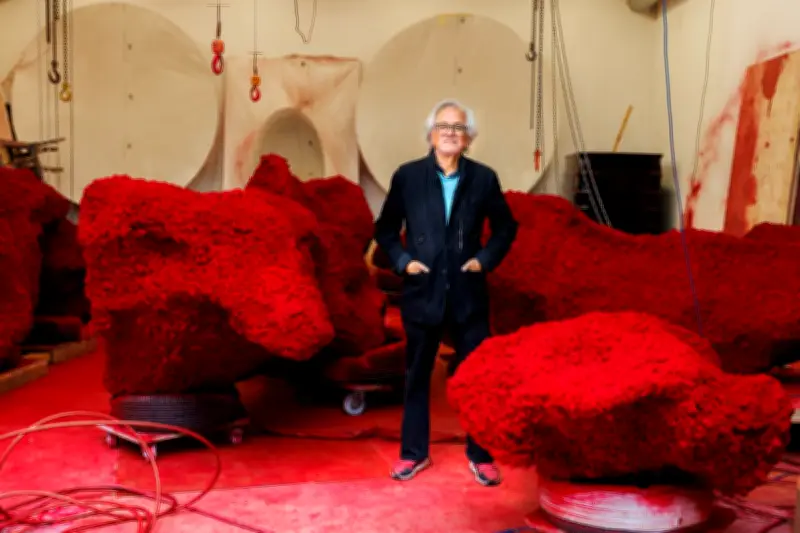
In Anish Kapoor’s 3,100 sq metre studio complex in south London, photographers, assistants and gallery representatives gather in an upstairs meeting room. The artist has a staff of 23 in London – 11 studio assistants, nine people in the offices, three stone masons at a yard in Battersea – and some have been with him for decades. When he’s in town, everyone wants a piece (“It’s like The West Wing,” says one gallery rep).
The studio, which takes up most of a converted dairy factory, is an upstairs-downstairs warren. Each room is dedicated to a different kind of thing: large red installations; small black sculptures; exhibition layout models; lacquered concave mirror paintings; archival drawings. In the upstairs meeting room, there is a weekly calendar hand-drawn over eight sheets of A3 paper with, beneath it, a very long list titled “Unfinished Hayward Works”. And on the windowsill stands a curious item: a solid cylinder of concrete, excavated from the Southbank Centre’s Hayward Gallery.
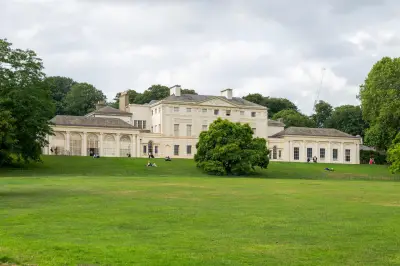
That cylinder was brought over by Kapoor’s old friend, the outgoing Hayward Gallery director Ralph Rugoff, to celebrate Kapoor’s 72nd birthday in March, as well as their current collaboration. It is symbolic of the 1.5 metre-wide bit of gallery floor that Kapoor has just had drilled out in preparation for his career-spanning show, which opens at the Hayward this week. (Rugoff describes the cylinder as the perfect gift for the artist who has spent his life producing voids: “This is what happens when you do that.”)
Emerging from his office in a faded black jacket and scuffed trainers, Kapoor embarks on a rapid-fire walk-and-talk tour, shoulders slightly hunched, like a trail runner hitting their stride. “Honestly,” he says, “everything’s a total mess here. But it doesn’t matter. Come.”
The Southbank Centre was the first to give Kapoor a major show in the UK, in 1998. He is one of the few artists to be asked back for a solo show. “I’m both excited and a little terrified,” he says. Tellingly, the pieces he’s most anxious about, he says, are those the public know best.
Threading a path between bulbous shapes wrapped in protective coverings, Kapoor heads for a giant, red mountain-like structure, just below the peak of which he has carved out one of his signature voids – a dark rectangular aperture. The structure, he explains, is one of the 31 parts comprising a new piece, titled Ha Makom, that is destined for the Hayward. “It’s a huge work, huge work,” he says, gesturing all over the room. “There’s a part of it, there’s another.”
Next door is another even bigger piece. Ancestor is “a kind of meteorite form,” says Kapoor. “We’ve been at it for, God knows, four, five, six months. It should have been finished a month ago.” A group of hazmat-suited assistants beaver away at its holey, pock-marked surface, using what look like ice-lolly batons to apply a red-tinted mixture of sawdust and resin.
Kapoor has a track record of, as Rugoff puts it, “trying to do these things that are very difficult … He himself can sometimes seem kind of impossible. But it’s all in this service of producing things that are going to be very exciting experiences for people.”
Coming to fame in the 1980s with a series of small, geometric sculptures covered in pure pigment, Kapoor’s international profile was established when he represented Britain at the 1990 Venice Biennale. There, he presented a field of large sandstone monoliths, into each of which was carved a small black hole – a tiny void. He has gone on to sink much larger voids into gallery floors, and dream up works of ever greater scale. He has made balloons the size of palaces (Leviathan from 2011), shot 12.5 tonnes of red wax, via cannon, into a corner of the Royal Academy (in 2009) and twisted 1,500 tonnes of steel into a sculpture, Orbit, commissioned for the 2012 London Olympics.
This expansive body of work has landed Kapoor some of the art world’s biggest prizes (he won the Turner prize in 1991 and the Wilhelm Lehmbruck prize last year) and as many civic honours (he’s a Royal Academician, a French Commandeur de l’Ordre des Arts et des Lettres and a knight), and he was one of the nine artists, alongside Constable and Shakespeare, that the UK government put on British passports in 2015.
With these plaudits – and his predilection for immense, sometimes overpowering spectacle – has also come criticism. People often either love what he does or they hate it. When Orbit was installed, some critics castigated Kapoor for what they deemed “a messy, meaningless, plutocrat’s plaything”, and “a vanity project”. The notion that his work flaunts wealth and elitism was only exacerbated by the exclusive licence he secured in 2016 to use Vantablack, a trademarked military-grade coating that is said to be the “blackest black”. “We should be able to use it,” one painter railed. “It’s not a paint,” Kapoor tells me today.
This distinctive – and divisive – ambition will now be on full display at the Hayward. Viewers will be greeted by Kapoor’s newest piece, All of Nothing, a red inflatable so large it cannot be seen in full from any vantage point, and this year’s Ritual Expiation, floor-based sculptures that resemble blood and guts floating in handcrafted metal trays. There are also iconic pieces: the confounding black void of Descent into Limbo; and Mount Moriah at the Gate of the Ghetto, an upside down mountain that hovers just inches from the floor.
Picking my way through room after room in Kapoor’s wake, I am struck by the sheer volume of his output. He is a compulsive doer. Reaching an upstairs room full of painted, concave mirrors, he explains that he has always had two sides to his practice. “One: this stuff, for some reason, the world, the market likes it. And the other,” referring to the gargantuan pieces we’ve walked through downstairs, “which I’ve never sold, not even one.” What he’s after is that “ahhh” moment, when the viewer experiences what he wants the piece to do. These concave mirrors, for instance, are designed and polished in such a way that the painted image appears to be located not on their surface, but surreally hovering in the empty space in front of them. There’s also an optical illusion with the “black-black” works, as he calls them. Vantablack reportedly absorbs 99.965% of visible light, thereby making all depth invisible. The works around me are all 3D shapes. But look at them head on and all you see is flat blackness. Ultimately, Kapoor says, it’s all about pushing at that fundamental question of “Is it art?”.
When asked if there are Vantablack pieces that don’t work, he replies: “Yes, but I’m not going to show them to you.” Similarly, when I ask if I can see the model of the Hayward show, he agrees on condition that no photographs be taken. The photographer duly stays outside as Kapoor leads the way to another room full of exhibition layout maquettes – small preparatory models – hastily crafted from rough-sawn plywood and styrofoam. “I’ve not shown the model to anyone, any journalist at all, ever,” he says.
This curious blend of freedom and control is brought into sharpest relief when we arrive in the drawing and painting room. “This is my space,” he says. Here, he works alone.
An entire wall is covered in quick line drawings, paint splatters and potential titles. The words and phrases on display run a surprising gamut – from the political (“War is won not by the pain inflicted but by the pain that can be suffered”) and the poetic (“Tongue memory”) to the downright meme-able (“I’m not making things, I’m manifesting them”).
“I’ve always been dyslexic,” says Kapoor. He finds writing really hard and trusts sculptural form over language. Yet, language is central to unpacking his work. Ha Makom – the title of the new mountainous piece – means “the place” in Hebrew. It is used in the traditional phrase spoken when leaving the home of mourners sitting shiva (the Jewish grief ritual), praying to God to comfort them.
“Makom in kabbalistic language literally means ‘place’. But it’s also one of the names of God. I like that strange overlap,” says Kapoor.
“It’s weird to have a Hebrew title,” he continues. “Especially now. But hopefully these questions go beyond.”
But using a Hebrew word is you, I say.
“Yeah, it is. It is me,” he replies. “I mean, I have deep trouble with the politics, revolting politics,” he says, referring to the current Israeli government. “But what to do?”
Kapoor has never shied away from politics. Recently, he collaborated with Greenpeace activists to install a large-scale canvas, splattered with blood-red paint, on a gas rig in the North Sea. He has also spoken out against voter ID laws, funding cuts to culture, Brexit and the UK government’s treatment of Shamima Begum. Today, he criticises the UK government’s approach to pro-Palestine protesters. As he puts it to me: “It’s illegal to protest pro-Palestine? Hello? Sorry, what’s wrong with everyone? You arrest them? It’s just outrageous. At so many levels, our ability to speak out is being curtailed: that idiot in America, that vile man in India, etcetera, not to mention Israel. What a shame.”
His relationship to Israel is complex. He was born in what is now Mumbai, India. His father, Darshan Chander Kapoor, an admiral and hydrographer in the Indian navy, was culturally Hindu. His mother, Hilda, born Hilda Murad Elias, was from a prominent family in the Iraqi-Jewish diaspora. His grandfather was the cantor in the synagogue in Pune and, for a time, in Bombay.
His parents were “wonderfully cosmopolitan”, he says with great warmth. “We grew up with this very strong sense of being Jewish and not being Jewish.” In spiritual terms, he has long been a Buddhist.
When he was 16, he and his brother emigrated to Israel. It was, he says, a “bafflingly disorientating and complicated” time. “We had been ‘the Jewish boys’ in India and then we went to Israel, my brother and I, and suddenly they called us ‘kushi’” – a racial slur. “I can’t tell you how shocking that was, to be, if you like, the ‘Black Jews’.”
Fast forward to his arrival in the UK in 1973 to attend art school (first at Hornsey College of Art then at Chelsea School of Art and Design) and, here too, the distance between who he was and how others boxed him in was profoundly unhelpful. His early pigment works were understood through the exoticising lens of his Indian heritage. His Indian citizenship was also a stumbling block for some when he was chosen to represent Britain in Venice. In 2015, a controversial work he installed in Versailles, Dirty Corner, was repeatedly vandalised with fascist and antisemitic graffiti. He refused to remove it the second time, describing it at the time as “really violent” and “a scar”.
Despite this, Kapoor has consistently refused to let what he calls “psychobiography” define his work (he told the curator Nicholas Baume in 2008: “I’m not Tracey Emin!”) and has no time for the increasingly prevalent practice of art being read through the lens of personal biography.
Museums the world over have become obsessed, he says, with “this strange, I think, bit of bullshit” belief that you can only make work that pertains to your narrow identity: so, for example, that only female artists can make feminine art. “Phooey,” he says. “We can inhabit other states, in all sorts of ways. That is one of the beauties of human consciousness, and I think it’s a great disservice to trap the artist.” He goes to museums, he says, “to be surprised, to be taken aback, to be hopefully inspired with some wonder”.
Faced with a world on fire, people increasingly ask where all the radical artists have gone. Kapoor, as this retrospective makes clear, has never let go of the dream that art can be just that.
Here he is, at 72, both making new work that is nothing like anything he’s done before and surprising himself with fresh seams in ideas he’s worked on for decades. The challenge, he says, is for an artist to somehow combine the personal (what he calls “my little story”) with a striving for artistic reinvention – and a rebellious mindset. He refers to the three words on the wall of his studio that he clings to most: disagree, disobey, disavow. “It may well be that that’s my naughty schoolboy attitude to things. But I do believe it’s really important. Disobedience sits alongside invention. It is radical, and I think it is vital.”
Anish Kapoor is at the Hayward Gallery, London, 16 June to 18 October.