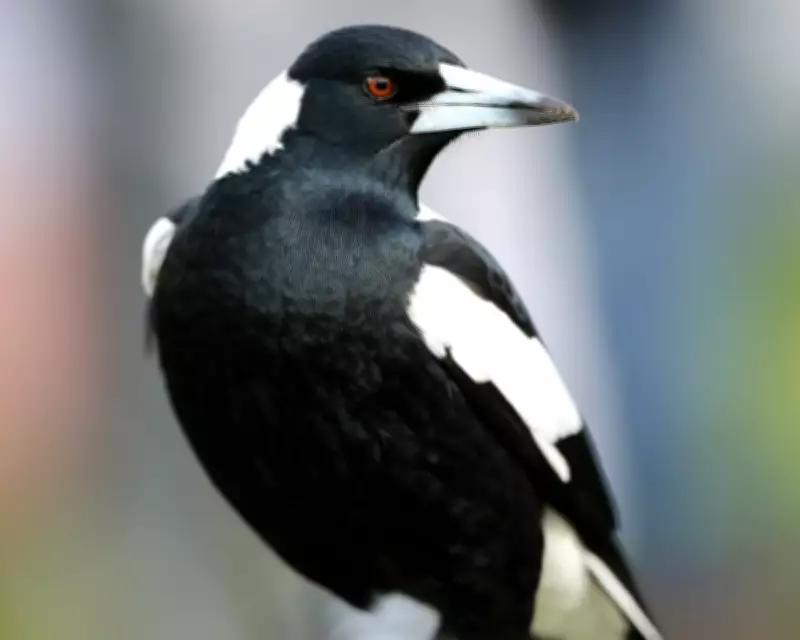
The Australian magpie has once again topped the charts in BirdLife Australia’s Aussie Bird Count as the most frequently spotted bird across the country. Half of the 153,000 surveys submitted by 64,000 observers included the magpie, ahead of the rainbow lorikeet (42%) and the noisy miner (34%). While this bird is a common sight for many, it is far from ordinary. Here are five amazing facts you might not know about Australia’s most often seen bird.
1. Magpies Can Recognize Human Faces and Voices
Emeritus Professor Gisela Kaplan from the University of New England, who has written extensively on magpie behavior, explains that magpies form relationships with people. They are nice to those who are nice to them. They can recognize faces and know which people belong to a property, as well as their pets. This ability helps them differentiate between threatening and friendly humans. They can also recognize humans by their voice.
2. Magpies Are Amazing Mimics
Kaplan has studied magpies for about 30 years. While lyrebirds are famous for mimicry (including car alarms and chainsaws), Kaplan compared their abilities with magpies. Only male lyrebirds mimic during courtship, but both male and female magpies can mimic other bird species, doing so more precisely and interspersing those calls with their own. Magpies also use mimicry intelligently. Kaplan recalls a male magpie that learned the name of the family dog. Whenever the cat stalked the magpie, the bird called the dog, which came running and scared the cat away.

3. Magpies Are Intelligent and Loyal
Professor Amanda Ridley, a behavioral ecologist at the University of Western Australia, studies the cognitive abilities of the state’s unique subspecies of Australian magpie. She considers them intelligent birds. Ridley and her colleagues set tests for magpies, such as learning which color was associated with a food reward or where a reward was likely in an array of holes. One study found that fledglings in larger groups solved puzzles faster than those in smaller groups, regardless of their parents’ performance. This may be because larger groups require individuals to recognize and remember more individuals, a skill they apply to puzzles. Kaplan adds that magpies are loyal. Groups search for territory and, once found, stay for many years. They become so familiar with people in their territory that they bring their fledglings to friendly humans, introducing them—a real honor, though Kaplan advises not to feed the young ones.
4. Magpies Help Each Other Out
Researchers at the University of the Sunshine Coast designed a GPS tracker harness for magpies to study their habits. They discovered an unexpected behavior: one magpie found the weak point of the harness and removed it from another magpie. After attaching trackers to five magpies, one female tried to remove her own tracker, then another magpie approached to help, pecking at the device. It was off within 10 minutes. Most trackers were removed within hours, and the last one, on a dominant male, was gone after three days. This “rescuing” behavior has only been observed in one other bird species: Seychelles warblers, which remove sticky seeds from each other’s feathers.
5. Magpies Don’t Just Randomly Swoop
During spring, magpies become hyper-vigilant while protecting their eggs, but not all swoop. Only about 10% of magpies—always males—swoop on humans. They may have specialist targets. In a study of 48 aggressive magpies in Brisbane, 71% attacked only one type of intruder: pedestrian, cyclist, or mail deliverer. The 10% that attacked posties did not attack any other type. So, if a magpie recognizes your face or voice and knows you are not a threat, it will not swoop.