The English National Opera has triumphantly revived its celebrated 2008 production of Handel's Partenope at the London Coliseum, presenting a taut and alluring spectacle that boldly reasserts the company's treasured Handel heritage.
A Surrealist Take on a Handel Classic
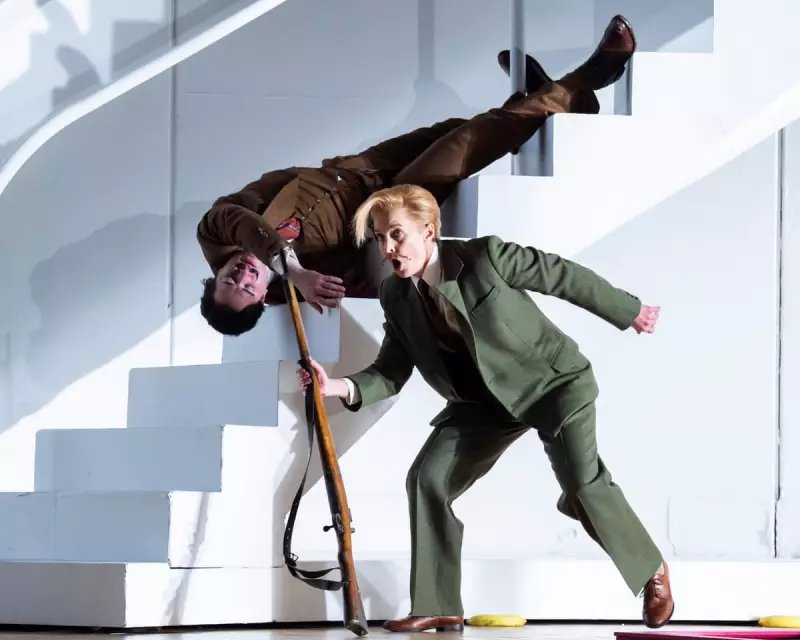
This run is resonantly dedicated to Sir Charles Mackerras, the prime mover behind the ENO's pioneering Handel reimaginings, who would have celebrated his 100th birthday this week. Director Christopher Alden, who first staged this production in 2008, has returned to supervise this revival, ensuring a sharp and inventive staging. He transposes the classical story into the brittle world of 1920s Parisian surrealism. Partenope, the supposed founder of Naples, is reimagined as a society hostess, while her foe Emilio becomes a Man Ray-type photographer, and her suitors are emotionally rudderless hangers-on.
The plot, while superficially political, functions as a domestic comedy. Partenope is pursued by three princely suitors. One of them, Arsace, is himself pursued by his former lover, Rosmira, who arrives thinly disguised as a man. The resulting maelstrom of passions and longings is both believable and, at times, searingly intense.
Standout Performances in a High-Class Show
Nardus Williams is extremely stylish in the updated title role. Though she took a little time to settle into her best voice, her performance peaked in the broad lines of her act two aria, where she declares her longing for Arsace. Countertenor Hugh Cutting, as Arsace, reached the evening's emotional zenith with his jangled act-three aria of renunciation, captivatingly accompanied by theorbo and strings.
Katie Bray was infinitely resourceful as the mixed-up Rosmira, and Jake Ingbar’s Armindo was ingenious, both vocally and gymnastically. Ru Charlesworth provided unflagging wit as Emilio, while William Thomas seized his moments both visually and vocally as Ormonte.
Unexpected Conducting Change
The musical direction saw an unexpected shift. Christian Curnyn, who conducted the production in both 2008 and its 2017 revival, was taken ill during the first interval. His assistant conductor, William Cole, took over for the final two acts with what was described as idiomatic assurance, ensuring the performance's musical integrity remained uncompromised.
The revival is a brave and cheering demonstration that the ENO can still deliver a high-class Handel show, even as the company itself faces an uncertain future following the recent departure of its chief executive, Jenny Mollica. The production runs at the London Coliseum until 6 December.