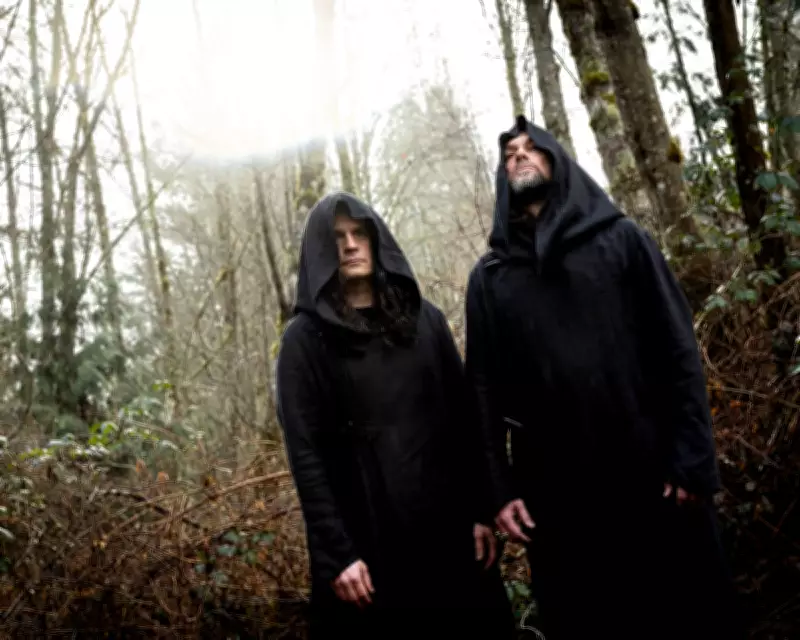
Nearly seven years after their last releases, the Steve Albini-produced companion pieces Life Metal and Pyroclasts, drone metal pioneers Sunn O))) have returned with their 10th album, a self-titled work that marks a seismic shift back to their elemental core. Released on Sub Pop, the label that originally put out drone metal's foundational text, Earth's 1993 debut Earth 2: Special Low Frequency Version, this new offering strips away the duo's recent penchant for high-profile collaborations and expanded musical palettes.
A Return to Basics with Monumental Scale
Gone are the church organs, dulcimers, vocals, and radical reassemblies that characterized their recent work. While closer Glory Black features a brief piano interlude and there are reportedly synthesizers somewhere in the mix, the album primarily deals in the heavily distorted, down-tuned guitars and feedback that have defined Sunn O)))'s sound since their formation in 1998. However, this back-to-basics approach should not be confused with understatement.
The album spans nearly 90 minutes and comes wrapped in a sleeve featuring two Mark Rothko paintings, used with permission from the painter's estate. The recording process involved producer Brad Wood miking up not just the duo's amplifiers but each amplifier's individual speakers, creating what he called "the world's largest stereo array of room mics" to capture ambient textures. This meticulous approach resulted in somewhere between 130 and 180 tracks of guitar per song.

Rooted in Natural Landscape
The album's connection to nature extends beyond its sonic qualities. Recorded at Bear Creek Studio in rural Washington, surrounded by acres of pasture and woods, Stephen O'Malley and Greg Anderson drew direct inspiration from their environment. Unlike Lionel Richie, who recorded Dancing on the Ceiling in the same studio, the duo spent their mornings hiking before recording sessions and incorporated the natural surroundings into their creative process.
Producer Brad Wood opened the studio doors and placed microphones in the surrounding landscape, resulting in subtle environmental sounds woven throughout the recordings. When the first massive bass explosion occurs two minutes into opener XXANN, it arrives accompanied by the gentle sounds of a stream and birdsong.
Nature Writing Meets Drone Metal
The album features sleeve notes from renowned nature writer Robert Macfarlane, who quotes diverse sources including Greek stoic Epictetus, Walter Benjamin, 19th-century naturalist John Muir, author Patrick White, and indigenous American environmentalist Robin Wall Kimmerer. This literary accompaniment underscores the album's deep connection to landscape and natural philosophy.
An Immersive, Transportive Experience
The environmental additions create a subtle but significant recontextualization of Sunn O)))'s sound, lending the music a distinct sense of escapism. Tracks like the feedback-strafed Does Anyone Hear Like Venom? and the 18-minute epic Mindrolling create overwhelming sonic experiences that feel genuinely transportive. When these pieces conclude, listeners experience a noticeable absence, as if being deposited back into ordinary reality.
The ambient elements make the music's destinations feel more welcoming than forbidding, highlighting the album's strangely euphoric effect. This isn't merely about the hypnotic qualities of repetition or the catharsis of noise consumption. There's something remarkably exhilarating about the constant ebb and flow of Butch's Guns, where Sunn O)))'s immense sound occasionally lapses into silence, creating dramatic tension and release.
Contemporary Relevance and Artistic Integrity
The album's sense of escapism feels particularly resonant in 2026, offering refuge from contemporary challenges. This is music that demands complete submission and undivided attention, standing in stark contrast to streaming platforms' increasing emphasis on passive consumption and background music. While Sunn O))) remains definitively not for everyone, even their harshest critics cannot accuse them of creating indistinct background wash.

The piano interlude on Glory Black creates a particularly confounding moment, feeling more desolate than the surrounding guitar sludge. There's a weird, triumphant quality when the detuned guitar textures reappear, creating a punch-the-air moment within the album's immersive soundscape.
Sunn O)))'s return represents more than just a musical homecoming. It's a statement about artistic integrity in an era of distraction, a celebration of immersive listening, and a testament to the power of elemental sound when rooted in natural inspiration. The album stands as both a return to origins and an evolution of the duo's distinctive approach to drone metal.