After what many consider a less stellar Cannes Film Festival this year, with Hollywood absent and more muted receptions to the movies premiering, it was Sebastian Stan's film Fjord that walked away last night with the prestigious Palme d'Or. It initially roused audiences, delivering the first double-digit standing ovation of the festival with a reported 12 minutes of applause – but then was later overshadowed in that arena by La Bola Negra's huge 20 minutes.
But while the awards on Saturday night spread the acclaim between several of the favourite films, including La Bola Negra, Fatherland, Minotaur and All of a Sudden, Cristian Mungiu's Fjord triumphed with the top prize. It's certainly a quieter type of film to win, although Mungiu is a previous Palme d'Or recipient for his searing abortion drama 4 Months, 3 Weeks and 2 Days in 2007, as well as picking up the award for best screenplay in 2012 (Beyond the Hills) and best director in 2016 (Graduation).
But it finally felt as I watched it that one of the most hyped films at the festival has delivered, despite some critics claiming it shouldn't have won the prize. If you were looking for anything boundary-breaking or flashy, that isn't Fjord at all – and it's refreshing to see the jury acknowledge that those aren't the only prerequisites of success and artistic merit. Rather, it's a movie of subtle, realistic storytelling centred around two impressively non-showy turns from its stars, Stan and fellow Oscar-nominee Renate Reinsve. It also really pulls you in on a topic that's going to cause huge conversation, gently interrogating both sides and focusing on the nuances.

A Quiet Film with a Big Impact
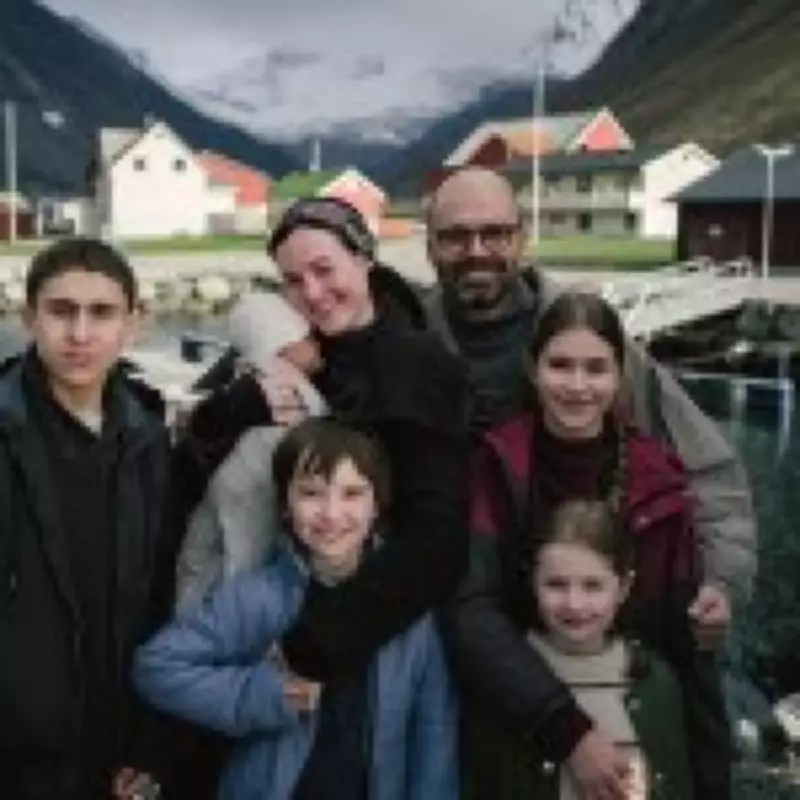
Stan and Reinsve play Mihai and Lisbet Gheorghiu, a Romanian and Norwegian couple and conservative Christians who move with their five children back to their mother's birthplace, a remote and liberal village in Norway. And this is Stan as he's not been seen – or heard – before, balding and speaking his native Romanian in the film, as well as English. He's completely convincing as a strict father but mild-mannered person, stripped of any swagger or star charisma. Reinsve matches him in her meekness, avoiding any over-the-top displays of emotion, instead focusing quietly on her family and evangelising.
While they are initially welcomed with open arms by the close-knit community – the children's headteacher is their neighbour – things begin to dramatically unravel when bruises are spotted on the body of their eldest daughter, Elia (Vanessa Ceban), raising suspicions about potentially abusive behaviour at home. What's clever about Fjord is you never see anything disturbing happen, but the way Mungiu uses certain phrases and slowly reveals information throughout the film means viewers continually question what they're told and who they may seek to blame.
Storytelling Through Subtlety
Fjord begins with Elia clearly having just been punished by her father, and being told to – reluctantly – apologise and hug him. Then she and her brother Emmanuel (Jonathan Ciprian Breazu) begin to taste a little rebellious freedom with neighbour Noora (Henrikke Lund-Olsen), with their parents painted as controlling and overly-severe – potentially even abusive. There are unsettling comments too; Mihai and Lisbet say they moved their children from Romania 'for their own good' when asked if the kids were upset with the change, and Mihai refuses to relent on a punishment for Elia and Emmanuel when Noora asks, simply responding 'they can be cheerful when they're grown up'.
As Child Protection Services become involved, questioning the Gheorghius, separating them from their children and pursuing prosecution to the full extent of the law, the couple find it challenging to stand up for themselves. The local police chief (Thorbjørn Harr) has Mihai sign a ruinous statement that almost certainly wouldn't have got past him if it had been written in his native Romanian. At 146 minutes, Fjord certainly takes its time. However, the quality of its performances and the all-too-real detail included in proceedings largely prevents it from feeling like it drags.

A Film That Sparks Conversation
The film isn't afraid to engage with the knottier elements and ironies of a more liberal society, as well as discrimination, racism and the rights of the state versus those of the parents. For a quiet film on the surface, it has a lot to say. Fjord is smaller and more straight-laced than the usual favourites at Cannes, but it gently works its way into your mind with its examination of a tricky issue, ably supported by a solid cast.
Fjord premiered at Cannes Film Festival on May 18. A UK release is yet to be announced.