If our world is currently thinking through the brave new future of generative AI and super intelligence, Karel Čapek's 1920 play RUR: Rossum's Universal Robots proves the notion of robot consciousness and rebellion is not a new anxiety. So does Mary Shelley's Frankenstein, which Čapek's drama resembles in its philosophical debates and moral warnings, despite its futurism.
Adaptation for modern times
Ella Road adapts Čapek's play for our times in this Headlong and Schwarzman Centre co-production, its science apparently informed by research from Oxford University academics, which gives it a cutting-edge, real-world underpinning.
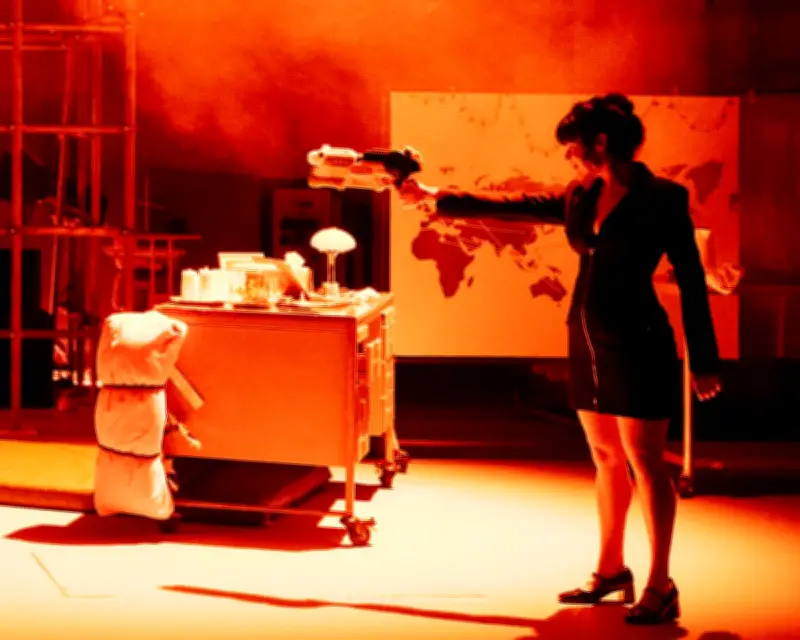
The stage is presented as the operations office for the company, also named RUR, which is creating humanoids by mixing human flesh and blood with code and data at its headquarters on an island (a lovely, lush foliage and scaffold design by Loren Elstein). Dom (Trevor Fox) is the company's boss – a "dom" in more ways than one as he is having a Secretary-style, S&M romance with his robot personal assistant, Sulla (Tiffany Gray).

Plot and themes
An activist, Helen (Ronkẹ Adékọluẹ́jọ́), who also happens to be the prime minister's daughter, infiltrates the island in a guerrilla protest. She thinks robots are sentient beings whose "human" rights need to be protected. The plot thickens when the company creates a replica version of her (Umi Myers), and she subsequently embarks on a romance with Ali (Irfan Shamji), one of the few people on this island.
Directed by Roy Alexander Weise, the story is rich in philosophical discussions about science, reproduction and humanness. That, in fact, is the problem in the static first half when every scenario becomes an opportunity to air an ethical or ontological debate.
Philosophical debates and humour
There is discussion on whether robots are capable of developing feelings and desire, as seems the case with robot Helen (Myers), as she becomes embroiled in Helen's romance with Ali. Alongside Helen's belief that these robots have a soul (though she seems to have changed her mind by the end), there are also reflections on fidelity – is Dom really cheating on his wife by having an affair with Sulla the robot? Like Frankenstein's monster, the robots begin to fight for their right to reproduce and the question of whether they should be allowed, morally, hovers.
The pace picks up in the second half and there are sharp, unexpected turns. It is modern in its humour too; Helen is deemed a "Marxist Trustafarian", and Sulla's glitching, followed by her rebellion, is an eye-popping comic highlight. It is a picaresque version of the robot apocalypse, no less a warning for its laughter, but a little too cartoonish to be truly chilling. At Schwarzman Centre, Oxford, until 18 July.