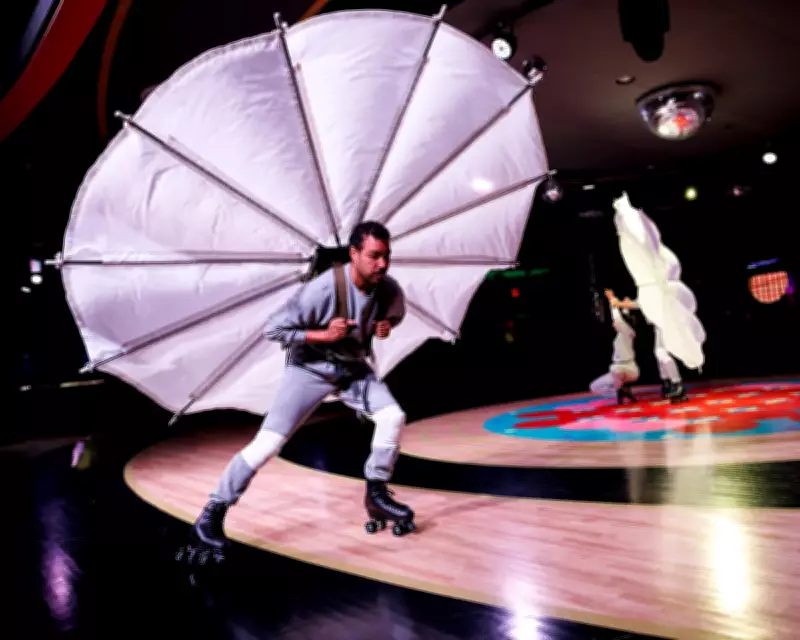
The Trisha Brown Dance Company has revived a nearly lost dance piece by artist Robert Rauschenberg, bringing his 1963 work Pelican back to life at a roller skating rink in Brooklyn. The one-night-only performance took place on 18 May at Xanadu, blending archival research with new choreographic elements.
A Mythic Dance Takes Flight
Rauschenberg, best known for his “combines” – painting-sculpture hybrids made from found objects – also had a deep connection to the dance world. His 1963 piece Pelican features two men on roller skates and a ballerina on pointe, all wearing 8ft parachutes on their backs like wings. Only a short video clip and a few black-and-white photographs survived of the original, giving the work an almost mythic status.
The piece was born from a typo in a festival program that mistakenly credited Rauschenberg as a choreographer. He had never staged a dance before but decided to try, learning to skate for the occasion. “Since I didn’t know much about actually making a dance, I used roller skates as a means of freedom from any kind of inhibitions,” Rauschenberg later said.

Reconstruction Through Forensic Research
The Trisha Brown Dance Company reconstructed Pelican for the first time, led by choreographer Tara Lorenzen and dancers Ashley Hod, Rashaun Mitchell, and Silas Riener. The team sifted through photos and notes from Rauschenberg and Brown’s archives. “We approached it in a forensic way,” Riener said. “Let’s get as much out of what we know to exist, and then fill in the gaps.”
The dancers rehearsed at the Rauschenberg Foundation headquarters on Captiva Island, Florida, where the artist spent his final years. Mitchell and Riener, a couple, partnered with Hod, a soloist at the New York City Ballet. “You feel a lot about a person through their contact when you’re partnering with them,” Riener noted.
A Trust Exercise on Wheels
Pelican is a trust exercise: the dancers rely on themselves and each other to stay upright on skates and pointe shoes. The climax sees the two skaters holding hands and encircling the ballerina, creating a music-box effect. “This work is not pedestrian at all. It’s pretty virtuosic and very high stakes,” Mitchell said.
The performance took place during a heatwave, with the audience seated on folding chairs around the rink. Mitchell and Riener wore bulky gray sweatsuits, kneepads, and 8ft parachutes, yet moved as if levitating. The piece is an absurdist love story, joyful in its defiance of logic. It echoes Rauschenberg’s 1982 comment: “Dance has an energy that makes you glad you’re alive one more minute.”