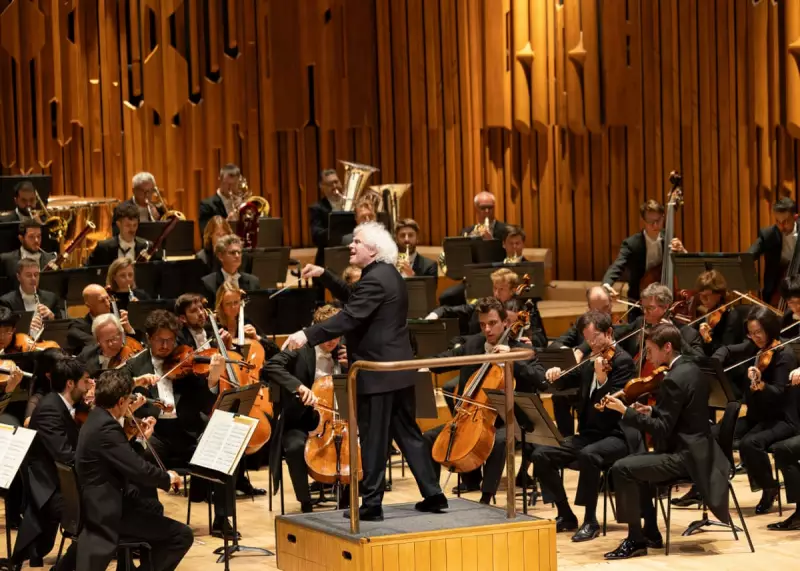
A Night of Musical Mastery at Barbican Hall
Sir Simon Rattle and the Bavarian Radio Symphony Orchestra commenced their European tour in Liverpool and Birmingham earlier this week, but saved a particularly special programme for their London appearance at Barbican Hall. While their previous performances featured works by Schumann and Stravinsky, the capital was treated to an entirely different musical experience, pairing Leoš Janáček's dramatic Taras Bulba with Anton Bruckner's monumental Seventh Symphony.
Janáček's Spine-Tingling Rhapsody
The concert opened with Janáček's Taras Bulba, a composition that has long been a speciality in Rattle's repertoire. The Bavarian Radio Symphony Orchestra demonstrated their exceptional quality from the very first notes, with particularly ardent solos from cor anglais, oboe and violin floating elegantly above the ensemble's rich, shimmering string section. The performance quickly transformed into a violent call to Slavic heroics, showcasing Janáček at his most angular and spine-tingling.
The orchestra's handling of this quicksilver and fervent score was predictably first-class, though some might argue their technical perfection occasionally missed the ineffable fragility that animates so much of Janáček's music. Nevertheless, no such reservations applied to the thrilling final movement, where Janáček's score truly caught fire, delivering an unforgettable musical experience.

Rattle's Evolving Relationship with Bruckner
The second half presented a fascinating insight into Simon Rattle's evolving interpretation of Bruckner's symphonies, developed over his many years working in Germany and central Europe. Where the conductor once seemed to keep his distance from Bruckner, he has gradually embraced the composer's works with growing confidence and understanding.
His earlier tendency to reshape Bruckner's symphonies in sometimes unconvincing ways has significantly eased, though traces of that instinct remain evident in questionably dramatic pianissimos. The overall result in this performance of the seventh symphony was both illuminating and vernacular, supported by the Bavarian musicians' consistently fine playing throughout the demanding work.
Symphonic Excellence Across Four Movements
The orchestra navigated the vast span of Bruckner's opening movement with persuasive power, carrying all before it while carefully avoiding any trace of needless religiosity as the music climbed towards its home key resolution. The adagio proved equally impressive, conceived with both coherence and boldness, while transitions were handled with delicate precision.
Orchestral balance and colours remained rich and varied, particularly notable during the sombre Wagner homage following the cymbal climax. The scherzo danced rather than battered, exactly as intended, and the finale succeeded brilliantly - something that doesn't always occur in performances of this challenging symphony.
This compelling Barbican Hall concert provided convincing evidence that Rattle's interpretation of Bruckner has acquired greater depth while retaining the indispensable element of flexibility, marking another significant milestone in the conductor's ongoing musical journey with this composer.