Ored Recordings: Preserving Caucasus Culture Through Punk Ethnography
In the turbulent landscape of cultural preservation, a unique record label has emerged as a defiant voice against historical erasure. Ored Recordings, founded by musicians Bulat Khalilov and Timur Kodzoko, employs what they term "punk ethnography" to document the endangered musical traditions of the Caucasus region. Their work has gained unexpected recognition, even from law enforcement during political demonstrations, highlighting the profound impact of their mission.
The Circassian Context: A Culture Under Threat
The Circassian people have endured centuries of cultural suppression following Russia's invasion in the mid-18th century. Historical Circassia once spanned from the Black Sea to the Greater Caucasus Mountains, but today exists as fragmented territories within the Russian Federation, with diaspora communities scattered across Turkey, the Middle East, and Europe. The systematic displacement of approximately 95% of the Circassian population created what Khalilov describes as "internalised self-doubt" among younger generations, shaped by Soviet attitudes that framed local culture as backward.
Unlike Russian culture's Orthodox Christian roots, Circassian traditions are predominantly influenced by Sunni Islam, with distinct dance traditions, wedding customs, and ethical codes that fundamentally shape their musical expressions. This cultural divergence forms the foundation of Ored Recordings' preservation efforts.

The Punk Ethnography Approach
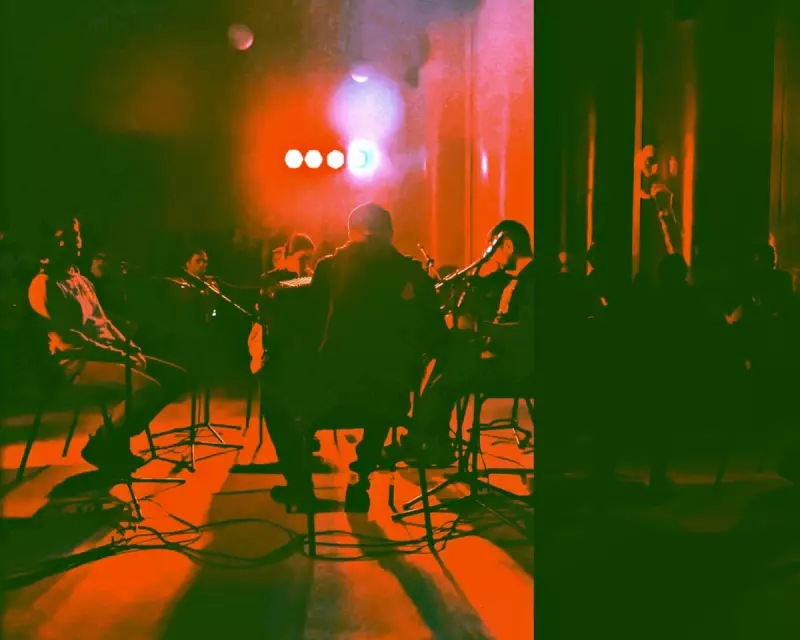
Ored Recordings' methodology represents a radical departure from conventional ethnomusicology. Rather than formal studio recordings, the label documents religious chants, laments, and displacement songs in authentic settings: family gatherings, local festivals, and even people's kitchens. This approach captures the music's true social function and emotional resonance, prioritising authenticity over production values.
Circassian and North Caucasian music is characterised by several distinctive features:
- Primary focus on voice, memory, and social function rather than performance spectacle
- Solo or small-group singing encompassing laments, mourning songs, historical narratives, and ritual chants
- Reliance on modal melodies, sustained tones, and subtle ornamentation rather than western harmonic development
- Emotional expression through breath, timbre, and phrasing rather than volume
- Supporting instruments like the pkhachich (percussion clappers) and shichepshin (bowed lute/flute) that complement rather than lead the voice
The label's work gained international recognition through French film-maker Vincent Moon's 2011 documentary Circassia: Sonic Exploration of an Ancient Land, which captured the region's musical diversity during travels with Khalilov and Kodzoko.
Annual Rituals and Diaspora Connections
Since their 2014 debut release documenting a festival dedicated to folk musician Aslanbech Chich, Ored Recordings has maintained a poignant annual tradition. Each year on or around 21 May – the Circassian Day of Mourning marking the end of the Russo-Circassian war in 1864 – the label releases new material. These releases deliberately foreground diaspora voices as integral to Circassian history, creating what Khalilov describes as "a living ritual where music becomes a tool for mourning loss and asserting continuity."
"As children, we often felt skeptical about our culture," Khalilov reflects. "Traditional music seemed old-fashioned, yet we strongly felt we weren't Russian, even without clearly understanding what being Circassian meant. Our goal isn't revenge or replacing one domination with another, but imagining a future where different communities can coexist safely and freely."
Political Pressures and Geographic Shifts
The full-scale Russian invasion of Ukraine in February 2022 created dangerous parallels between historical conquests in the Caucasus and contemporary warfare. Within Russia's ethnic republics, anti-war and anti-imperial voices face rapid suppression, while state institutions promote narratives of loyalty and unity regarding the Ukraine conflict.

Feeling increasingly restricted by their region's isolation from the international community, Khalilov and Kodzoko made the difficult decision to leave their homeland. They relocated first to Georgia, spending nearly two years awaiting German visas, before settling in the university town of Göttingen in Lower Saxony.
New Directions and Continued Mission
The move to Germany has transformed Ored Recordings' relationship with the Circassian diaspora while opening new creative possibilities. Proximity to European artists and labels has inspired experimental collaborations, including an electronic project with Martina Bertoni and TAL founder Stefan Schneider, formerly of electronica trio To Rococo Rot.
Despite geographical distance, the label continues its core regional work. Current projects include:
- A new album from Karachay band Gollu
- Collaborations between Kodzoko's group Jrpjej and Berlin-based vocalist Svetlana Mamresheva
- Archival projects with musicians of the Nogai ethnic minority scattered across the North Caucasus, Volga region, and Central Asia
This month marks a significant milestone with Düsseldorf-based label TAL releasing Music from the Caucasus – The Archive of Ored Recordings 2013–2023, a comprehensive compilation featuring stories of struggle, independence, and historical memory.
The Enduring Significance of Cultural Preservation
"Over time, we've realised that trauma or victim narratives don't give value to the music – it's the stories behind it," Khalilov emphasises. "These songs aren't abstract sadness; they're tied to genocide, displacement, language loss, and everyday colonial conditions that persist. Historical problems continue shaping the present. If we want anything to change, we must speak about it."
Ored Recordings stands as testament to the power of cultural preservation as political resistance. Through their punk ethnography approach, Khalilov and Kodzoko have created more than just a record label – they've established a living archive that challenges historical erasure while imagining new possibilities for cultural continuity in an increasingly fragmented world.