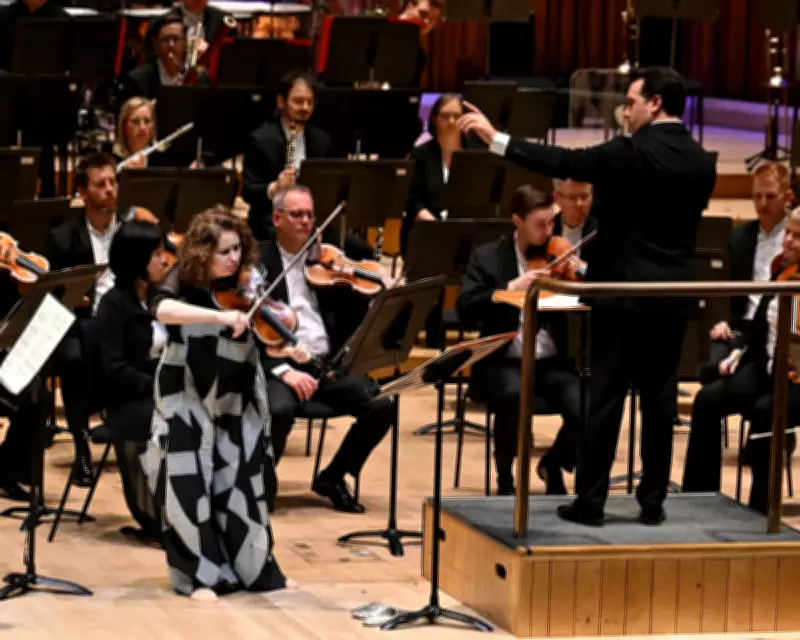
The London Symphony Orchestra, under the assured baton of Robert Treviño, delivered a captivating performance at Barbican Hall in London, featuring soloist Patricia Kopatchinskaja. This concert marked a significant return for Treviño to the LSO podium, nearly a decade after his acclaimed debut with the orchestra in 2017.
A Decade in the Making: Treviño's Commanding Return
Back in 2017, Robert Treviño, then a relatively unknown American conductor, made a sensational debut with the London Symphony Orchestra by stepping in at short notice to lead Mahler's Third Symphony. This performance established him as a rising star in the classical music world. Since then, his career has flourished across Europe, including a notable success in Zurich. Recently announced as the new principal conductor of Bucharest's George Enescu Philharmonic, Treviño's reunion with the LSO proved to be well worth the wait.
On the podium, Treviño is not a flamboyant figure; his conducting style is characterised by tidy beats and deceptively contained gestures. However, there is a coiled-spring muscularity and undeniable authority in his delivery that resonated throughout the evening's repertoire. This quality was evident across a bizarrely programmed sequence of works, showcasing his versatility and deep musical insight.

Mystical and Modern: A Diverse Programme
The concert opened with Messiaen's 1932 Hymne, a piece lost during the second world war and later reconstructed from memory by the composer. The accuracy of this reconstruction remains unknown, adding an element of mystery to the performance. Described as a Eucharist-ritual in sound, the work is a mystical and immanent affair. Treviño skillfully guided the orchestra, ensuring that the structural cathedral pillars of the composition remained clear even as clouds of incense seemed to billow from the LSO strings, with woodwind evoking the distant sound of an organ.
Following this, the programme featured Márton Illés's 2019 composition Vont-tér, performed by maverick soloist Patricia Kopatchinskaja. This piece, part of her Artist Portrait series at the Barbican, challenges traditional concerto forms by stripping away virtuosity and lyricism. In a single continuous movement, it turns musical expectations inside-out. Kopatchinskaja delivered a fiercely precise and playful interpretation, leading a chamber-sized LSO through a haunted textural dance filled with shudders, creaks, and cracks. Her performance was a bold statement, though it raised questions about its dialogue with the other works on the programme.
Cinematic Rachmaninoff: A Crowd-Pleasing Finale
The second half of the concert was devoted to Rachmaninoff's Symphony No. 2, a crowd-pulling masterpiece. Treviño approached this monumental work with a focus on pace and vertical translucency, tempering its grandeur to create a cinematic experience. The melodies were always on the move, glancing forwards or harking back within an integrated web of sound. This interpretation prevented the symphony from becoming top-heavy, instead setting off with the eruptive finale in sight from the beginning. The performance galloped to a thrilling close, with the brass section evoking visions of Valhalla.
Overall, the evening was a testament to Treviño's growing stature as a conductor and the LSO's enduring excellence. The collaboration with Patricia Kopatchinskaja added a layer of innovation and playfulness, making this a memorable event in London's classical music scene.