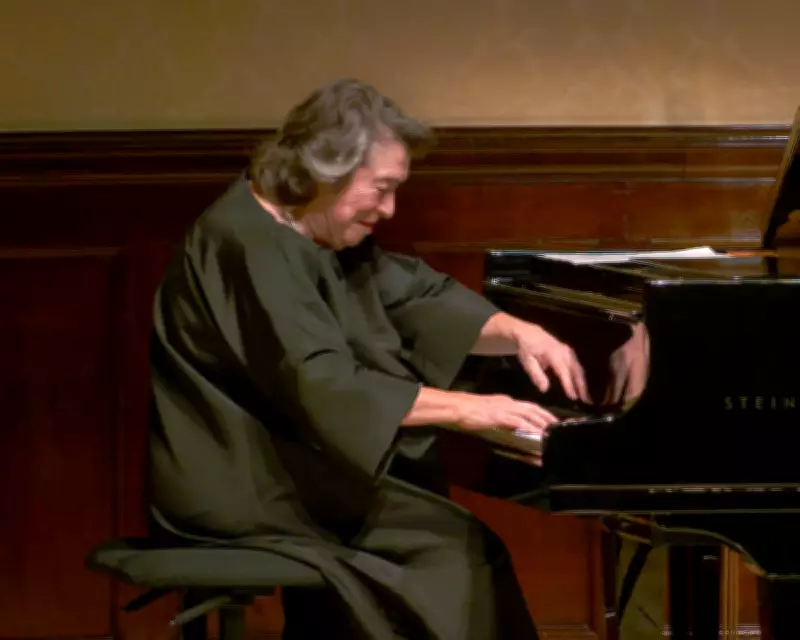
Elisabeth Leonskaja's Architectural Piano Mastery Illuminates Wigmore Hall
In a captivating recital at London's renowned Wigmore Hall, the eighty-year-old piano legend Elisabeth Leonskaja delivered a performance that transcended mere technical skill, revealing deep connections and kinships across a diverse programme. The Austrian pianist's expressive and emotional playing, combined with her unerring sense of underlying musical architecture, offered new insights into works by Beethoven, Schoenberg, Chopin, Webern, and Schubert.
A Bold Opening and Thoughtful Programming
Leonskaja began with a dramatic gesture, throwing herself onto the piano stool and launching into Beethoven's Op 77 Fantasia in G minor with its two tumultuous descending chromatic scales. This set the tone for a recital that, while appearing like a Mittel-European lucky dip, was anything but random. The programme was carefully curated to highlight shared foundations and secret connecting passages between the composers, showcasing Leonskaja's lifelong dedication to musical structure.
Her approach to Beethoven's Fantasia was particularly revealing. By focusing on the truncated utterances, half-thoughts, and thematic dead ends that open the piece, she suggested these were its true heart, rather than the later variations. When the chromatic scales returned, it felt like a powerful punchline, emphasizing the music's wild and unbroken spirit.

Bridging Styles with Lyricism and Force
The recital seamlessly transitioned into the inscrutable aphorisms of Webern's Op 27 Variations and the fragments of Schoenberg's 6 Little Piano Pieces. Leonskaja darted through these works with precision, highlighting their lyrical and yearning qualities. In a surprising twist, she blurred the lines between Schoenberg and Chopin, with No 2 of the former sounding almost like a second Viennese "Raindrop" Prelude, contrasting with the spiky flurries of Chopin's Scherzo No 1 in B minor.
While passagework was not always perfectly clean, there was no doubt about her intent. From the musical storm of Chopin's beginning to the thunderous force closing the Polonaise-fantaisie in A flat, Leonskaja's playing was both powerful and nuanced.
A Substantial Conclusion with Schubert
The programme concluded with Schubert's substantial Piano Sonata in A minor D845, composed in 1825 on the brink of his stardom. Leonskaja cherished each variation in the slow movement, with her left hand anchoring their lightness and reminding listeners of their kinship with the scherzo and closing rondo. This sonata provided a sense of completeness, like a full fresco in a programme otherwise filled with mosaic fragments.
Throughout the evening, Leonskaja's performance demonstrated how emotional expressiveness and architectural precision can coexist, offering a masterclass in piano artistry that resonated deeply with the audience at Wigmore Hall.