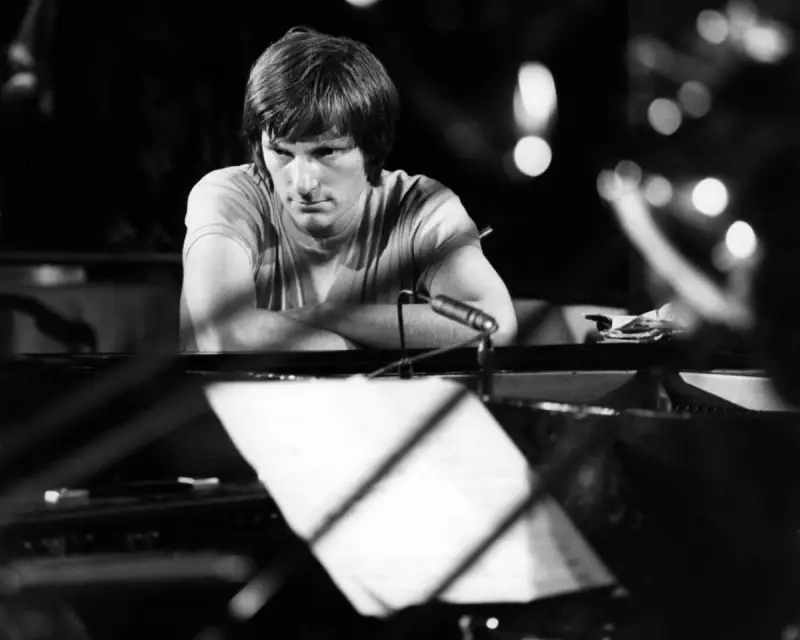
From his seaside Devon cottage, surrounded by books and a signed picture of Duke Ellington, 89-year-old Mike Westbrook reflects on a life dedicated to shattering musical conventions. The calm of his sitting room belies the revolutionary spirit that has defined his six-decade career, a journey now marked by an extraordinary technological rescue mission.
The AI-Powered Resurrection of a Lost Epic
Recent health challenges have limited Westbrook's ability to play, leading him to spend the past two years archiving his life's work. During this process, attention turned to The Cortège, a monumental two-and-a-half-hour jazz suite that has been unavailable for years. The original 1982 studio recording remains trapped in legal limbo, prompting Westbrook to take matters into his own hands.
He turned to a primitive 1980 BBC Radio 3 recording, captured live in a single take. "The balance was poor, and the tape quality wasn't very good, so it was a question of: could this be rescued?" Westbrook explains. Using artificial intelligence software, engineers isolated and enhanced individual voices and instruments from the muddy mix. The result has delighted the composer: "It's one of the best things we've done."
A Genre-Bending Journey Across Europe
The Cortège represents the culmination of Westbrook's artistic vision, which saw him climb to the forefront of British jazz during the 1960s and 70s. The work emerged from extensive European touring with his wife Kate and vocalist Phil Minton during the late 1970s, when "we wanted to be full time artists, and we were both broke."
They developed what Westbrook calls jazz-cabaret, blending comic songs, serious music, and poetry. "When we were in France, Italy and Germany, they really went for these ideas – there's more of a tradition of mixing musical genres," he recalls. Their journey even included playing as a circus band in France, leading to numerous collaborations.
The suite finally came together at a 1978 street festival in Santarcangelo, Italy, mixing all his influences from rock bands, cabaret, street performance, circus, and theatre. One track from the suite, named after the festival, features William Blake's Jerusalem, reflecting Blake's major influence on Westbrook's work.
Breaking Barriers from National Theatre to BBC Proms
Westbrook's boundary-pushing approach extended to theatre, where in 1971 he created music for Adrian Mitchell's Blake-themed play Tyger at the National Theatre. "Laurence Olivier, who I admire enormously, was creative director then," Westbrook remembers. "He was kept away from the underlings like me, but when he went around, it was like the pope visiting with his bodyguards."
Britain's arts scene during the 1970s and 80s provided fertile ground for innovation. "The BBC had a jazz officer who had freedom to listen to bands and invite them back to the studio," Westbrook notes. The Arts Council's generous subsidies encouraged promoters to take risks on bold new music, leading to "very good audiences" for The Cortège and even a BBC documentary about the work.
The music itself remains challenging and complex. Opening track It Starts Here bursts with energy propelled by a loping 11/4 rhythm, while Santarcangelo uses an 11/8 time signature that Westbrook admits is "another difficult one to play." He didn't begin with a clear plan, drawing instead from diverse influences including television music for Steven Poliakoff's film Caught on a Train.
In 1992, Westbrook led the first jazz orchestra to play at the BBC Proms, performing big band versions of Rossini to initially hostile reception. "At first, the prommers stood with their backs to the stage," he recalls. "Gradually they came round and by the end when we played a rock version of the William Tell overture, they were all jigging about. But we got some hate mail afterwards."
New Frontiers at 89: Church Bells and Beyond
Even at 89, Westbrook continues exploring new musical territories. He's currently learning church bells for a collaboration with composer Marcus Vergette at an abandoned church in Highampton, Devon. His wife Kate remains his central creative partner, writing lyrics for the piece.
"This has led me into a whole new, rather strange territory that I can't even begin to describe," Westbrook says. "It's a whole different musical language. You've got three bells, A, C and D, and I've been trying to find what you can do with it all."
As he continues sorting through a lifetime of scores and recordings, Westbrook recognizes his extraordinary fortune. "I was allowed to experiment, make mistakes and spend a lot of time on the road, and to figure out what it's all about," he reflects. "Music is a serious business." The newly resurrected Cortège Live at the BBC 1980 releases on 14 November by Cadillac Records, ensuring this groundbreaking work finally reaches new audiences.