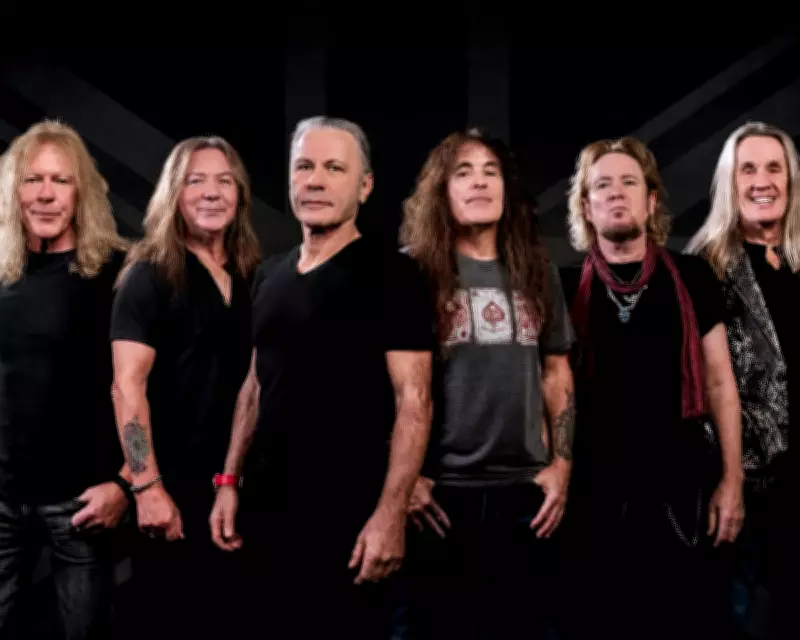
Iron Maiden bassist and founder Steve Harris sounds bewildered when asked about the band's half-century longevity. 'It's gone so quick. You go on tour for a few months and it seems to fly, but so much happens. Our whole career is an extension of that – for 50 years.'
He reflects on steering one of the most influential and idiosyncratic British bands in history. Catapulted to the premier league of 80s metal with multi-platinum LPs like The Number of the Beast, Powerslave, and Seventh Son of a Seventh Son, Iron Maiden not only survived the mid-90s slump but grew heavier and more ambitious.
Last year, they celebrated their 50th anniversary with the Run for Your Lives tour, continuing until November and including their biggest UK headline shows at their own two-day EddFest at Knebworth in July. Next month sees the cinema release of Burning Ambition, a documentary featuring rare archival footage and talking heads including Tom Morello, Chuck D, Lars Ulrich, and Javier Bardem.

'Diehard Maiden fans will be saying: why isn't it 10 hours long?' laughs singer Bruce Dickinson. 'But hopefully it's an entertaining romp.'
Formation and Early Days
Formed in London in 1975 by Harris, Iron Maiden went through multiple lineup changes before settling on Paul Di'Anno as vocalist in 1978 and clawing to the forefront of the new wave of British heavy metal (NWOBHM) through constant gigging. The NWOBHM played out in backstreet pubs to crowds in customised denim and leather, during punk's heyday. Critics sometimes compared punk and Maiden, but Harris says in the documentary, 'I would've rather swept the roads than play that shit.'
Dickinson was entrenched in the NWOBHM with his band Samson. 'The NWOBHM! It was like: OK, if you can spell it you might as well say it,' he says. 'But at ground zero, we were all: what are you talking about? This has been around for years.' He cites the Marquee Club and Music Machine as pinnacle venues. 'The one thing metal did adopt [from punk] was the idea of 'Let's just do it ourselves'. People released their own singles, got deals with indie labels. Then punk morphed into new wave and new romantic, but we didn't morph into anything – we just cracked on.'
Rise to Fame and Challenges
Maiden's self-titled debut hit No 4 in the UK charts in 1980. By the time of Killers, Di'Anno was burnt out from booze and drugs and left in 1981. Dickinson joined after a 'clandestine chat' with manager Rod Smallwood at Reading festival. Dickinson brought an octave-shattering voice and discipline. 'It was like being a striker for the Conference and they say: go and play front and centre for Man City,' he says. 'But I was grossly overconfident because I was 21 years old.'
Dickinson's visceral narratives became a hallmark, with literary references from Coleridge to Huxley. The Number of the Beast (1982) contained classics like the title track, Run to the Hills, and Hallowed Be Thy Name. 'When you go in with a batch of songs, you don't necessarily think you've made a classic album,' Harris says. Dickinson recalls staying in the studio drinking Watneys Party Sevens, 'pinching ourselves going: fucking hell, isn't this great?'
Throughout the early 80s, the band wrote and recorded an album every year. For Piece of Mind (1983), Smallwood booked arenas in the US, including Madison Square Garden. It paid off. 'When you're in your 20s it's amazing how much punishment your body can take,' says guitarist Adrian Smith. 'But a band like Maiden had to do that kind of schedule, because we'd never have a massive hit single.'
The World Slavery Tour for Powerslave (1984) was gruelling. Dickinson had a wobble: 'I had no life. It started to feel like a golden cage. I was thinking of packing it in to become a fencing teacher.' He worried about losing connection to 'the reason why I got into music in the first place: because it was a form of dramatic storytelling.'

Decline and Reunion
By 1990, heavy music was changing. After Seventh Son of a Seventh Son, No Prayer for the Dying aimed for a return to roots, but Smith left. 'I was in a kind of turmoil,' he says. 'I just couldn't seem to come up with anything.' Dickinson also left in 1993, feeling the band was off the zeitgeist. 'It was a period of reflection and self doubt,' he says. Harris notes poor communication: 'It was almost: 'All right, I'm leaving.' 'Oh, OK – well that's it then.' We didn't really talk about it.'
The 90s were difficult. Maiden soldiered on with Blaze Bayley on vocals, but struggled in the US. 'It was difficult in America,' says Harris. 'Metal was struggling everywhere.' Dickinson and Smith rejoined in 1999, recording Brave New World. A secretive meeting between Harris and Dickinson was set up by management. 'I just found the whole thing ludicrous,' Dickinson laughs. 'The degree of paranoia lest me and Steve be seen together in public – it was like a bloody Len Deighton novel.'
Later Years and Legacy
The reunion led to a tight Iron Maiden headlining Rock in Rio 2001 in front of 250,000 people. Albums have come at a less frenetic pace but with high quality, incorporating progressive elements. Post-millennial albums like The Book of Souls and Senjutsu proved their vitality. Harris is sorrowful about the current tour ending. 'It looks like we're taking next year off,' he says. 'Personally, I didn't want to, but that's me.'
As for new music, Harris won't be drawn on details. Dickinson remains confident: 'Any song on the planet, if you give it to Iron Maiden it'll always sound like Iron Maiden. That's incredible. You give the Rolling Stones something and 'oh my God, it's the Rolling Stones!' – well, Maiden is like that, too. Don't ask me how, don't ask me why, don't ask me where the magic comes from – at that point my analysis skills go in the dustbin. It just is.'
Iron Maiden: Burning Ambition is in cinemas from 7 May. Eddfest is at Knebworth, Hertfordshire, 10 and 11 July.