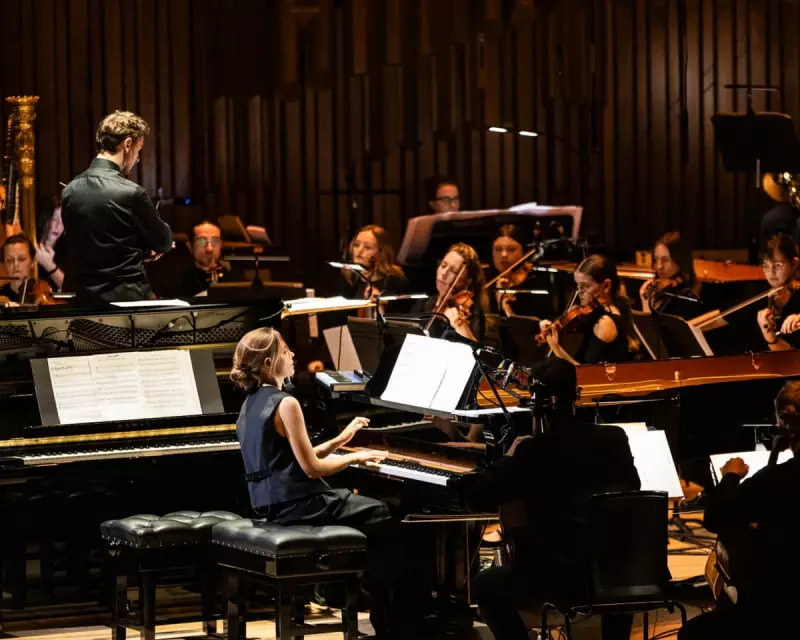
In a significant event for London's classical music scene, Polish pianist and composer Hania Rani presented the world premieres of two major new works at the Barbican Hall. The concert, performed by the innovative Manchester Collective, showcased Rani's unique ability to craft atmospheric and absorbing soundscapes that defy simple genre classification.
An Ethereal First Half: Shining
The first half of the evening was dedicated to Shining, a piece composed for a 12-piece ensemble. The work draws its inspiration from a stream-of-consciousness short story by Jon Fosse, which details the experience of a man lost in woods at night.
From its opening, the piece established a haunting mood. Sinister discords from the bass clarinet, bassoon, and horn created an immediate sense of unease. The use of a pall of smoke and half-lit performers enhanced the ghost-story atmosphere, making the audience feel as if they were gathered around a midnight campfire.

Musically, Shining is a masterclass in minimalist storytelling. Its motifs continuously shifted and evolved, with motoric rhythms emerging that pulled the listener into a powerful undertow. At one memorable point, the string players' bows bounced off their instruments, producing a sound eerily reminiscent of twigs tapping on a windowpane. The piece succeeded in its goal of drawing the audience in, making them hyper-aware of every subtle rhythmic and harmonic change.
A Personal Concerto: The Story of Non Fiction
After the interval, the focus shifted to the premiere of Non Fiction, a piano concerto five years in the making. This deeply personal work was inspired by the sketchbooks of Josima Feldschuh, a profoundly talented young pianist who was forced into the Warsaw ghetto in 1940.
Rani, acting as the soloist, eloquently described in the program notes how the piece channels themes of human resilience in the face of oppression, drawing clear parallels to contemporary global issues.
On paper, the concerto was a monumental undertaking. Rani juggled parts for both an upright and a grand piano, set against a vast and multihued 47-piece orchestra. The instrumentation was notably rich, featuring a mournful soprano saxophone, a busy harp, bass and alto flutes, celesta, and even pre-recorded electronic tape.
At its most powerful, the music was hauntingly beautiful. Its unrooted harmonies created a soundscape through which sepia-tinted musical snapshots seemed to emerge, as if viewed through the distorting mists of time. The work was frequently ethereal and occasionally sombre, incorporating aleatoric, or chance-based, passages that added to its textured narrative.
A Triumph of Imagination, Hindered by Balance
Despite the clear imagination and emotional weight behind Non Fiction, the performance faced a significant practical challenge. Issues of balance between the solo piano and the substantial orchestra proved difficult to overcome.
Unfortunately, the piano was often drowned out by the lavish orchestration, which scuppered the traditional concerto dynamic where the soloist and ensemble engage in a musical dialogue. This was a particular shame, as the music itself was rather beautiful and had a great deal to say, both historically and in a modern context.
The concert, which attracted a notably younger and stylish audience than is typical for classical events, was repeated on 26 November. It solidified Hania Rani's position as a composer with a distinct and compelling voice, capable of creating work that is both intellectually rigorous and deeply moving, even when facing technical hurdles.