Earth and Other Planets Review: A Quirky Fusion of Folk and Classical Traditions
In a bold and innovative performance at Milton Court, London, the left-field folk duo Stevens & Pound joined forces with the esteemed Britten Sinfonia and writer Robert Macfarlane to present The Silent Planet. This ambitious project serves as a reimagining of Gustav Holst's iconic orchestral suite, The Planets, blending classical precision with folk energy in a unique artistic endeavour.
A Night of Musical Cross-Pollination
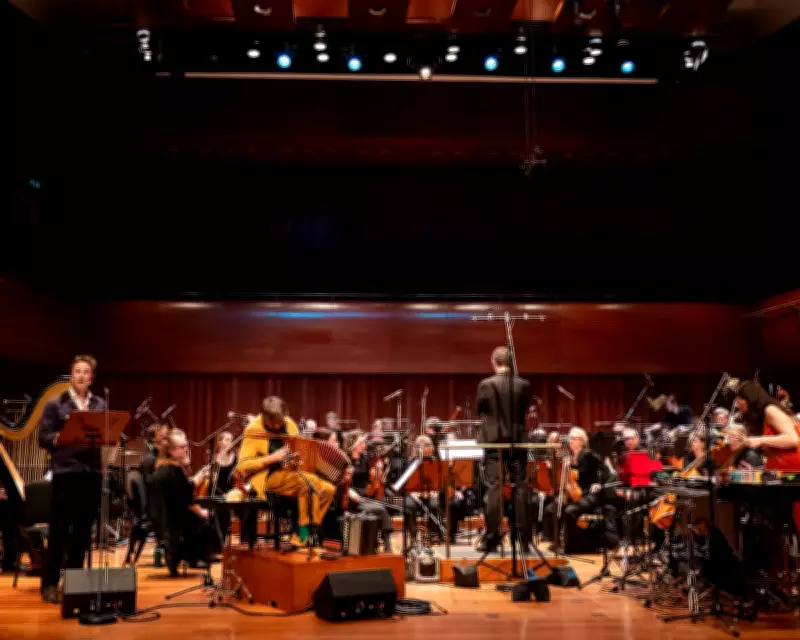
The evening opened with a question posed by Robert Macfarlane, who wondered aloud whether the event should be classified as a concert or a gig. This query set the tone for a performance that defied easy categorisation, seamlessly merging disparate musical worlds. By the conclusion, melodeon and harmonica virtuoso Will Pound had his own answer, jokingly describing the encore—a lively arrangement of the Sailor's Hornpipe—as "a rave", eliciting polite laughter from the attentive audience.
Throughout the night, percussionist Delia Stevens ensured that the energy remained high, dancing between an eclectic array of instruments arranged around her like treasures at a jumble sale. Her setup included mixing bowls, a toy piano, a guitar positioned next to a vibraphone, and an assortment of drums and shakers, many of which she played simultaneously with remarkable dexterity.

The Silent Planet: A Reimagined Masterpiece
The Silent Planet represents the core of Stevens & Pound's creative vision, combining Macfarlane's poetic narrations with atmospheric improvisations from Britten Sinfonia soloists, alongside the duo's own contributions. Under the baton of conductor Clark Rundell, each movement of Holst's suite was reinterpreted with folk influences, resulting in some truly captivating moments.
- For Mars, terrifying blasts of conch shell evoked warmongering intensity.
- Mercury featured bright, flaring horn passages that danced with agility.
- Venus transformed into a whirlwind hoedown, infusing the movement with rustic charm.
However, the performance was not without its challenges. At times, the piece sprawled noisily, with movements sliding into one another amid rapid transitions from drones to jigs and reels. Ian Gardiner's orchestration, while inventive, occasionally lacked the refined finesse of Holst's original compositions. The newly composed Earth movement, threaded with the melody of All Things Bright and Beautiful, offered a brief respite with more breathing space before launching into another syncopated romp.
Celebrating Folk and Classical Heritage
The first half of the programme paid homage to earlier intersections of folk and classical music. Benjamin Britten's understated English Folksong Suite and Percy Grainger's irresistibly clever Lincolnshire Posy bookended a medley by Stevens & Pound. In this segment, the duo transformed traditional folk tunes into funky explorations of tango and bluegrass, showcasing their versatility and creative flair.
While the overall structure may have felt fragmentary at times, the ambition behind the performance was unmistakable. This is characteristic of the Britten Sinfonia, one of the UK's most tenacious classical ensembles, known for pushing artistic boundaries. The event proved to be not only ambitious but also immensely enjoyable, offering audiences a fresh perspective on familiar works.
The production is set to tour, with upcoming performances at the Norfolk Events Centre in Norwich on 29 January and West Road Concert Hall in Cambridge on 30 January, providing further opportunities for audiences to experience this innovative fusion of musical traditions.