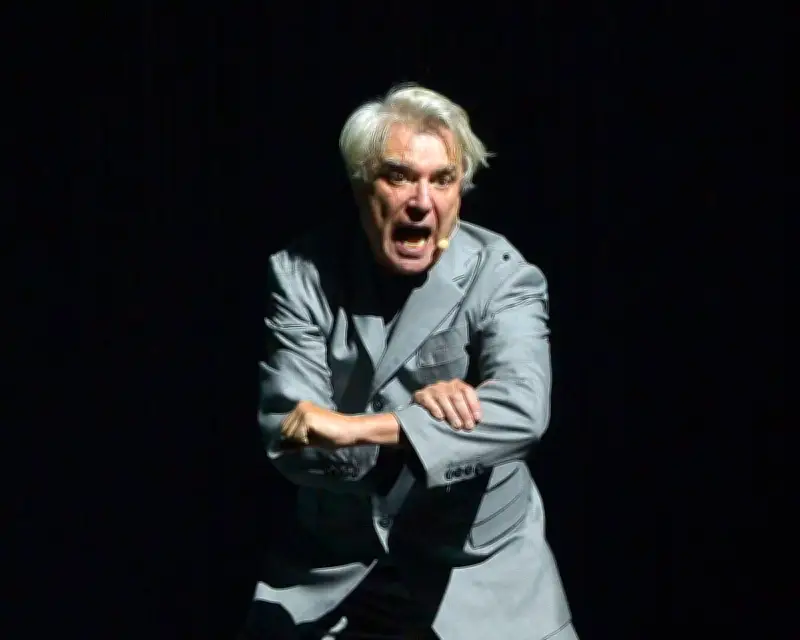
In a wide-ranging interview ahead of the release of his concert film 'American Utopia', directed by Spike Lee, David Byrne answered questions from readers about his career, from the early days of Talking Heads to his innovative live performances.
Touring with Ramones During Punk's Explosion
Asked about the 1977 UK tour with Ramones, Byrne recalled the audience's curiosity and openness. 'There was something really great about that tour because other than maybe a few singles the audience had never seen us, so there was a lot of curiosity and openness to us and Ramones, as different as we were.' He noted that later, fans became more decided in their preferences. At a show at the Roundhouse, audience members spat on the bands. 'Ramones got more of that than we did, but at least they had leather jackets. We didn't.'
Unchaining the Band: Evolution of Live Shows
Byrne discussed his quest to liberate musicians from the physical restrictions of traditional rock concerts. 'From various tours I'd realised that my guitar could be wireless,' he said. After a tour with St Vincent, he considered mobile brass players. He asked percussionist Mauro Refosco how many players were needed to break down the drum kit into components; the answer was six. 'I took a big gulp and said: "I think we can afford it."' A Hungarian company's self-powered Midi keyboard rack further freed the band. 'Suddenly, the whole band were liberated to move about, which democratised the concert experience.' He emphasized the heartening effect of six people working in sync: 'humans are not as dysfunctional as we think, we can work together to produce something joyful.'

Happiness and Hope as Resistance
Byrne clarified a quote from his show: 'I read a quote from the actor and director John Cameron Mitchell. He said: "Love and kindness are the most punk things you can do right now." It's the reverse of punk being associated with angry guitars and shouting vocals.' He added that seemingly sentimental acts now constitute a form of resistance.
Why No Second Film After 'True Stories'?
Byrne explained that 'True Stories' was artistically satisfying, but the film industry's demands diverted him. 'Part of the problem is of my own making. I'd paid for the script-writing, the research, looking at locations... but after that people in LA said: "Now you've done a film you can get somebody else to pay for that." Which I did, more than once, but if somebody's putting up some money, they want a say in what you do.' He ended up thinking he could be writing a record and doing a show instead. However, he hopes to make another film using digital cameras and computer editing, which offer more control.
Scottish Roots and Outsider Perspective
Byrne reflected on being born in Scotland and moving to Canada then the US. 'It didn't make me completely alienated, but I felt like Americans didn't know that other people do things a little bit differently. They didn't know that there are different kinds of humour and so on. Scottish humour is very specific. I find it very funny and it can be very dark.' He believes this background gives a different perspective, not necessarily smarter, but different.
Living in a Shotgun Shack
Regarding the phrase 'shotgun shack' from 'Once in a Lifetime', Byrne said he likely heard it from a radio preacher. He once stayed in one with his daughter at an Airbnb in New Orleans.
Working with Brian Eno
Byrne described Eno's role as a cheerleader who understood the band's goals. 'At first, his goal was to capture what the band was doing. Once that was achieved, he brought ideas such as adding funny sounds, not having the songs all written – so we could improvise – and as he calls it, "using the studio as an instrument."' Eno's Oblique Strategies cards were present, though Byrne isn't sure they were ever used, but they contain clever ideas to break out of ruts.
Producing Fun Boy Three
Byrne produced Fun Boy Three's album 'Waiting' and the single 'Our Lips Are Sealed'. He suspected Terry Hall liked his work and thought Byrne would understand his songwriting. Byrne acted as a cheerleader, stepping back when needed. For 'Our Lips Are Sealed', originally written with Jane Wiedlin for the Go-Go's, Byrne meddled with loops and repeats to differentiate their version.

Life During Wartime and Touring
When asked if 'Life During Wartime' could be interpreted as life on tour, Byrne said, 'I can't say you're wrong, but it hadn't occurred to me.' He noted the song feels more relevant than ever, especially in the US with ICE raids.
Lou Reed's Advice
Byrne recalled Lou Reed inviting the band to his apartment after seeing them at CBGB. Reed ate two quarts of ice cream and played their song 'Tentative Decisions' on guitar, suggesting it be slowed down to the speed of a Velvet Underground song. 'Which was pretty cool, but we didn't slow it down as far as he suggested.' Reed also advised Byrne: 'You should never wear a short-sleeved shirt on stage,' referring to Byrne's hairy arms.
The 4K release of 'American Utopia', directed by Spike Lee, is in cinemas from 5 August.