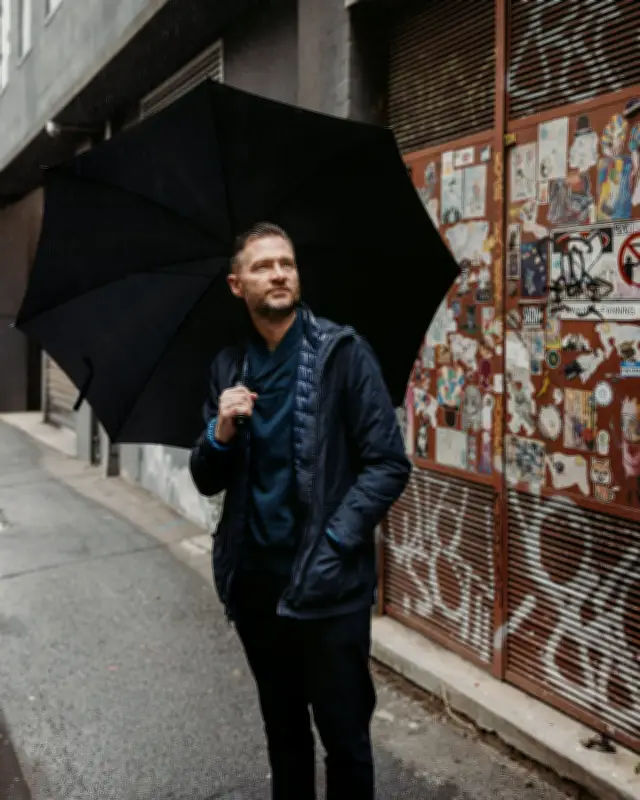
Charlie Pickering has been a constant on Australian screens for much of this century: ‘I could just keep working and working … I love every minute of what I do.’ Photograph: Charlie Kinross/The Guardian
Charlie Pickering: ‘We used to be able to just disagree. Social media has a lot to answer for’
The comedian and broadcaster on his new radio gig, being diagnosed with ADHD and the problems with online discourse.
Sandwiched between the Arts Centre and Hamer Hall, in Melbourne’s arts precinct, is a sculpture of wave-like steel structures called Forward Surge. On the day we walk past, it is hidden behind construction fencing, but Charlie Pickering has fond memories of the place. “As a teenager, I would almost every weekend get kicked out of here,” he says. He and his friends would catch the train into town, skateboarding the rails and stairs along St Kilda Road’s corporate buildings, before they got to the steep slopes of Forward Surge, where they’d use the sculpture as a quarter pipe. “I was a public menace, obviously,” he says.

The skateboarding-obsessed teen has given way to a genial man nearing 50, with salt and pepper stubble and close-cropped hair. An easy interlocutor, brimming with anecdotes as we stroll up St Kilda Road, Pickering has been a perennial on Australian screens – current affairs and comedy programs in particular – for much of this century to date. “I always had that performative attention-seeking element,” he laughs. “I was trying to put on shows when I was about four. I used to sing into the electric cable on the back of a trailer.”
Across the road from Hamer Hall, we descend into Alexandra Gardens, and Pickering points across the river at 101 Collins, an imposing commercial tower in the city. The building used to house the law firms then known as Blake Dawson Waldron and Freehills, which both offered Pickering a job after he graduated with an arts law degree from Monash University. He spent a single week at Blakes before leaving to pursue standup comedy. He had been “100% certain” since he was 12 that this was what he wanted to do with his life. His parents, both pharmacists, had worked hard to provide him with an exclusive education at Melbourne’s Brighton Grammar, but accepted his decision to quit: “They let me move back in with them. They were so supportive and helpful, but there was obviously disappointment … I think they would have just been, more than anything, concerned.”
They needn’t have worried: an expansive career in entertainment has followed. Pickering became one of the original hosts of The Project, spent a stint as Gen X team captain on Talkin’ ’Bout Your Generation, and since 2015 has hosted the news satire program The Weekly on the ABC.
Despite his career successes, Pickering had long struggled with a feeling that he hadn’t achieved enough. He is quietly reflective when discussing this, self-conscious it “might sound silly”. Things changed with an ADHD diagnosis three years ago, which was “like looking back on my life and seeing everything click into place”. “When I got diagnosed I understood that I had been using all of this extra time to catch up and to get things done, because the administration of life took longer,” he says. “Once I had kids [Pickering has two children, with the writer Sarah Krasnostein], I didn’t have that time, and the wheels fell off.” There was some grief involved in the diagnosis: “Just understanding that a huge portion of life – for me, it was like 45 years – would have been very different had you known this really important thing about yourself and how your brain works.”
He has “made peace” over time with the feeling that he didn’t capitalise more on moments of high momentum in his career. Ambition has clearly played its part, but the impression Pickering gives is less that of someone overtly driven by achievement than an inexorable interest in his work. “I could just keep working and working … I love every minute of what I do,” he says. “I love a new problem to solve.”

Now, in addition to the weekly radio show Thank God It’s Friday!, Pickering has a new broadcast gig, hosting Drive on ABC Radio Melbourne. When first approached for the role, his initial reservation was whether “I’m grownup enough for it yet”. He will never claim to be a journalist, he says; the hosting gig is “still [about] being interested in the world”. When asked what he wants to achieve in the role, he gives the question some thought. “I want to be useful,” he says. “I do believe in hearing, listening to, understanding more diverse viewpoints.”
The threatening skies finally open and, sheltering from the rain, we continue the conversation inside Mr Summit, over chicken, cheese and mayo toasties. He has suggested the cafe for its $10 meal and coffee deal – appealing for someone on an ABC wage, he quips, smiling. “I’m in a good mood!” he tells the woman at the counter.
As we wait for our food, he gets on a roll about social media, a topic about which he clearly feels strongly. As he tackles these thornier subjects, Pickering is still an effortless conversationalist, thoughtful one moment, laughing the next. “There’s such a lie about social media. There’s no context, but there’s the illusion of connection,” Pickering says firmly. He describes algorithms being “designed to generate anger and division to increase engagement” as “a really sinister way to run a business”. “We used to be able to just disagree, or not like a thing someone said … social media has a lot to answer for.”
He is also critical of the clip economy, in which short soundbites from longer conversations such as podcast interviews are clipped up for social media, designed to maximise engagement. “To atomise [storytelling] means we’re losing something … what that eventually means is we lack the ability to keep the powerful accountable.” he says. “You don’t get enough people paying attention to one thing long enough to do something about it.” Democracy, he believes, “suffers as a result of it”.
Pickering found himself at the centre of his own viral moment last week when, outside the ABC studio, he was subjected on livestream to a barrage of questions by the rightwing provocateur Avi Yemini. Pickering was hoping to interview people – outside the building for an anti-ABC protest – on their concerns about the ABC, and to air their views on his Drive program. Yemini spotted Pickering and asked what he thought about the ABC’s appointment of the former Australian of the Year Grace Tame to host a four-part podcast series about autism. Tame’s hiring has been criticised by some because of comments she made in an ABC interview about Israel and Gaza, including referring to the rape of Israeli women by Hamas on 7 October 2023 as “propaganda” and “debunked”. On the live stream Yemini asked Pickering how he felt about Tame’s hiring “after all of that”, which appeared to refer to her use of the phrase “globalise the intifada” at the Sydney protest against the Israeli president, Isaac Herzog.
Pickering, who converted to Judaism before marrying, said: “I do actually think it’s problematic, that’s my personal opinion, and I think … as a Jewish Australian, there is a complete misunderstanding of a lot of the words that are said and what the true meaning of them are.” In the livestreamed full conversation – nearly 20 minutes long – Pickering tries to engage with accusations of editorial bias at the ABC, disagreeing with a claim by Yemini that the majority of Australians wanted to defund the national broadcaster. But the “problematic” comment was clipped up and went viral. Echoing comments he made on his Drive show days after the incident, Pickering describes Tame as “an outstanding advocate for survivors and women. I have always championed her on The Weekly.”
When I ask about the incident, Pickering becomes more contemplative, as if choosing his words carefully – wary, perhaps, of how they may be interpreted. “For anyone to suggest that I was commenting on her ability to host a podcast on autism … my feelings are irrelevant in this, but that was nothing about what I was saying. And it also saddens me that anyone would think that I would agree to an interview with that provocateur. I was out in good faith, trying to talk to protesters who were outside the ABC and were critical of ABC bias, and I wanted to get their stories. “I was ambushed, essentially, while I was … repeatedly trying to talk to other people and trying to, as gracefully as possible, get out of the situation.”
Pickering pauses again, serious, his toastie untouched. He describes himself as “a huge fan of Grace Tame”, and expresses deep disappointment “that it’s been portrayed that I feel otherwise in any way”. “I was asked a question about something that was of importance to myself and my family, and I was clear to say I was speaking … on behalf of myself and not my organisation.” After the incident, an ABC investigation found Pickering had not breached its code of conduct or public comment guidelines. “I probably should have just walked away. But we live and learn.” Charlie Pickering is on 774 ABC Melbourne Drive on weekdays.