Bad Bunny's Super Bowl Spectacle: A Triumphant Ode to Puerto Rican Culture
On 8 February 2026, the Super Bowl half-time stage was transformed into a vibrant celebration of Puerto Rican heritage, as Grammy-winning megastar Bad Bunny delivered a performance that was both thrilling and politically resonant. The Puerto Rican artist, whose real name is Benito Antonio Martínez Ocasio, took centre stage at the NFL's flagship event, defying expectations and crafting a show that was a detailed tribute to his roots while teasing future artistic greatness.
Anticipation and Backlash
When the NFL announced Bad Bunny as the half-time performer in September, anticipation was high that he would make a significant statement. This expectation was met with mixed reactions, including backlash from some who viewed a Spanish-language performance as un-American, despite Puerto Rico's status as a US territory. Others criticised the very notion of performing on an NFL stage post-Kaepernick, arguing it could not meaningfully challenge the power structures involved. Meanwhile, Puerto Ricans noted that many fans' engagement with the island often begins and ends with the artist himself.
Bad Bunny's 2025 album, Debí Tirar Más Fotos, served as a monumental entry in his documentation of Puerto Rican struggle. It cautioned against the erosion of Puerto Rican identity amid foreign tax incentives and economic displacement, honoured Afro-Puerto Rican musical traditions like bomba and plena, and through a 31-show residency at el Coliseo de Puerto Rico, injected millions into the local economy. This album underscored his unwavering devotion to his land and history, setting the stage for his Super Bowl appearance.

A Performance Packed with Cultural Detail
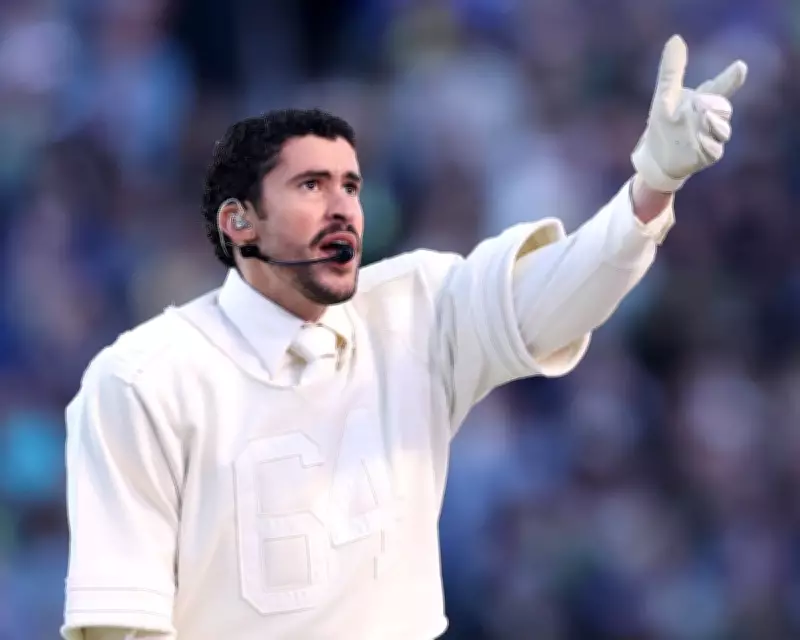
The show, dubbed the Benito Bowl, opened with a young man carrying a Puerto Rican flag before a sea of sugarcane, delivering a benediction: "Qué rico es ser Latino. Hoy se bebe" ("How sweet it is to be Latino. Today we drink"). Bad Bunny, dressed in a bespoke white jersey-suit-jacket emblazoned with his mother's birth year, 1964, launched into Titi Me Preguntó, affirming his persona.
He built an entire ecosystem of community on stage, featuring:
- Elderly men playing dominos
- Street vendors selling coco frío, piraguas, and tacos
- Boxers Xander Zayas and Emiliano Vargas in a fight scene
- A marriage proposal during the femme-forward Yo Perreo Sola
Behind him, a replica of a Puerto Rican house, or la casita, hosted a star-studded yearbook including Karol G, Pedro Pascal, Cardi B, Jessica Alba, Young Miko, and Alix Earle. The performance of Safaera highlighted its many bleeps and FCC-unfriendly lines, adding a rowdy edge.
Musical Homages and Celebrity Appearances
In a dramatic moment, Bad Bunny fell through the roof into la casita, disoriented as a mix of reggaetón's heaviest hits unfolded, including Tego Calderón's Pa' Que Retozen, Don Omar's Dale Don, and Daddy Yankee's Gasolina, followed by his own EoO. This segment served as a dizzying reminder of the pantheons of Puerto Rican legends in reggaetón, salsa, and jíbaro music that Bad Bunny is succeeding.
Lady Gaga made a surprise appearance, salsafying Die With a Smile with Los Sobrinos at a literal wedding onstage, before Bad Bunny joined her for a beautiful Baile Inolvidable in Latine wedding style. Later, Ricky Martin delivered a powerful rendition of Lo que le pasó a Hawaii, while the reconstruction of a New York block featured Toñita of Williamsburg's Caribbean Social Club, a symbol of community resistance since 1974.
Political Undertones and Social Commentary
Bad Bunny's performance of El Apagón was particularly striking, as he ran the light-blue flag of Puerto Rican independence across the field, with performers on power lines evoking the island's frequent blackouts due to decaying energy infrastructure. This somber moment shifted to the jubilant Café Con Ron, joined by Los Pleneros de la Cresta.

In a closing proclamation, he said, "God bless America," naming Chile, Argentina, and all of South and Central America and the Caribbean before finishing with the United States, Canada, and Puerto Rico. He concluded with "Seguimos aquí" ("We're still here"), spiking a football that read: "Together, we are America."
Earlier in the broadcast, during his Grammy acceptance speech for Debí Tirar Más Fotos—the first predominantly Spanish-language album to win album of the year—he opened with a direct statement: "Before I say thanks to God, I'm going to say ... ICE out." He emphasised, "We're not savage, we're not animals, we're not aliens. We are humans, and we are Americans." This reflected his ongoing concerns about immigration enforcement, which influenced his decision not to tour the mainland US.
Reflections on Legacy and Impact
This wasn't Bad Bunny's first Super Bowl half-time show; in 2020, he was a guest of Jennifer Lopez and Shakira at Super Bowl LIV in Miami. That performance was seen as a defiant celebration of Latina giants, with protest elements attributed to cages on the field, highlighting Latine oppression. In contrast, his 2026 show focused on love, community, and joy, created in spite of external challenges.
While the Super Bowl may never televise a revolution, Bad Bunny's performance reminded audiences of the resilience and cultural richness of Puerto Rican and Latin communities. Through music, symbolism, and celebrity cameos, he crafted a show that was not just entertainment but a powerful statement on identity and belonging in contemporary America.