Being an Australian living overseas often comes with a certain level of cultural cringe, especially when faced with yet another question about surviving in a country where 'everything can kill you.' Over the years, I've started to roll my eyes each time an American talk show host welcomes an Aussie guest and inevitably asks about our dangerous wildlife. So, while in Vienna last night watching the Australian-themed interval act during the Eurovision Song Contest semi-final, my first concern was that we might become the butt of another string of bad jokes.
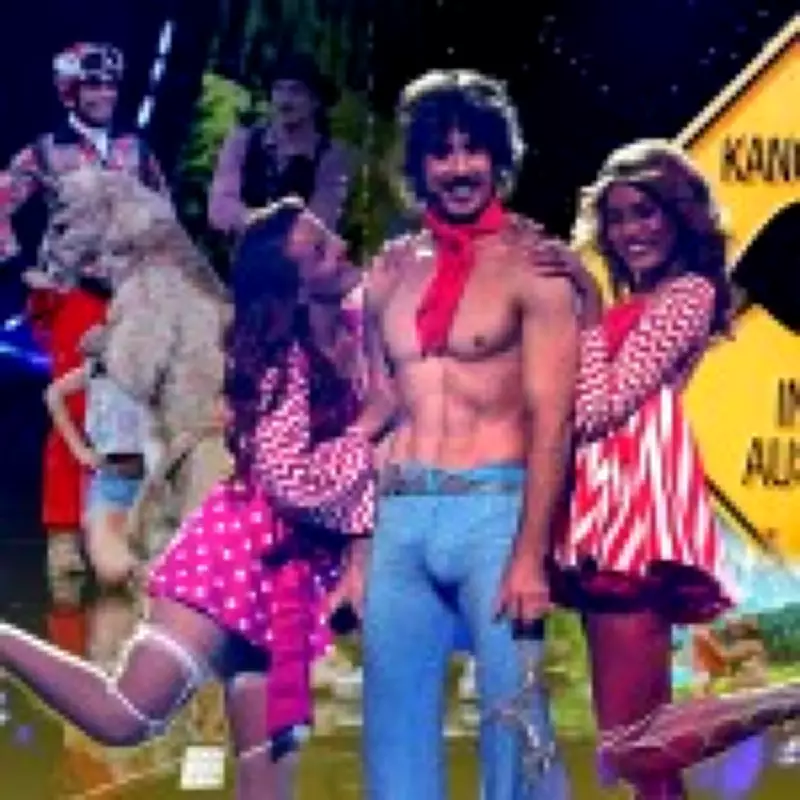
Ahead of the first semi-final, it was revealed that Australia's 2025 act Go-Jo would team up with this year's hosts, Victoria Swarovski and Michael Ostrowski, to perform a song called Kangaroo and finally settle the apparent confusion that Austria and Australia are actually completely different places. Running for five minutes, the performance kicked off with the simple but apt line, 'Australia is huge in size…and Austria is small.' As sung by Victoria, one of the first lines also referred to how 'spiders, snakes and shark attacks' could potentially kill her.
Watching the act play out while sitting in the Media Centre in the Wiener Stadthalle, I initially wanted to sink into my chair and avoid anyone clocking that I was Australian myself. Sitting further down my table was a group of fellow Aussie journalists, many of us looking at the big screen wide-eyed before the performance began, wondering what we were in for. Minutes earlier, a friend had mentioned he'd seen the act during a rehearsal and assured me it was more charming than cringe… but I had my doubts.
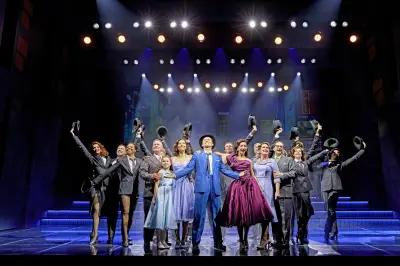
Cue a sing-along with the audience asking them to cheer out 'Roo' after Go-Jo chanted 'Kanga', a massive human-sized kangaroo mascot appearing on stage, and a rap, followed by a chorus line that ended with said kangaroo twerking to 166 million people around the world. Those five minutes and 37 seconds felt like a complete fever dream, but throughout it all, I'll admit I had a massive grin on my face. So did other journalists from countless other countries, who I saw standing, dancing and singing along, fully embracing it all.
Yes, it was ridiculous. Yes, it played into long-standing cultural stereotypes. But if we Australians can no longer poke fun at ourselves, we risk losing the self-deprecating humour we are so known for. Props also have to go to Go-Jo – real name Marty Zambotto – who was (in mine and many others' opinion) robbed of a place in the Grand Final last year, but has now cemented himself a place in Eurovision lore for years to come. He was a brilliant sport, going along for the ride and playing into the OTT character, leading the charge perfectly.
After the act ended, I raced to social media to determine how others tuning in felt about it all. There were plenty of detractors who declared it was 'not funny at all.' However, others said they were 'dying laughing' and that it was 'the most beautiful fever dream imaginable.'
Despite my initial reservations and belief that I'd have to lay low to avoid outing myself as an Aussie, I allowed myself to get swept up in not taking the act too seriously and embracing it for the light-hearted joke it all was. Having not been home for over two years, I was genuinely shocked by how small cultural references tugged at my heartstrings and made me feel anything but ashamed about where I'm from.
When Australia was invited to perform as an interval act in Eurovision in 2014, people dressed in budgie smugglers, as drag queens, lifeguards, farmers and AFL players, while (fake) koalas and kangaroos flooded the stage. The directive from organisers was for the delegation from Down Under to shake up the show big time, and boy did they deliver – including one lyric which rhymed Albania with genitalia and suggested replacing the Louvre with the Big Pineapple. I still tear up watching Jessica Mauboy's performance of Sea of Flags, which came right after, with her lyrics centring on the unifying nature of the contest and eventually opening the doors for Australia's full participation in Eurovision.
Being in Vienna over the past few days, I've also witnessed just how warmly people from around the world react when mentioning Australia. This year's act, Delta Goodrem (who is currently a favourite to win with her song Eclipse), is a bona fide national treasure at home, but I underestimated how many people from countless countries have followed her career over the past two decades and are rooting for her to take out the trophy. I've met people from not only Australia and the United Kingdom who are getting behind her, but fans from Hungary, Denmark and the Netherlands, who all think this could be the year chants of 'Aussie, Aussie, Aussie, OI, OI, OI' are heard in living rooms across Europe if she wins.
Visiting Austria for the fourth time now, it also always makes me laugh seeing tourism gift shops filled with the famous 'No Kangaroos in Austria' merchandise, which Delta has even purchased and posed in herself. When first visiting the country a decade ago, I managed to avoid a $400 (£200) excess luggage cost after the check-in agent asked for my passport, saw where I was from, chuckled to himself for a good 30 seconds and exclaimed out loud, 'I LOVE the kangaroo passport', before winking at me and letting me go through without paying any extra fees. Over the years, rumours have also swirled that some Austrian airports have set up help desks for stranded tourists trying to get Down Under after accidentally booking flights to the landlocked European nation. However, those were later proved to be a genius marketing campaign from a baggage handling company.
After moving overseas and travelling around Europe extensively over the past four years, I've actually always felt quite proud when people hear where I'm from and respond with their desire to one day visit, or list off all of their favourite places they've been in my home country (many of which I've never even been to myself). At times, I have had to dodge the dreaded question about the deadly wildlife – yes, I've been bitten by spiders before, have seen plenty of snakes and sharks in the bush and at the beach, and admittedly had kangaroos in my front garden at times growing up. However, instead of wanting to wince when witnessing these stereotypes of my country and people broadcast to millions around the world, I'm now feeling pretty proud that there is such a fascination with the amazing place I was able to grow up.
The 2026 Eurovision Song Contest continues tomorrow night, with the Second Semi-Final airing from 8pm on BBC One and iPlayer.