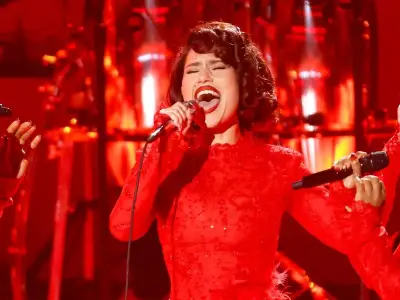
The Eurovision Song Contest has produced some of the most memorable TV moments over the years, but it has also been no stranger to controversy. With 166 million viewers tuning in for the 2025 edition, the 2026 contest in Vienna, Austria, is set to be another spectacular event. However, ongoing debates over Israel's participation amid the Gaza war have led to boycotts and divisions among fans. Here are the 17 biggest controversies in Eurovision history.
1. Israel’s Lyric Change (2024)
Israel’s 2024 entry, Eden Golan, originally performed a song titled October Rain, which was believed to reference the Hamas attacks. Following backlash, the lyrics were changed and the song was renamed Hurricane. The European Broadcasting Union (EBU) maintained its non-political stance, but over 2,000 musicians from Finland, Iceland, and Sweden signed open letters calling for Israel's ban due to the Gaza war. UK act Olly Alexander and other entrants issued a joint statement calling for peace and a ceasefire.
2. Maneskin vs. the Green Room Table (2021)
Italian rock band Maneskin won Eurovision 2021, but their victory was overshadowed by speculation that singer Damiano David used cocaine after he bent over a table during voting. Damiano denied the allegations, explaining he was checking a broken glass. A voluntary drug test came back negative, and the EBU confirmed no drug use occurred. The band later joked about the incident at the 2022 contest, advising contestants to "have fun and don’t get close to the table."
3. Belarus Breaks the Rules (2021)
Belarus was disqualified from Eurovision 2021 after their song Ya Nauchu Tebya by Galasy ZMesta was deemed political. The lyrics included lines like "I’ll teach you to toe the line," believed to mock protests against President Alexander Lukashenko. An amended version was also rejected, leaving Belarus out of the contest.
4. Hatari’s Palestinian Banners (2019)
Icelandic act Hatari caused controversy at Eurovision 2019 in Tel Aviv by holding up Palestinian banners during the live broadcast. The band admitted this was their main reason for participating. The EBU fined Iceland’s broadcaster €5,000 for breaching the no-politics rule.
5. Ukraine Withdraws (2019)
Ukraine’s national final winner Maruv was dropped after refusing to sign a contract barring her from performing in Russia. The runners-up also declined, forcing Ukraine to withdraw. Maruv’s song Siren Song remains a fan favorite at Eurovision parties.
6. Russia Pulls Out of Ukraine (2017)
Russia initially planned to participate in Kyiv 2017 with Julia Samoylova, but she was banned from entering Ukraine for performing in Crimea. Russia withdrew, and Julia competed in 2018 but failed to qualify for the final.
7. Armenia vs. Azerbaijan (2016)
Armenian singer Iveta Mukuchyan waved a flag of the disputed Nagorno-Karabakh region during the semi-final, leading to an EBU sanction. She reached the final and finished seventh.
8. Romania Gets the Boot (2016)
Romania was expelled from Eurovision 2016 after broadcaster TVR failed to pay debts to the EBU dating back to 2007. Singer Ovidiu Anton was chosen but could not compete. Romania returned in 2017.
9. Finland’s Same-Sex Kiss (2013)
Finland’s Krista Siegfrieds kissed a female backing dancer during her performance of Marry Me to protest against Finland’s ban on same-sex marriage. Turkey and China censored the moment, and Krista finished 24th.
10. Georgia Takes Aim at Putin (2009)
Georgia’s song We Don’t Wanna Put In was deemed political for targeting Vladimir Putin. The EBU asked for changes, but Georgia withdrew instead.
11. Dustin the Turkey Takes the Stage (2008)
Ireland sent puppet Dustin the Turkey to Eurovision 2008 after a public vote. The act was booed and failed to qualify, finishing 15th in the semi-final with 22 points.
12. Terry Wogan Announces the Wrong Winner (2007)
During the UK selection for 2007, Terry Wogan mistakenly announced Cyndi as the winner, but Scooch had actually won. Scooch went on to score only 19 points in the final.
13. Silvia Night Upsets Everyone (2006)
Iceland’s Silvia Night, a character played by Agusta Eva Erlandsdottir, insulted journalists and other contestants. She was booed on stage and failed to qualify, later threatening to sue everyone.
14. France or Sweden? (1991)
The 1991 contest ended in a tie between France and Sweden. Both had four douze points, but Sweden won with five tens compared to France’s two. France missed its first win since 1977.
15. Israel’s First and Third Wins (1978/1998)
In 1978, Jordanian TV cut the broadcast and falsely declared Belgium the winner. In 1998, transgender winner Dana International faced protests from conservative groups in Israel and required police protection.
16. Belgium’s Winner (1986)
Sandra Kim won for Belgium at age 13, not 16 as reported. Switzerland petitioned for disqualification but failed. The minimum age was later raised to 16.
17. Portugal Incites Revolution (1974)
Portugal’s song E Depois do Adeus was used as a signal to start the Carnation Revolution, which overthrew the authoritarian regime. It remains the only Eurovision entry to start a revolution.
The Eurovision 2026 Grand Final airs May 16 at 8pm on BBC One and BBC iPlayer.