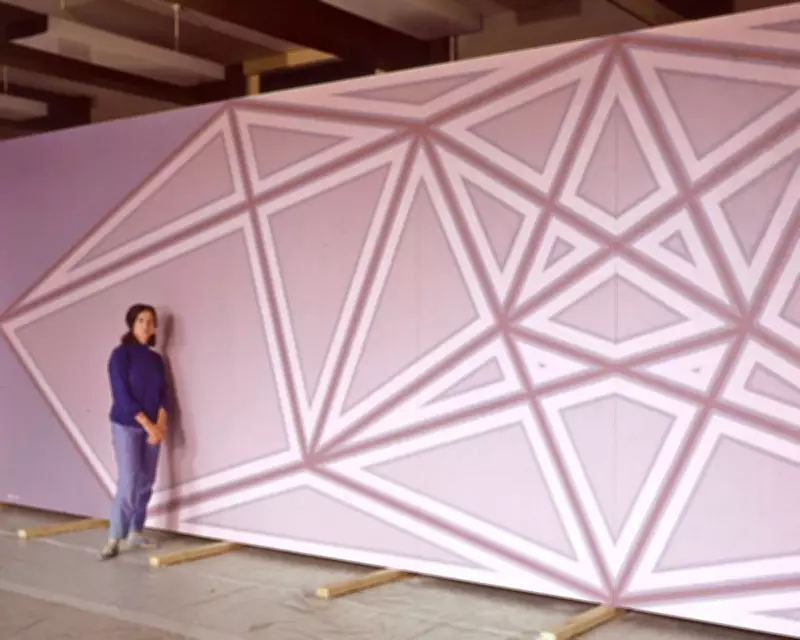
Tess Jaray, the influential artist and teacher who explored architectural and pictorial space in her work, has died aged 88. Her career spanned more than six decades, during which she created abstract paintings, public art commissions, and taught generations of artists at the Slade School of Fine Art.
Early life and education
Born in Vienna on 31 December 1937 to Franz Ferdinand, an engineer and inventor, and Pauline (nee Arndt), who had studied painting, Jaray came from an artistic family. Her father's aunt was Lea Bondi Jaray, a noted collector and gallerist, and his godfather was the art historian Ernst Gombrich.
The family were Jewish. After the annexation of Austria by Nazi Germany in March 1938, those who could fled to Britain. Jaray's parents settled in a cottage in rural Worcestershire, where she was raised from the age of eight months. She attended the Alice Ottley school in Worcester, then studied at St Martin's School of Art in London (1954-57) before three years at the Slade.
Artistic revelation in Italy
In 1960, on a travelling scholarship from the Slade, Jaray made her first trip to Italy. She arrived in Florence with her head full of painting, of Giotto, Duccio and Cimabue. But it was architecture that moved her most. 'Nobody who heard Gombrich speak has ever forgotten it,' Jaray recalled, 'but he never talked about architecture. Going to Italy was like opening a door into paradise. It was truly shocking, in a wonderful way.'
This revelation shaped her art. In the late 1950s, exhibitions of non-figurative American painting, such as Modern Art in the United States (1956) and The New American Painting (1959) at the Tate, changed British art. Jaray later said, 'It was slightly annoying that the Americans should have done it first, but there you are.'
Abstract paintings and public art
By 1962, Jaray was making abstract paintings with allusive titles like Cupola Blue that evoked rather than replicated architecture. Her geometric lines were both flat and suggestive of movement, a duality that sometimes led to her being mistaken for an Op artist. In 1967, she created a mural for the British Pavilion at Expo 67 in Montreal, a work 3m high by 12m wide. However, her typical scale was more intimate, with canvases seldom exceeding 2m in any dimension.
In the 1980s, she took on public art commissions, starting with a floor at Victoria Station in London (1985). This was followed by a patterned brick precinct for Wakefield Cathedral (1989-92) and a complete decorative programme for Birmingham's Centenary Square (1988-92, removed in 2017). In 1995, she was made an honorary fellow of the Royal Institute of British Architects, and in 2010 she became a Royal Academician.
Teaching and influence
Jaray taught at Hornsey College of Art from 1964, then returned to the Slade in 1968 to run the postgraduate course for more than 30 years. Her students included Turner prize-winning conceptualist Martin Creed. She embraced new technology early, using masking tape from 1960 and later computers and laser cutting. In 2013, she curated The Edge of Painting in London, featuring works that did not use paint but were painterly.
Later years
In 2001, she produced screenprints responding to WG Sebald's books and collaborated with him on For Years Now. In her 80s, she reconciled with Vienna, exhibiting at the Secession and Exile galleries. She donated a portfolio of her uncle Richard Jaray's designs to the MAK Museum. A retrospective at the Millennium Gallery in Sheffield and a show at Frieze Masters followed in 2024.
Jaray married painter Marc Vaux in 1960; they divorced in 1982. She is survived by their daughters, Anna and Georgia, and four grandchildren.