Church marks 300 years with exhibition and online archive
St Martin-in-the-Fields church on Trafalgar Square is marking its 300th anniversary with the Stories Behind the Stones project, an online archive of the lives of those once buried in its churchyard. The project is part of the anniversary celebrations, which also include a free exhibition titled 300 Years at the Heart and on the Edge, showcasing the church's history as a place of activism and protest.
Engraved memorial stones reveal forgotten lives
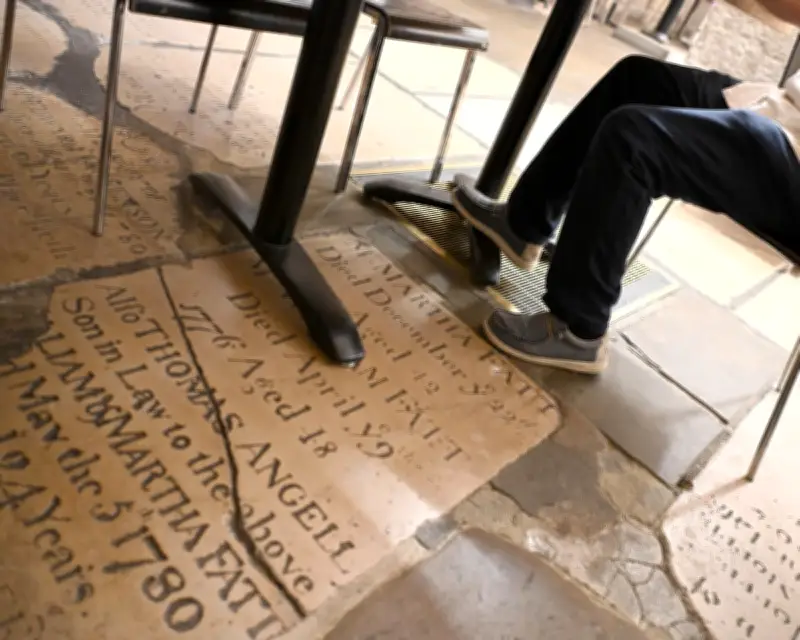
The engraved memorial stones set into the floor and walls of the crypt and cafe yield glimpses into long-forgotten lives of ordinary Londoners. New research shows that William Fatt, a chimney sweep for the Admiralty and Royal Hospital Chelsea, was the son of another William Fatt, a Black chimney sweep of the king's palaces, who voted in the 1749 Westminster byelection, making him one of the very first known Black voters. John London had been understood to have been the first Black voter, but historian Dr Robin Eagles notes that William Fatt appears to be the joint-earliest, both pre-dating Ignatius Sancho by 31 years.
Mystery of Richard James Said
Another memorial stone commemorates Richard James Said, 'a native of Africa' who died aged 19 in 1810. The inscription reads: 'The Family whom he served for seven Years with uniform integrity and attention has caused this Stone to be placed over his Grave in memory of his worth and of the regret which his loss has occasioned.' Dan Kaszeta, volunteer archivist at St Martin, said: 'It's a little bit of a mystery. He could have been a freed slave.' But he added that the 'weight of evidence' at a time when 'the majority of black residents were slaves' pointed to enslavement. The stone would have cost £20 in 1810, about £2,000 today, indicating that 'these people were not poor'.
Gravestones moved during development
Gravestones were moved from the churchyard during development of the area, with some reused on the crypt floor and others mounted on the walls. Louisa Price, St Martin archivist, said: 'We've got some really great stories that are emerging. By putting them all online we can make it available to others to tell us some good stories about the people who are represented here.' Other notable figures include the Huguenot celebrity physician Théodore de Mayerne, who championed free hospitals for plague victims, and Henry Croft, the original pearly king.
Exhibition highlights history of compassion and protest
Art and artefacts, including a royal chair last used by Queen Mary, chart the church's colourful history. St Martin's launched London's first free lending library, and its origins can be traced to the Big Issue, Amnesty International and Shelter. Its steps are a well-known site of protest, notably the anti-apartheid demonstrations of the 1980s. The original door handle of the 1726 church, featuring a design of St Martin sharing his cloak with a beggar, is on display, alongside the Lampedusa Cross, made from wood from a boat that sank off the Italian island in 2013 with the loss of 360 of 500 people on board seeking sanctuary in Europe.
Audio recordings and innovation
Audio includes 1928 recordings of the church's choir, highlighting its history of innovation from the 1890s, when its services were relayed on the Victorian telephone audio system, the Electrophone. Rev Sam Wells, vicar of St Martin, said: 'The phrase we've used is 'at the heart on the edge', so the heart refers to obviously the compassion associated with issues surrounding homelessness or since the first world war.' During the first world war, St Martin's opened its doors to give refuge to soldiers on their way to France. Wells added: 'And he turned a blind eye to who they spent the night with, which would be quite radical now, but back then was particularly embracing shall we say.'
Continued fight against homelessness
St Martin formalised its fight against homelessness with the foundation of the Social Services Unit in 1948. Today The Connection at St Martin cares for about 7,500 individuals each year. The exhibition runs from 24 June to 15 November 2026.