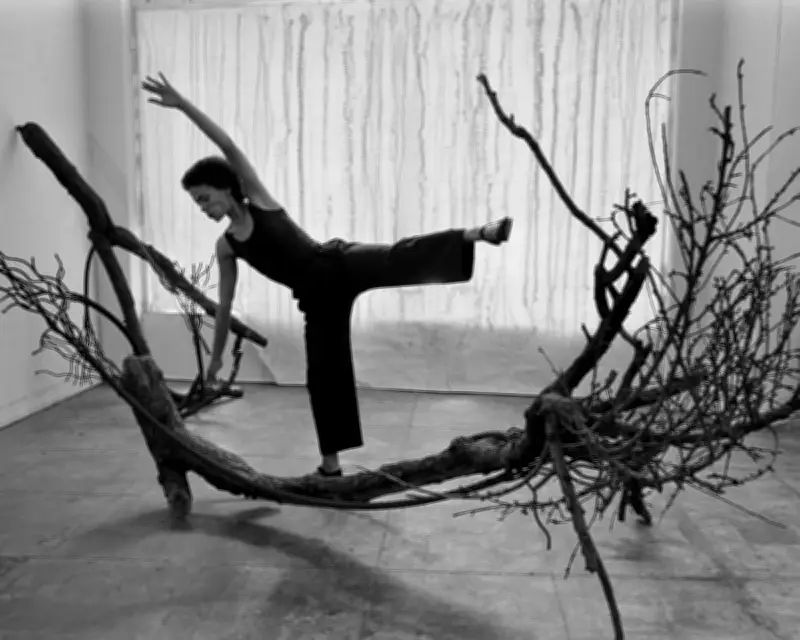
For five decades, American artist Maren Hassinger has crafted captivating site-specific sculptures from the simplest actions: tying a square knot, twisting metal into organic shapes, exhaling breath into a plastic bag, or walking through a room. The exhibition Maren Hassinger: Living Moving Growing at the Berkeley Art Museum (BAMPFA) presents a comprehensive yet ephemeral retrospective, recreating her most celebrated works, documenting numerous performances, and engaging audiences in the creative process.
Transforming Materials and Space
“There’s a kind of magic to her work,” said BAMPFA senior curator Anthony Graham. “The way she’s able to transform materials and really change the space that those things inhabit, to make us see them in a new way.”
Hassinger compels viewers to see familiar objects anew. One of her earliest pieces, Untitled Rope, features four thick, industrial-grade rope lengths, each arranged into a loose macrame knot on the verge of being pulled taut. “I always approach the sculpture thinking that it’s this latent performance,” Graham explained, suggesting the collaborative action of tightening the ropes. “If we were to walk on either end, pick up the rope, and close the knot together, we’d be pulling away, but also joining closer.”
The Ubiquity of Knots
Knots appear throughout Living Moving Growing. They are present in Untitled Rope and Sign of the Times, which features countless strips of the New York Times twisted and tied into massive ropes hanging from a gallery wall. Enormous wire ropes on the verge of being knotted, pink plastic bags tied off to hold breath, and Hassinger’s hands tying knots in her 2005 video piece Birthright further illustrate this theme.
Graham noted that the everyday nature and versatility of knots make them ideal for Hassinger, who focuses on repetitive actions that become invisible yet are essential to daily life. “Tying knots is a skill that is at once everyday, like tying one’s shoes, but could also be decorative, like macrame, or industrial, like knots on ships,” he said. “In her work, these repetitive gestures are approached with a sculptural sensibility, shifting scale.”
Building Connection Through Art
In Hassinger’s hands, routine practices become means of connection. Her piece Love (Pyramid) involves filling neon pink plastic shopping bags with her breath and a tiny love note, then pinning them to the gallery wall. Works like Love (Pyramid) and Sign of the Times transform consumerist trash into sources of wonder and humanity, highlighting how the simple act of breathing unites us. Love (Pyramid) requires ongoing care, engaging museum staff in Hassinger’s daily practices. “It’s simple: take a deflated bag, fill it with air, and pin it back on the wall,” said Graham. “This ability to care for things gives them new lives.”
Community Engagement
Sign of the Times involves the Berkeley community through workshops that slowly build the sculpture. When I toured the exhibit, long cords of knotted newsprint hung down a gallery wall, resembling jungle vines. Over time, as Hassinger leads monthly workshops, the sculpture will grow to fill the entire gallery with organic forms.
These workshops are not just about tearing paper into strips—they bring Hassinger’s use of repetition to a wider audience, fostering togetherness. Graham explained that inviting everyday people into the creative process breaks down hierarchies in the art museum. “On opening day, the theater was full of everyone talking, all together in the world, breaking down hierarchical structures. For Hassinger, that becomes the radical act—to create a caring world.”
Politics and Identity
Video pieces like Birthright and Daily Mask foreground race and identity politics. Birthright traces her family history through a first meeting with her uncle. Daily Mask shows a closeup of Hassinger applying grease oil to her face, eventually covering herself in blackface.
As a Black female artist emerging in the 1970s in performance and site-specific sculpture, Hassinger faced challenges finding her place. After graduating from UCLA in 1973, she found community with other Black avant-garde artists like David Hammons, Franklin Parker, and Ulysses Jenkins, supporting each other in a time of limited support.
Recognition and Legacy
Hassinger moved to New York in 1984, eventually becoming director of the Reinhardt School of Sculpture at the Maryland Institute College of Art. Institutional recognition grew after a 2011 show at the Hammer Museum titled Now Dig This!, which highlighted pioneering Black artists in Los Angeles. “That show was a revelation of an entire art history unknown to many,” said Graham.
The retrospective at BAMPFA is a major moment, arriving when the simplicity and joy of her practice are needed. Graham noted that caring and joy are at the root of Hassinger’s work. Recalling a workshop in Ohio, he paraphrased her: “If we can come together to make something as absurd as a newspaper ball, we can come together to bring love to one another always.”
Graham hopes the show encourages audiences to slow down and pay attention. “I hope people see the small gestures and materials full of meaning. Simple gestures, when done together, can really make a change.”
Maren Hassinger: Living Moving Growing is on display at the Berkeley Art Museum until 29 November.