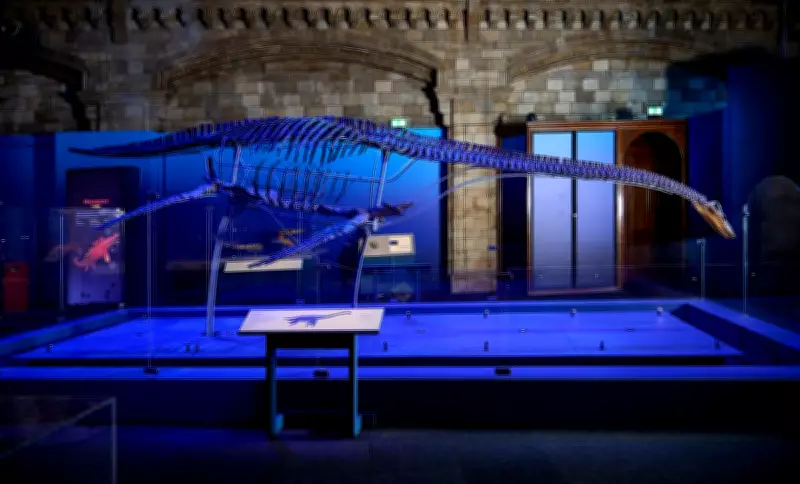
The Natural History Museum in London has unveiled a new exhibition, Jurassic Oceans: Monsters of the Deep, which immerses visitors in the world of prehistoric marine reptiles that ruled the seas while dinosaurs roamed the land. The exhibition features fossils, casts, and 3D-printed sculptures of creatures such as plesiosaurs, ichthyosaurs, and mosasaurs, offering a glimpse into ancient marine ecosystems and drawing stark parallels with the impact of climate change on today's oceans.
Plesiosaurs: Stealth Predators of the Deep
One of the centerpieces of the exhibition is the skeleton of a 23-foot plesiosaur, a fearsome marine reptile with a remarkably long neck. Kate Whittington, the museum's exhibition and interpretation manager, explains how this adaptation allowed the plesiosaur to ambush prey. "Its long neck allowed its head to get a head start on its body, so it could sneak up on prey and grab it before its body and flippers created a disturbance in the water," she says. The plesiosaur's hunting strategy highlights the specialized evolution of marine reptiles during the Jurassic period.
Jurassic Oceans: A Warmer, Higher Sea Level World
Curator Marc Jones describes the environmental conditions of the Jurassic era, noting that the sun was slightly dimmer but the planet was much warmer and more humid due to higher atmospheric CO2 levels. This resulted in no permanent ice caps and higher sea levels, with much of the landmass joined in the supercontinent Pangaea surrounded by a single global ocean, Panthalassa. "Because that ocean was so vast and slow moving, circulation was limited in many places," Jones explains.
Ammonites Thrived in Warm, Stagnant Waters
Ammonites, soft-bodied creatures related to modern cephalopods, were particularly well-suited to these conditions. Jones notes that squid relatives are thriving today as oceans warm, suggesting a parallel. "There's evidence that squids are doing really well because the oceans are getting warmer," he says. "Their relatives did really well in this warmer, slightly more stagnant ocean."
Ichthyosaurs: Speedy Predators with Giant Eyes
The exhibition also features ichthyosaurs, a family of long-snouted marine reptiles with the largest eyes of any vertebrate. "Ichthyosaurs probably have the largest eye of any vertebrate animal," says Jones. "It shows that it had areas that were very developed in processing movement, vision and scent, which reinforces what we know about it being a very speedy predator that relied on vision as one of its strategies." A bottlenose dolphin skeleton is displayed alongside ichthyosaurs to illustrate convergent evolution, where unrelated species develop similar adaptations for similar environments and diets.
Extinction of Ichthyosaurs Linked to Climate Change
Unlike many marine reptiles wiped out by the asteroid impact at the end of the Mesozoic era, ichthyosaurs became extinct earlier due to natural climate changes that reduced their prey, particularly ammonites. "It might be that, as the climate changed and ammonites started to die out, the ichthyosaurs couldn't adapt fast enough to recover from one of their main food sources declining," Jones explains.
Mosasaur: The T-Rex of the Sea
The grand finale of the exhibition is the skull of a mosasaur, known as the "T-rex of the sea." These large predators ruled the oceans during the Cretaceous period, which ended about 66 million years ago. "It has these big pointy teeth on the outside, but it also has teeth in the roof of its mouth to help it grip on to prey," says Whittington. Jones adds that while dinosaurs dominated land, the oceans were filled with giant marine reptiles, a role now filled by mammals like whales and seals.
Lessons for Today: Climate Change and Ocean Warming
The exhibition draws a clear warning from prehistoric climate shifts. Today, more than 90% of heat trapped by carbon emissions is absorbed by the ocean, with record-breaking temperatures set almost every year since 2000. Jones emphasizes the speed of current changes: "There is lots of evidence of the climate changing during the prehistoric era and that being associated with changes in the fauna, the ecosystem and the environments. Some of those changes took place over millions of years and yet they still had a big impact. It's the speed of the changes happening today that is the problem. Many animals can't keep up."
Ocean Acidification and Deoxygenation Threats
Ocean warming, acidification, and deoxygenation threaten phytoplankton, the base of the marine food chain. Jones notes that over 2,000 gigatons of CO2 have been added to the atmosphere in less than 200 years, with consequences for entire ecosystems. The exhibition serves as a stark reminder of the fragility of marine life in the face of rapid environmental change.
Jurassic Oceans: Monsters of the Deep is now open at the Natural History Museum in London, offering a unique window into the past and a critical perspective on the future of our oceans.